 Add to Chrome
 Add to Firefox
 Add to Edge
On the Depth Scalability of Logic Gate Networks
Jul 19, 2026
Logic Gate Networks (LGNs) implement computation through compositions of Boolean operations, yet unlike classical Boolean circuits, existing LGNs do not reliably benefit from increased depth. We identify two distinct causes: optimization collapse in deep relaxed LGNs and a topology-induced limitation that persists even when skip-biased initialization and straight-through estimation stabilize training. Thus, trainability alone is insufficient; deeper layers must also receive information that supports useful computation. We introduce Input-Anchored Logic Gate Networks (IALGNs), in which each gate combines an evolving hidden feature with a direct input anchor. This topology preserves a computational spine while conditioning every layer on the original input. We show that a depth-D path can depend on up to D+1 input bits and establish a strict path-wise depth hierarchy. Random-k anchor relaxation further improves anchor selection without relaxing the spine. Across MNIST, CIFAR-10, and CIFAR-100, IALGNs achieve consistent fixed-width depth--accuracy improvements beyond 100 layers, whereas alternative LGN topologies saturate or degrade. Layer-wise probes, topology ablations, and effective-depth analysis show that input anchoring produces progressively more informative representations and preserves longer computational paths. These results demonstrate that scalable depth in LGNs requires both stable optimization and an information-access pattern that supports input-conditioned refinement.

Toward Scalable and Efficient Visual Data Transmission in 6G Networks
Sep 24, 2024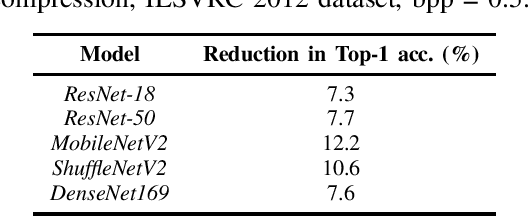
6G network technology will emerge in a landscape where visual data transmissions dominate global mobile traffic and are expected to grow continuously, driven by the increasing demand for AI-based computer vision applications. This will make already challenging task of visual data transmission even more difficult. In this work, we review effective techniques for visual data transmission, such as content compression and adaptive video streaming, highlighting their advantages and limitations. Further, considering the scalability and cost issues of cloud-based and on-device AI services, we explore distributed in-network computing architecture like fog-computing as a direction of 6G networks, and investigate the necessary technical properties for the timely delivery of visual data.
CycleGANAS: Differentiable Neural Architecture Search for CycleGAN
Nov 13, 2023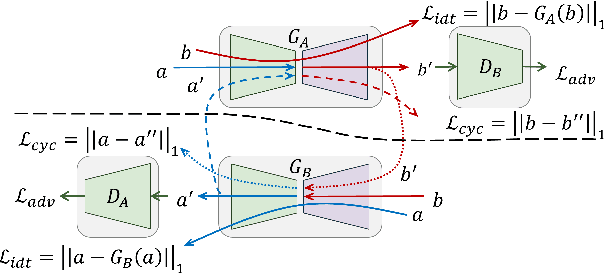
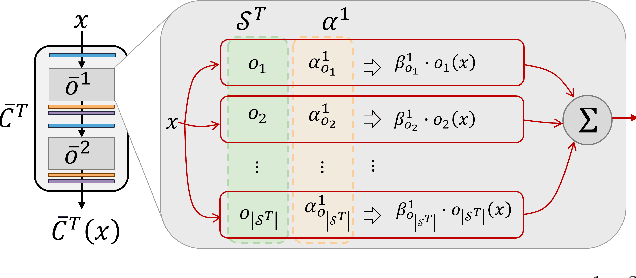
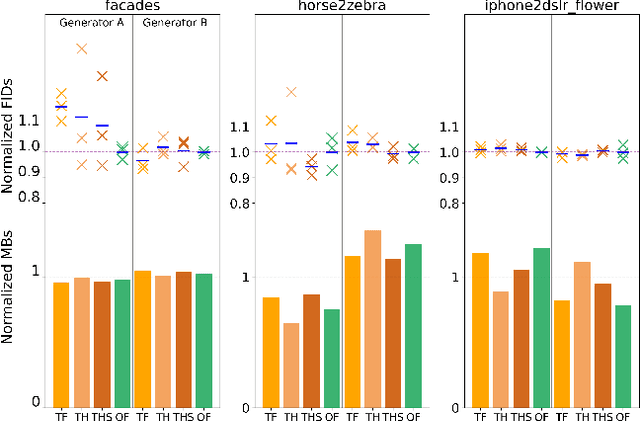
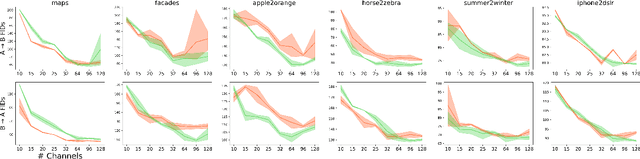
We develop a Neural Architecture Search (NAS) framework for CycleGAN that carries out unpaired image-to-image translation task. Extending previous NAS techniques for Generative Adversarial Networks (GANs) to CycleGAN is not straightforward due to the task difference and greater search space. We design architectures that consist of a stack of simple ResNet-based cells and develop a search method that effectively explore the large search space. We show that our framework, called CycleGANAS, not only effectively discovers high-performance architectures that either match or surpass the performance of the original CycleGAN, but also successfully address the data imbalance by individual architecture search for each translation direction. To our best knowledge, it is the first NAS result for CycleGAN and shed light on NAS for more complex structures.