 Add to Chrome
 Add to Firefox
 Add to Edge
Elbow Angle Guidance System Based on Surface Haptic Sensations Elicited by Lightweight Wearable Fabric Actuator
Aug 11, 2026
The demand for wearable haptic devices has rapidly increased for various applications. However, many haptic devices interfere with the wearer's activities and movements. In addition, several haptic devices fail to elicit intuitive haptic sensations by adjusting to the natural posture of the wearer. To address these issues, we propose an elbow angle guidance system using a lightweight wearable fabric actuator. The proposed actuator is made of fabric and has two McKibben-type artificial muscles attached to it, rendering it extremely lightweight and facilitating the delivery of surface haptic sensations to intuitively induce elbow extension and flexion. The surface haptic sensation elicited by the fabric actuator is adjusted to natural body movements without interfering with the wearer's movements. Moreover, the proposed system measures and guides the elbow angle by changing the intensity of the surface haptic sensation delivered to users in real time. The accuracy of the proposed system is demonstrated through experiments involving human participants.
* This is the accepted version of the paper published in Proc. 2024 IEEE International Conference on Advanced Intelligent Mechatronics (AIM), 1447-1454 (2024)

Intuitive Directional Sense Presentation to the Torso Using McKibben-Based Surface Haptic Sensation in Immersive Space
Aug 10, 2026In recent years, systems that utilize immersive space have been developed in various fields. Immersive spaces often contain considerable amounts of visual information; therefore, users often fail to obtain their desired information. Therefore, various methods have been developed to guide users toward haptic sensations. However, many of these methods have limitations in terms of the intuitive perception of haptic sensation and require practice for familiarization with haptic sensation. Fabric actuators are wearable haptic devices that combine fabric and McKibben artificial muscles to provide wearers with surface haptic sensation. These sensations can be provided to a wide area of the body with intuitive perception, instead of only to a part of the body. This paper presents a novel air pressure adjustment method for whole-body motion guidance using surface haptic sensations provided by a wearable fabric actuator. The proposed system can provide users with a directional sense without visual information in an immersive space. The effectiveness of the proposed system was evaluated through subject experiments and statistical data analysis. Finally, a directional sense presentation was conducted for users performing micromanipulations in a mixed-reality space to demonstrate the applicability of the proposed system for teleoperation.
* This is the accepted version of an article published in IEEE Transactions on Haptics 18(1), 244-254 (2025). DOI: 10.1109/TOH.2024.3522897. Open Access under CC BY-NC-ND 4.0
Dual Learning-based Video Coding with Inception Dense Blocks
Nov 22, 2019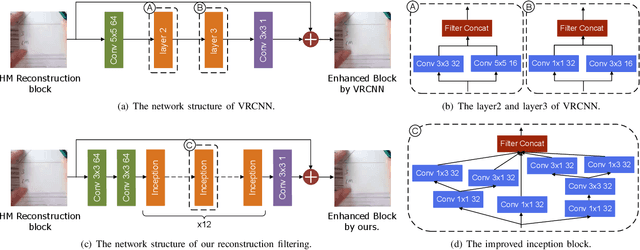
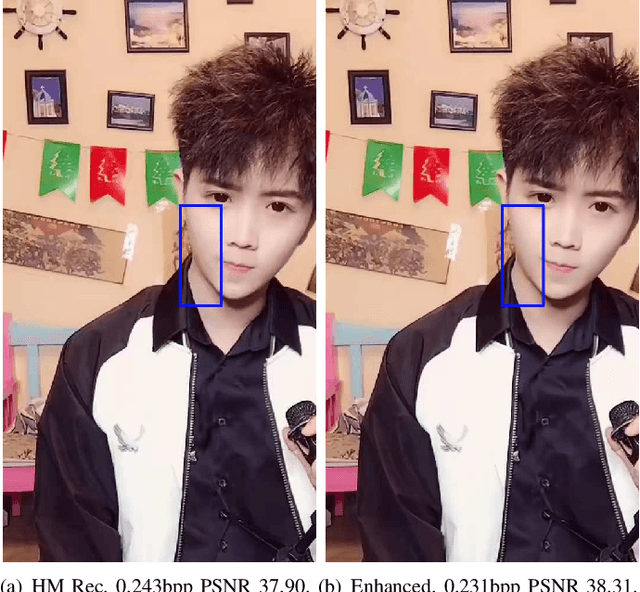
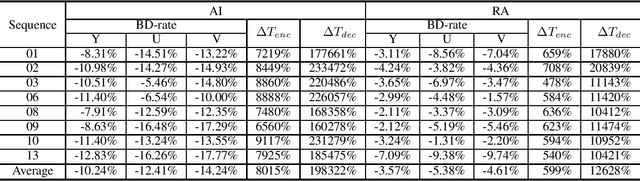
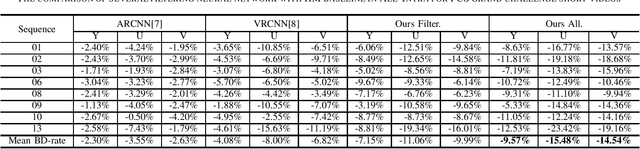
In this paper, a dual learning-based method in intra coding is introduced for PCS Grand Challenge. This method is mainly composed of two parts: intra prediction and reconstruction filtering. They use different network structures, the neural network-based intra prediction uses the full-connected network to predict the block while the neural network-based reconstruction filtering utilizes the convolutional networks. Different with the previous filtering works, we use a network with more powerful feature extraction capabilities in our reconstruction filtering network. And the filtering unit is the block-level so as to achieve a more accurate filtering compensation. To our best knowledge, among all the learning-based methods, this is the first attempt to combine two different networks in one application, and we achieve the state-of-the-art performance for AI configuration on the HEVC Test sequences. The experimental result shows that our method leads to significant BD-rate saving for provided 8 sequences compared to HM-16.20 baseline (average 10.24% and 3.57% bitrate reductions for all-intra and random-access coding, respectively). For HEVC test sequences, our model also achieved a 9.70% BD-rate saving compared to HM-16.20 baseline for all-intra configuration.
Deep Convolutional AutoEncoder-based Lossy Image Compression
Apr 25, 2018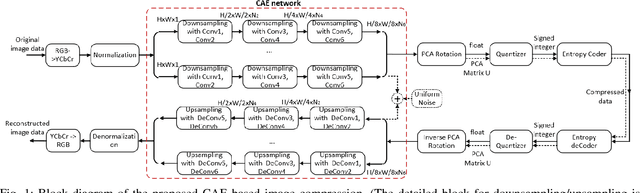
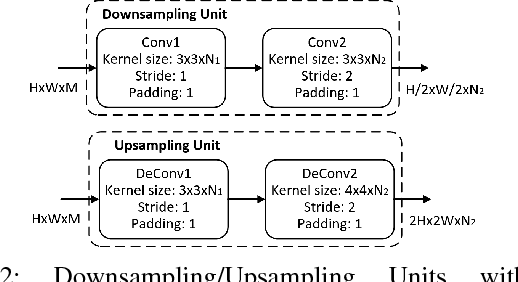
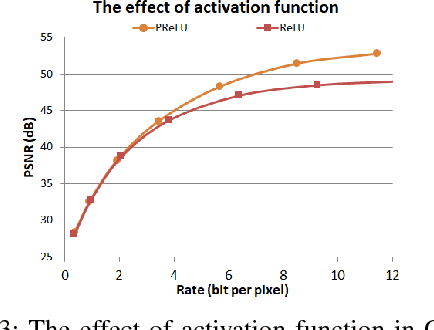
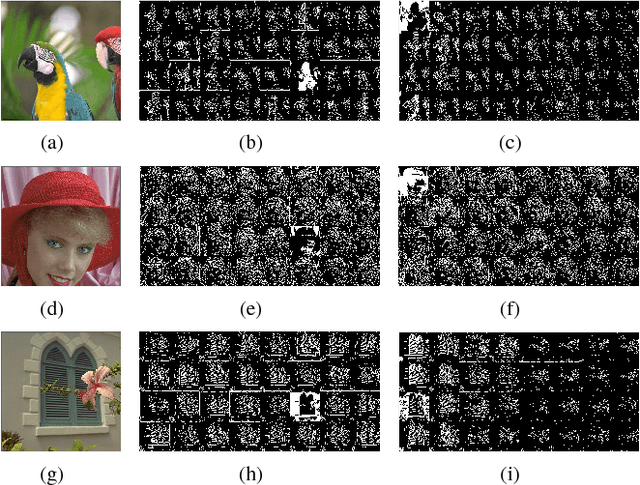
Image compression has been investigated as a fundamental research topic for many decades. Recently, deep learning has achieved great success in many computer vision tasks, and is gradually being used in image compression. In this paper, we present a lossy image compression architecture, which utilizes the advantages of convolutional autoencoder (CAE) to achieve a high coding efficiency. First, we design a novel CAE architecture to replace the conventional transforms and train this CAE using a rate-distortion loss function. Second, to generate a more energy-compact representation, we utilize the principal components analysis (PCA) to rotate the feature maps produced by the CAE, and then apply the quantization and entropy coder to generate the codes. Experimental results demonstrate that our method outperforms traditional image coding algorithms, by achieving a 13.7% BD-rate decrement on the Kodak database images compared to JPEG2000. Besides, our method maintains a moderate complexity similar to JPEG2000.