 Add to Chrome
 Add to Firefox
 Add to Edge
Transfer learning via interpolating structures
Mar 23, 2026
Despite recent advances in population-based structural health monitoring (PBSHM), knowledge transfer between highly-disparate structures (i.e., heterogeneous populations) remains a challenge. The current work proposes that heterogeneous transfer may be accomplished via intermediate structures that bridge the gap in information between the structures of interest. A key aspect of the technique is the idea that by varying parameters such as material properties and geometry, one structure can be continuously morphed into another. The approach is demonstrated via a case study involving the parameterisation of (and transfer between) simulated heterogeneous bridge designs (Case 1). Transfer between simplified physical representations of a 'bridge' and 'aeroplane' is then demonstrated in Case 2, via a chain of finite-element models. The facetious question 'When is a bridge not an aeroplane?' has been previously asked in the context of predicting positive transfer based on structural similarity. While the obvious answer to this question is 'Always,' the results presented in the current paper show that, in some cases, positive transfer can indeed be achieved between highly-disparate systems.

Anomaly Detection in Offshore Wind Turbine Structures using Hierarchical Bayesian Modelling
Feb 29, 2024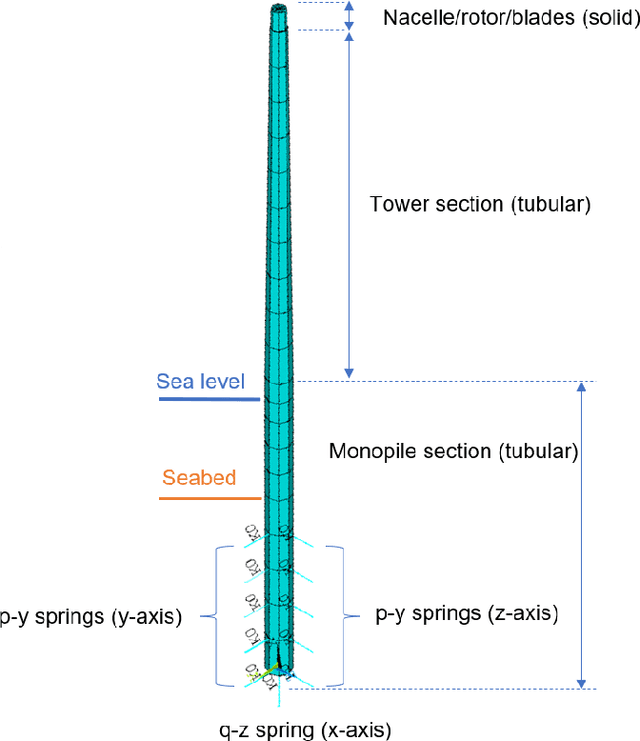
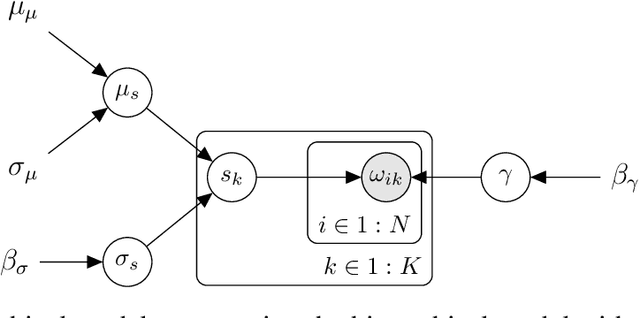
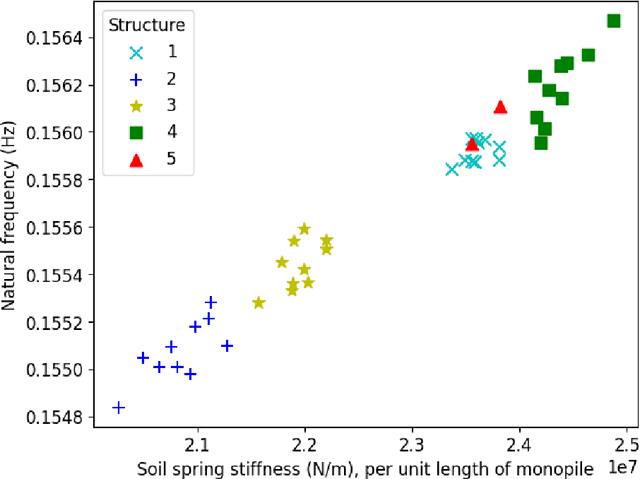
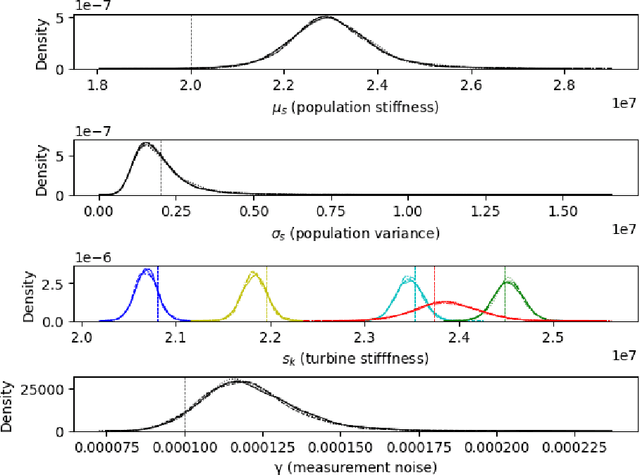
Population-based structural health monitoring (PBSHM), aims to share information between members of a population. An offshore wind (OW) farm could be considered as a population of nominally-identical wind-turbine structures. However, benign variations exist among members, such as geometry, sea-bed conditions and temperature differences. These factors could influence structural properties and therefore the dynamic response, making it more difficult to detect structural problems via traditional SHM techniques. This paper explores the use of a hierarchical Bayesian model to infer expected soil stiffness distributions at both population and local levels, as a basis to perform anomaly detection, in the form of scour, for new and existing turbines. To do this, observations of natural frequency will be generated as though they are from a small population of wind turbines. Differences between individual observations will be introduced by postulating distributions over the soil stiffness and measurement noise, as well as reducing soil depth (to represent scour), in the case of anomaly detection.
On the hierarchical Bayesian modelling of frequency response functions
Jul 12, 2023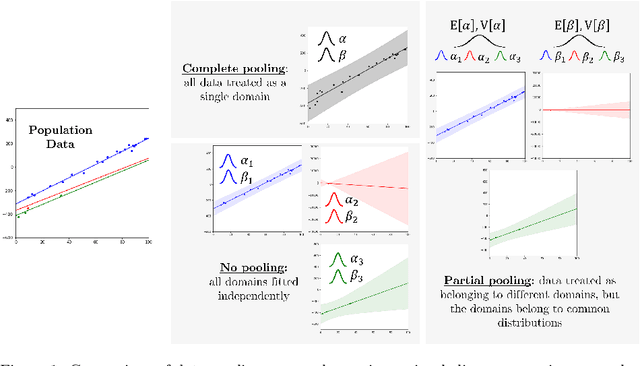

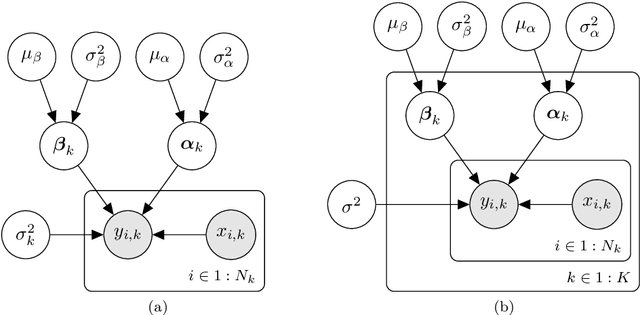
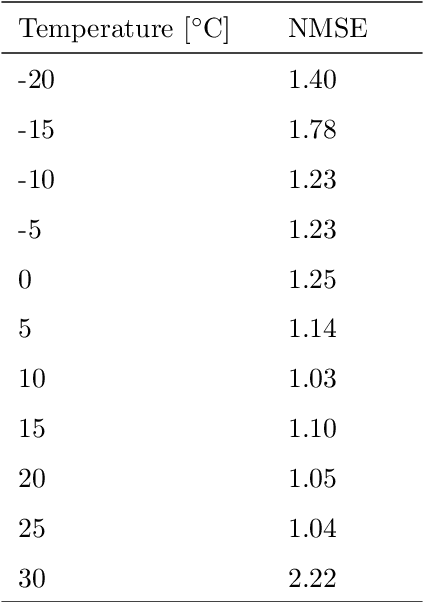
Population-based structural health monitoring (PBSHM) aims to share valuable information among members of a population, such as normal- and damage-condition data, to improve inferences regarding the health states of the members. Even when the population is comprised of nominally-identical structures, benign variations among the members will exist as a result of slight differences in material properties, geometry, boundary conditions, or environmental effects (e.g., temperature changes). These discrepancies can affect modal properties and present as changes in the characteristics of the resonance peaks of the frequency response function (FRF). Many SHM strategies depend on monitoring the dynamic properties of structures, so benign variations can be challenging for the practical implementation of these systems. Another common challenge with vibration-based SHM is data loss, which may result from transmission issues, sensor failure, a sample-rate mismatch between sensors, and other causes. Missing data in the time domain will result in decreased resolution in the frequency domain, which can impair dynamic characterisation. The hierarchical Bayesian approach provides a useful modelling structure for PBSHM, because statistical distributions at the population and individual (or domain) level are learnt simultaneously to bolster statistical strength among the parameters. As a result, variance is reduced among the parameter estimates, particularly when data are limited. In this paper, combined probabilistic FRF models are developed for a small population of nominally-identical helicopter blades under varying temperature conditions, using a hierarchical Bayesian structure. These models address critical challenges in SHM, by accommodating benign variations that present as differences in the underlying dynamics, while also considering (and utilising), the similarities among the blades.