 Add to Chrome
 Add to Firefox
 Add to Edge
Secret Key Rate Analysis of RIS-Assisted THz MIMO CV-QKD Systems under Localized and Global Eavesdropping
Mar 30, 2026
A multiple-input multiple-output (MIMO) system operating at terahertz (THz) frequencies and consisting of a transmitter, Alice, that encodes secret keys using Gaussian-modulated coherent states, which are communicated to a legitimate receiver, Bob, under the assistance of a reconfigurable intelligent surface (RIS) is considered in this paper. The composite wireless channel comprising the direct Alice-to-Bob signal propagation path and the RIS-enabled reflected one is modeled as a passive linear Gaussian quantum channel, allowing for a unitary dilation that preserves the canonical commutation relations. The security of the considered RIS-empowered MIMO system is analyzed under collective Gaussian entangling attacks, according to which an eavesdropper, Eve, is assumed to have access to environmental modes associated with specific propagation segments. We also study, as a benchmark, the case where Eve has access to the purification of the overall channel. The legitimate receiver, Bob, is designed to deploy homodyne detection and reverse reconciliation for key extraction. Novel expressions for the achievable secret key rate (SKR) of the system are derived for both the considered eavesdropping scenarios. Furthermore, an optimization framework is developed to determine the optimal RIS phase configuration matrix that maximizes the SKR performance. The resulting optimization problem is efficiently solved using particle swarm optimization. Numerical results are presented to demonstrate the system's performance with respect to various free parameters. It is showcased that the considered RIS plays a crucial role in enhancing the SKR of the system as well as in extending the secure communication range. This establishes RIS-assisted THz MIMO CV-QKD as a promising solution for next generation secure wireless networks.

Performance Analysis of One- and Two-way DV-QKD with MIMO FSO Communication Systems
Nov 07, 2025This paper considers a multiple-input multiple-output (MIMO) wireless system wherein two legitimate users attempt to exchange secret keys over free-space optical (FSO) channels. Novel frameworks for the use of the one- and two-way discrete-variable quantum key distribution (DV-QKD) protocols, employing weak coherent pulses and decoy states, are presented. Focusing on the case where a photon-number-splitting attack is adopted by the eavesdropper and the legitimate multi-antenna receiver using threshold detection for the key extraction, novel expressions for the secret key rate and quantum bit error rate for both one- and two-way protocols are derived. The performance gain with larger MIMO configurations and the tradeoff between the performances with the one- and the two-way protocols with respect to the transmission distance of the legitimate FSO link are numerically assessed.
RIS-Assisted MIMO CV-QKD at THz Frequencies: Channel Estimation and SKR Analysis
Dec 25, 2024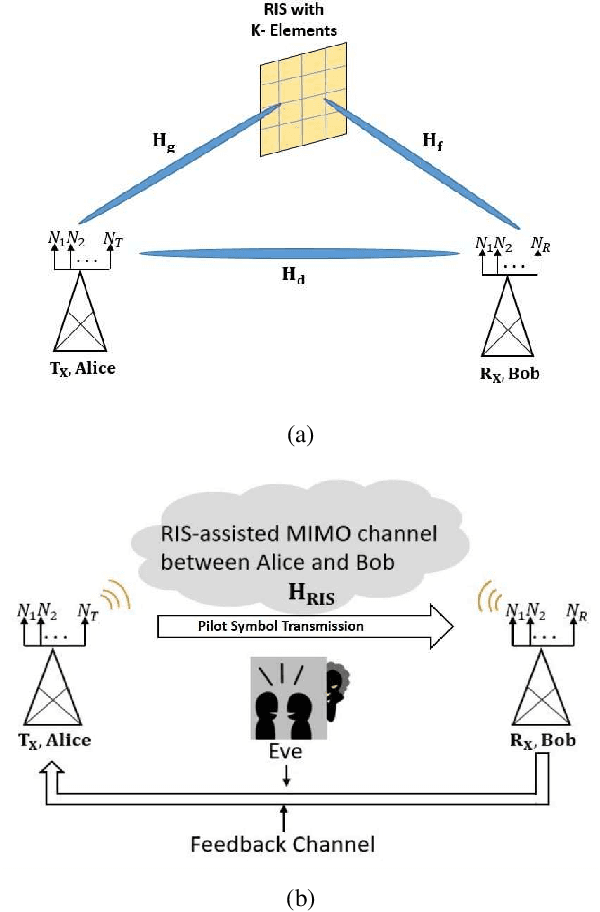

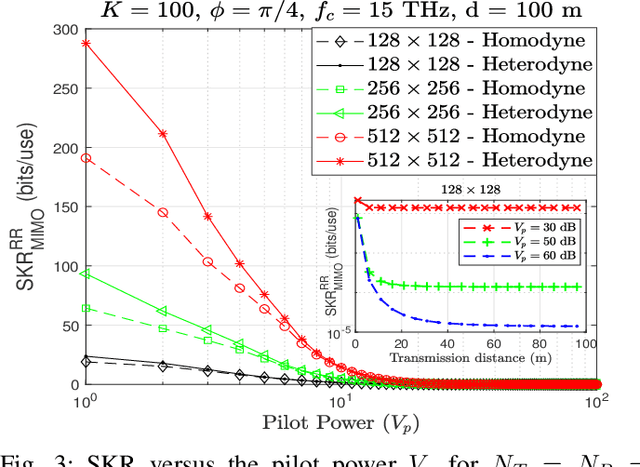
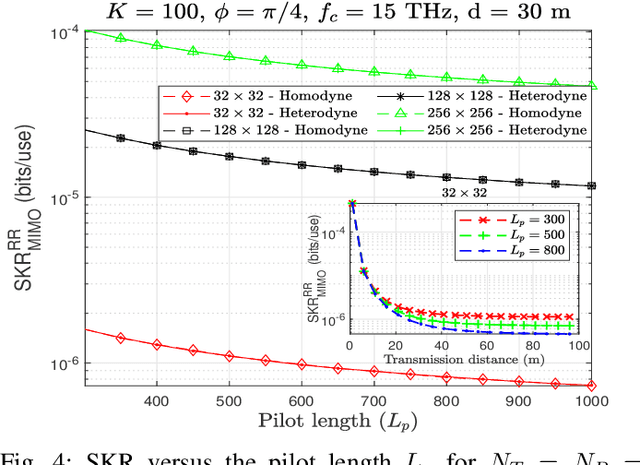
In this paper, a multiple-input multiple-output (MIMO) wireless system incorporating a reconfigurable intelligent surface (RIS) to efficiently operate at terahertz (THz) frequencies is considered. The transmitter, Alice, employs continuous-variable quantum key distribution (CV-QKD) to communicate secret keys to the receiver, Bob, which utilizes either homodyne or heterodyne detection. The latter node applies the least-squared approach to estimate the effective MIMO channel gain matrix prior to receiving the secret key, and this estimation is made available to Alice via an error-free feedback channel. An eavesdropper, Eve, is assumed to employ a collective Gaussian entanglement attack on the feedback channel to avail the estimated channel state information. We present a novel closed-form expression for the secret key rate (SKR) performance of the proposed RIS-assisted THz CV-QKD system. The effect of various system parameters, such as the number of RIS elements and their phase configurations, the channel estimation error, and the detector noise, on the SKR performance are studied via numerical evaluation of the derived formula. It is demonstrated that the RIS contributes to larger SKR for larger link distances, and that heterodyne detection is preferable over homodyne at lower pilot symbol powers.
Resolving Semantic Confusions for Improved Zero-Shot Detection
Dec 12, 2022Zero-shot detection (ZSD) is a challenging task where we aim to recognize and localize objects simultaneously, even when our model has not been trained with visual samples of a few target ("unseen") classes. Recently, methods employing generative models like GANs have shown some of the best results, where unseen-class samples are generated based on their semantics by a GAN trained on seen-class data, enabling vanilla object detectors to recognize unseen objects. However, the problem of semantic confusion still remains, where the model is sometimes unable to distinguish between semantically-similar classes. In this work, we propose to train a generative model incorporating a triplet loss that acknowledges the degree of dissimilarity between classes and reflects them in the generated samples. Moreover, a cyclic-consistency loss is also enforced to ensure that generated visual samples of a class highly correspond to their own semantics. Extensive experiments on two benchmark ZSD datasets - MSCOCO and PASCAL-VOC - demonstrate significant gains over the current ZSD methods, reducing semantic confusion and improving detection for the unseen classes.