 Add to Chrome
 Add to Firefox
 Add to Edge
Symbol Error Analysis for Fluid Antenna Systems with One- and Two-Dimensional Modulation Schemes
Apr 08, 2026
This paper considers a Fluid Antenna (FA) system comprising a single-antenna transmitter that communicates with a receiver equipped with an FA array with $N$ ports. The transmitter is assumed to deploy any of the modulation schemes: \textit{i}) two-sided $M$-ary amplitude-shift keying, \textit{ii}) $M$-ary phase-shift keying, iii) $M$-ary quadrature-amplitude modulation, and \textit{iv}) binary frequency-shift keying, the channels between its antenna and the receiver ports are subjected to Rayleigh fading, and the receiver chooses the best $K$ out of its $N$ ports for symbol detection. Considering that the receiver combines the signals from the best $K$ ports using maximal-ratio combining, the optimal reception structures for all the considered signaling schemes are obtained. We also present novel exact closed-form expressions for the respective symbol error probabilities (SEPs) of the FA system, as well as asymptotic approximations valid at high signal-to-noise ratios. The presented analysis is corroborated through comparisons with simulation results, showcasing the critical role of various system parameters on the SEP performance.

Multi-User Symbol Detection with XL Reception: Dynamic Metasurface Antennas with Low Resolution ADCs
Apr 08, 2026Dynamic Metasurface Antennas (DMAs) have been recently proposed as a cost- and energy-efficient front-end solution for eXtremely Large (XL) antenna array systems, supporting scalable Analog and Digital (A/D) beamforming while using a reduced number of Radio-Frequency (RF) chains. This array architecture is commonly realized as partially connected hybrid A/D beamformers, in which non-overlapping subarrays are linked to separate RF chains, each attached to a waveguide hosting multiple metamaterials. In this work, we study uplink multi-user communications where each RF chain of an XL DMA receiver is equipped with a $b$-bit resolution Analog-to-Digital Converter (ADC). We cast a Mean Squared Error (MSE) minimization problem for the design of the hybrid A/D combiner aimed at multi-user symbol detection, which is intrinsically non-convex due to the structural constraints imposed by the DMA hardware. By exploiting the Bussgang decomposition and a tractable modeling framework, we propose an efficient joint design of the hybrid A/D combining parameters. Our numerical evaluations showcase that XL DMA receivers can perform highly accurate multi-user symbol detection, revealing attractive trade-offs between hardware complexity and MSE performance.
Secret Key Rate Analysis of RIS-Assisted THz MIMO CV-QKD Systems under Localized and Global Eavesdropping
Mar 30, 2026A multiple-input multiple-output (MIMO) system operating at terahertz (THz) frequencies and consisting of a transmitter, Alice, that encodes secret keys using Gaussian-modulated coherent states, which are communicated to a legitimate receiver, Bob, under the assistance of a reconfigurable intelligent surface (RIS) is considered in this paper. The composite wireless channel comprising the direct Alice-to-Bob signal propagation path and the RIS-enabled reflected one is modeled as a passive linear Gaussian quantum channel, allowing for a unitary dilation that preserves the canonical commutation relations. The security of the considered RIS-empowered MIMO system is analyzed under collective Gaussian entangling attacks, according to which an eavesdropper, Eve, is assumed to have access to environmental modes associated with specific propagation segments. We also study, as a benchmark, the case where Eve has access to the purification of the overall channel. The legitimate receiver, Bob, is designed to deploy homodyne detection and reverse reconciliation for key extraction. Novel expressions for the achievable secret key rate (SKR) of the system are derived for both the considered eavesdropping scenarios. Furthermore, an optimization framework is developed to determine the optimal RIS phase configuration matrix that maximizes the SKR performance. The resulting optimization problem is efficiently solved using particle swarm optimization. Numerical results are presented to demonstrate the system's performance with respect to various free parameters. It is showcased that the considered RIS plays a crucial role in enhancing the SKR of the system as well as in extending the secure communication range. This establishes RIS-assisted THz MIMO CV-QKD as a promising solution for next generation secure wireless networks.
Outage Probability Analysis of MRC-Based Fluid Antenna Systems under Rician Fading
Nov 12, 2025This paper investigates a fluid antenna system (FAS) where a single-antenna transmitter communicates with a receiver equipped with a fluid antenna (FA) over a Rician fading channel. Considering that multiple ports among the M available FA ports can be activated, the receiver selects the best K with the highest instantaneous signal-to-noise ratio (SNR) and combines the received signals at the selected ports using maximum ratio combining. The statistics of the post-combining SNR are derived using a Laplace transform-based approach, which allows to analyze the outage probability (OP) of the FAS. Additional closed-form expressions for a lower bound on the OP and the asymptotic OP at high SNR are presented. Numerical results validate the analytical framework and demonstrate the interplay of key system parameters on the performance of the considered MRC-based FAS.
Performance Analysis of One- and Two-way DV-QKD with MIMO FSO Communication Systems
Nov 07, 2025This paper considers a multiple-input multiple-output (MIMO) wireless system wherein two legitimate users attempt to exchange secret keys over free-space optical (FSO) channels. Novel frameworks for the use of the one- and two-way discrete-variable quantum key distribution (DV-QKD) protocols, employing weak coherent pulses and decoy states, are presented. Focusing on the case where a photon-number-splitting attack is adopted by the eavesdropper and the legitimate multi-antenna receiver using threshold detection for the key extraction, novel expressions for the secret key rate and quantum bit error rate for both one- and two-way protocols are derived. The performance gain with larger MIMO configurations and the tradeoff between the performances with the one- and the two-way protocols with respect to the transmission distance of the legitimate FSO link are numerically assessed.
RIS-Assisted Noncoherent Wireless System: Error Analysis with Optimal Receiver and Multi-level ASK
Apr 24, 2025This paper considers a reconfigurable intelligent surface (RIS) aided wireless communication system where the transmitter employs one-sided amplitude-shift keying (ASK) for data modulation and the receiver employs an optimal noncoherent maximum-likelihood rule for symbol detection. A novel statistical analysis is presented to approximate the weighted sum of a central and a non-central chi-squared random variable, which is used to derive a novel closed-form expression for the symbol error probability (SEP) of the noncoherent system. Furthermore, an optimization problem to minimize the system's SEP under transmission energy constraint is proposed, and novel algorithms are presented to obtain the optimal ASK constellation minimizing the SEP. Numerical results indicate that the noncoherent system achieves superior error performance and higher diversity order with the optimal ASK constellation compared to the traditional equispaced ASK constellation. Further, the optimal ASK significantly differs from the traditional one, with the difference becoming significant with an increase in the average signal-to-noise ratio and at a lower number of RIS's reflecting elements.
Optimal One- and Two-Sided Multi-Level ASK for Noncoherent SIMO Systems Over Correlated Rician Fading
Mar 26, 2025This paper analyzes the performance of a single-input multiple-output (SIMO) wireless communication system employing one- and two-sided amplitude shift keying (ASK) modulation schemes for data transmission and operating under correlated Rician fading channels. The receiver deploys an optimal noncoherent maximum likelihood detector, which exploits statistical knowledge of the channel state information for signal decoding. An optimal receiver structure is derived, from which series-form and closed-form expressions for the union bound on the symbol error probability (SEP) are obtained for general and massive SIMO systems, respectively. Furthermore, an optimization framework to derive the optimal one- and two-sided ASK modulation schemes is proposed, which focuses on minimizing SEP performance under an average transmit energy constraint. The conducted numerical investigations for various system parameters demonstrate that the proposed noncoherent SIMO system with the designed optimal ASK modulation schemes achieves superior error performance compared to traditional equispaced ASK modulation. It is also shown that, when the proposed system employs traditional two-sided ASK modulation, superior error performance from the case of using one-sided ASK is obtained.
RIS-Assisted MIMO CV-QKD at THz Frequencies: Channel Estimation and SKR Analysis
Dec 25, 2024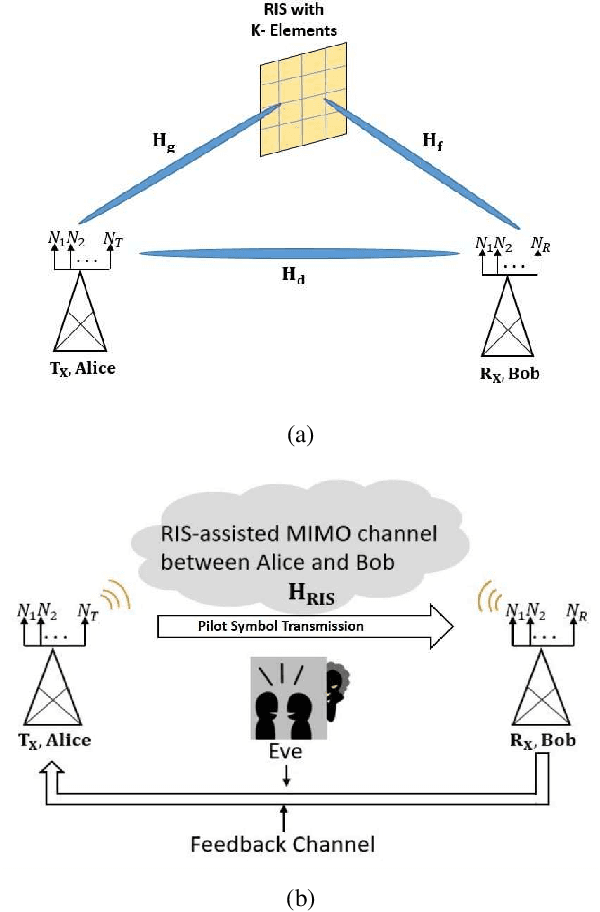

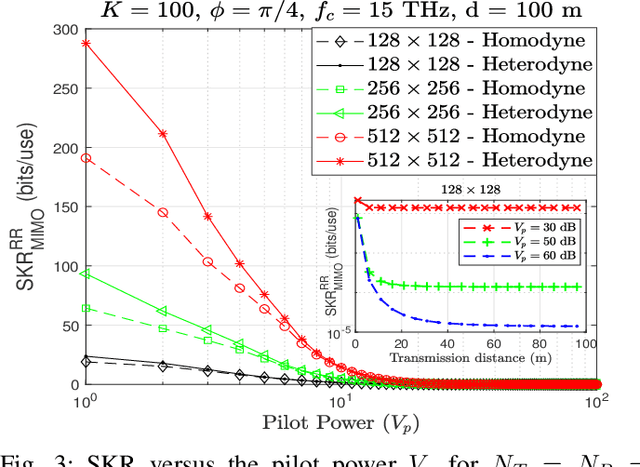
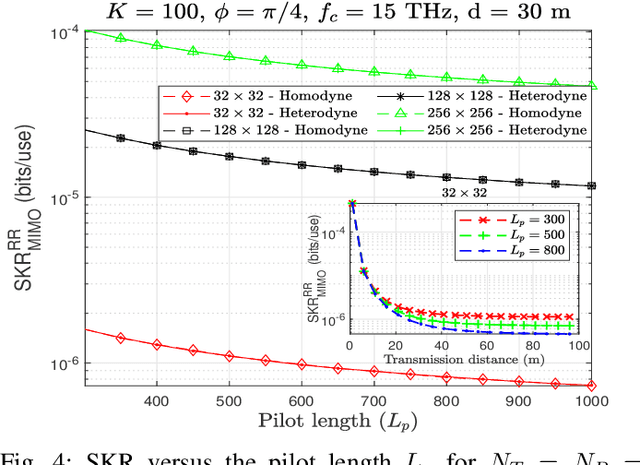
In this paper, a multiple-input multiple-output (MIMO) wireless system incorporating a reconfigurable intelligent surface (RIS) to efficiently operate at terahertz (THz) frequencies is considered. The transmitter, Alice, employs continuous-variable quantum key distribution (CV-QKD) to communicate secret keys to the receiver, Bob, which utilizes either homodyne or heterodyne detection. The latter node applies the least-squared approach to estimate the effective MIMO channel gain matrix prior to receiving the secret key, and this estimation is made available to Alice via an error-free feedback channel. An eavesdropper, Eve, is assumed to employ a collective Gaussian entanglement attack on the feedback channel to avail the estimated channel state information. We present a novel closed-form expression for the secret key rate (SKR) performance of the proposed RIS-assisted THz CV-QKD system. The effect of various system parameters, such as the number of RIS elements and their phase configurations, the channel estimation error, and the detector noise, on the SKR performance are studied via numerical evaluation of the derived formula. It is demonstrated that the RIS contributes to larger SKR for larger link distances, and that heterodyne detection is preferable over homodyne at lower pilot symbol powers.
Optimal Multi-Level ASK Modulations for RIS-Assisted Communications with Energy-Based Noncoherent Reception
Dec 23, 2024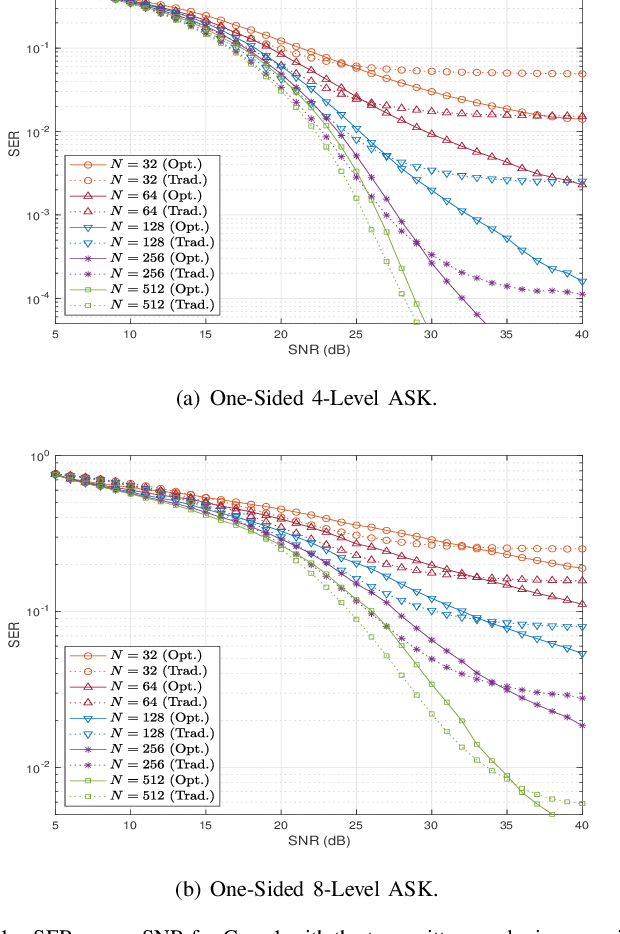
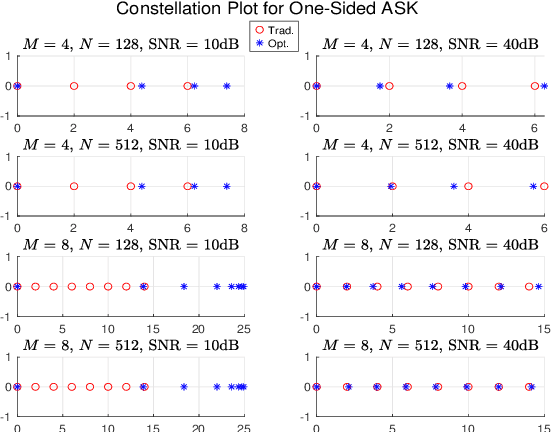
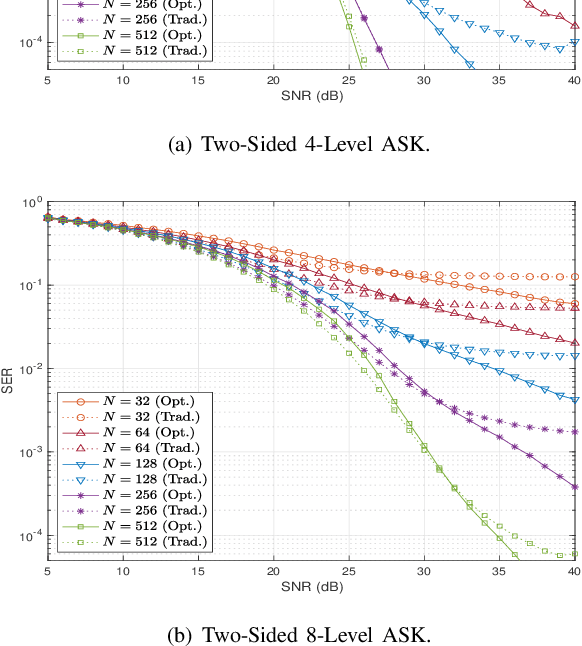
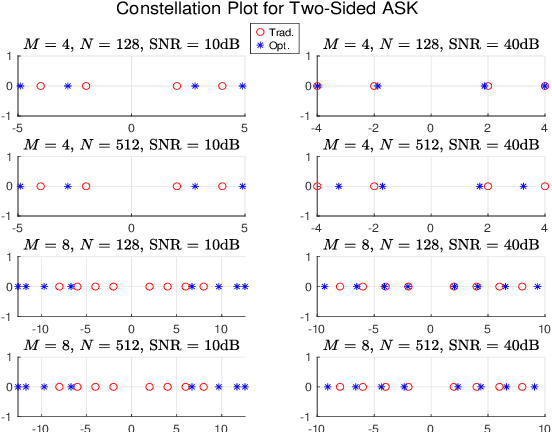
This paper investigates the performance of one- and two-sided amplitude shift keying (ASK) modulations in noncoherent single-input single-output (SISO) wireless communication systems assisted by a reconfigurable intelligent surface (RIS). Novel noncoherent receiver structures are proposed based on the energy of the received symbol and the choice of the modulation scheme for data transmission. The system's performance is assessed in terms of the symbol error rate (SER) and an optimization framework is proposed to determine the most effective one- and two-sided ASKs to minimize the SER, while adhering to average a transmit power constraint. Two scenarios based on the availability of the statistical characteristics of the wireless channel are explored: a) the transceiver pair has complete knowledge of the channel statistics, and b) both end nodes possess knowledge of the statistics of the channel gain up to its fourth moment, and novel algorithms are developed to obtain optimal ASKs for both of them. Extensive numerical evaluations are presented showcasing that there exists a threshold signal-to-noise ratio (SNR) above which the optimal ASKs outperform the traditional equispaced ASKs. The dependencies of the SER performance and the SNR threshold on various system parameters are assessed, providing design guidelines for RIS-assisted noncoherent wireless communication systems with multi-level ASK modulations.
RIS-Assisted Space Shift Keying with Non-Ideal Transceivers and Greedy Detection
Nov 07, 2024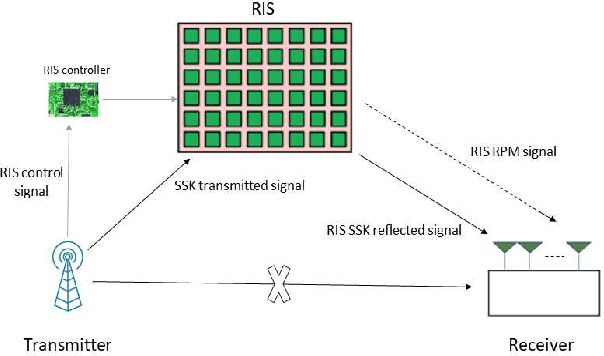
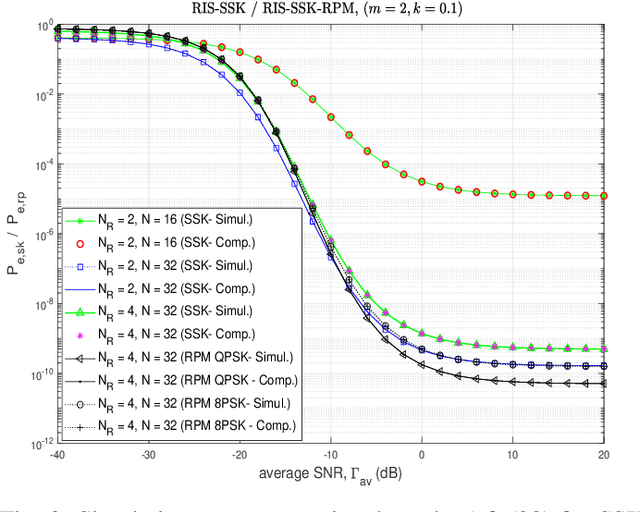
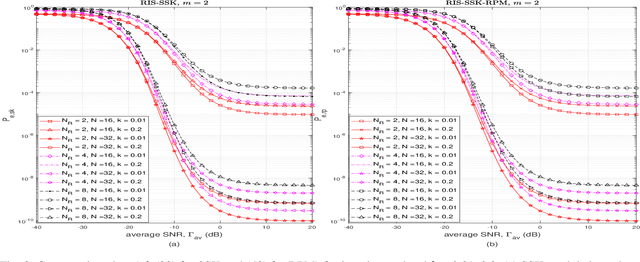
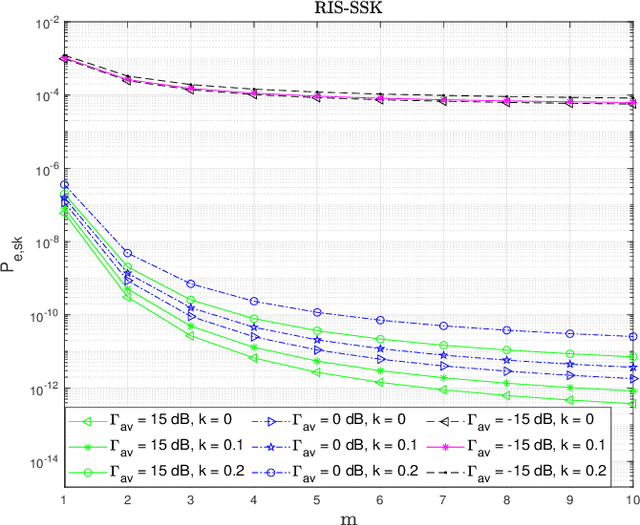
Reconfigurable intelligent surfaces (RIS) and index modulation (IM) represent key technologies for enabling reliable wireless communication with high energy efficiency. However, to fully take advantage of these technologies in practical deployments, comprehending the impact of the non-ideal nature of the underlying transceivers is paramount. In this context, this paper introduces two RIS-assisted IM communication models, in which the RIS is part of the transmitter and space-shift keying (SSK) is employed for IM, and assesses their performance in the presence of hardware impairments. In the first model, the RIS acts as a passive reflector only, reflecting the oncoming SSK modulated signal intelligently towards the desired receive diversity branch/antenna. The second model employs RIS as a transmitter, employing M-ary phase-shift keying for reflection phase modulation (RPM), and as a reflector for the incoming SSK modulated signal. Considering transmissions subjected to Nakagami-m fading, and a greedy detection rule at the receiver, the performance of both the system configurations is evaluated. Specifically, the pairwise probability of erroneous index detection and the probability of erroneous index detection are adopted as performance metrics, and their closed-form expressions are derived for the RIS-assisted SSK and RIS-assisted SSK-RPM system models. Monte-Carlo simulation studies are carried out to verify the analytical framework, and numerical results are presented to study the dependency of the error performance on the system parameters. The findings highlight the effect of hardware impairment on the performance of the communication system under study.