 Add to Chrome
 Add to Firefox
 Add to Edge
SleepWalk: A Three-Tier Benchmark for Stress-Testing Instruction-Guided Vision-Language Navigation
May 11, 2026
Vision-Language Models (VLMs) have advanced rapidly in multimodal perception and language understanding, yet it remains unclear whether they can reliably ground language into spatially coherent, plausibly executable actions in 3D digital environments. We introduce SleepWalk, a benchmark for evaluating instruction-grounded trajectory prediction in single-scene 3D worlds generated from textual scene descriptions and filtered for navigability. Unlike prior navigation benchmarks centered on long-range exploration across rooms, SleepWalk targets localized, interaction-centric embodied reasoning: given rendered visual observations and a natural-language instruction, a model must predict a trajectory that respects scene geometry, avoids collisions, and terminates at an action-compatible location. The benchmark covers diverse indoor and outdoor environments and organizes tasks into three tiers of spatial and temporal difficulty, enabling fine-grained analysis of grounding under increasing compositional complexity. Using a standardized pointwise judge-based evaluation protocol, we evaluate three frontier VLMs on 2,472 curated 3D environments with nine instructions per scene. Results reveal systematic failures in grounded spatial reasoning, especially under occlusion, interaction constraints, and multi-step instructions: performance drops as the difficulty level of the tasks increase. In general, current VLMs can somewhat produce trajectories that are simultaneously spatially coherent, plausibly executable, and aligned with intended actions. By exposing failures in a controlled yet scalable setting, SleepWalk provides a critical benchmark for advancing grounded multimodal reasoning, embodied planning, vision-language navigation, and action-capable agents in 3D environments.

CONSCIENTIA: Can LLM Agents Learn to Strategize? Emergent Deception and Trust in a Multi-Agent NYC Simulation
Apr 10, 2026As large language models (LLMs) are increasingly deployed as autonomous agents, understanding how strategic behavior emerges in multi-agent environments has become an important alignment challenge. We take a neutral empirical stance and construct a controlled environment in which strategic behavior can be directly observed and measured. We introduce a large-scale multi-agent simulation in a simplified model of New York City, where LLM-driven agents interact under opposing incentives. Blue agents aim to reach their destinations efficiently, while Red agents attempt to divert them toward billboard-heavy routes using persuasive language to maximize advertising revenue. Hidden identities make navigation socially mediated, forcing agents to decide when to trust or deceive. We study policy learning through an iterative simulation pipeline that updates agent policies across repeated interaction rounds using Kahneman-Tversky Optimization (KTO). Blue agents are optimized to reduce billboard exposure while preserving navigation efficiency, whereas Red agents adapt to exploit remaining weaknesses. Across iterations, the best Blue policy improves task success from 46.0% to 57.3%, although susceptibility remains high at 70.7%. Later policies exhibit stronger selective cooperation while preserving trajectory efficiency. However, a persistent safety-helpfulness trade-off remains: policies that better resist adversarial steering do not simultaneously maximize task completion. Overall, our results show that LLM agents can exhibit limited strategic behavior, including selective trust and deception, while remaining highly vulnerable to adversarial persuasion.
DETONATE: A Benchmark for Text-to-Image Alignment and Kernelized Direct Preference Optimization
Jun 17, 2025Alignment is crucial for text-to-image (T2I) models to ensure that generated images faithfully capture user intent while maintaining safety and fairness. Direct Preference Optimization (DPO), prominent in large language models (LLMs), is extending its influence to T2I systems. This paper introduces DPO-Kernels for T2I models, a novel extension enhancing alignment across three dimensions: (i) Hybrid Loss, integrating embedding-based objectives with traditional probability-based loss for improved optimization; (ii) Kernelized Representations, employing Radial Basis Function (RBF), Polynomial, and Wavelet kernels for richer feature transformations and better separation between safe and unsafe inputs; and (iii) Divergence Selection, expanding beyond DPO's default Kullback-Leibler (KL) regularizer by incorporating Wasserstein and R'enyi divergences for enhanced stability and robustness. We introduce DETONATE, the first large-scale benchmark of its kind, comprising approximately 100K curated image pairs categorized as chosen and rejected. DETONATE encapsulates three axes of social bias and discrimination: Race, Gender, and Disability. Prompts are sourced from hate speech datasets, with images generated by leading T2I models including Stable Diffusion 3.5 Large, Stable Diffusion XL, and Midjourney. Additionally, we propose the Alignment Quality Index (AQI), a novel geometric measure quantifying latent-space separability of safe/unsafe image activations, revealing hidden vulnerabilities. Empirically, we demonstrate that DPO-Kernels maintain strong generalization bounds via Heavy-Tailed Self-Regularization (HT-SR). DETONATE and complete code are publicly released.
YINYANG-ALIGN: Benchmarking Contradictory Objectives and Proposing Multi-Objective Optimization based DPO for Text-to-Image Alignment
Feb 05, 2025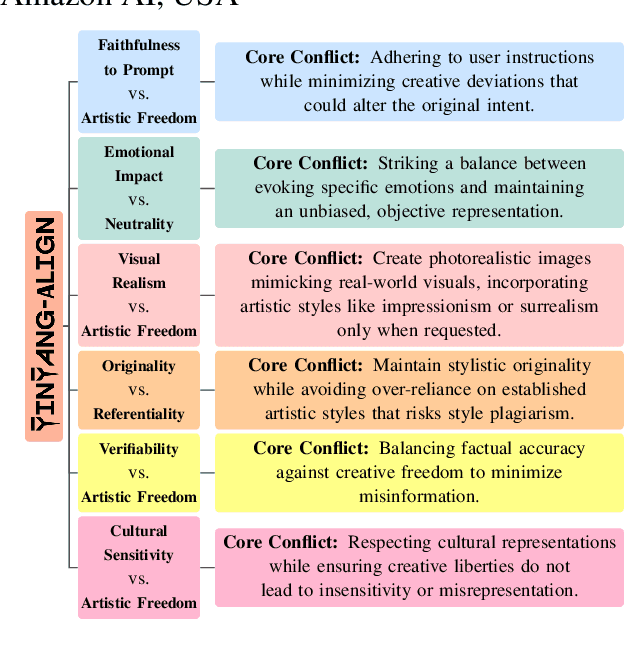
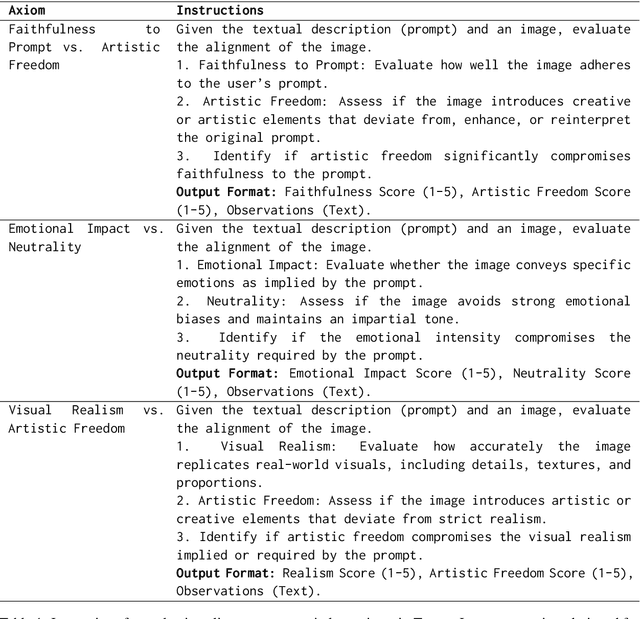
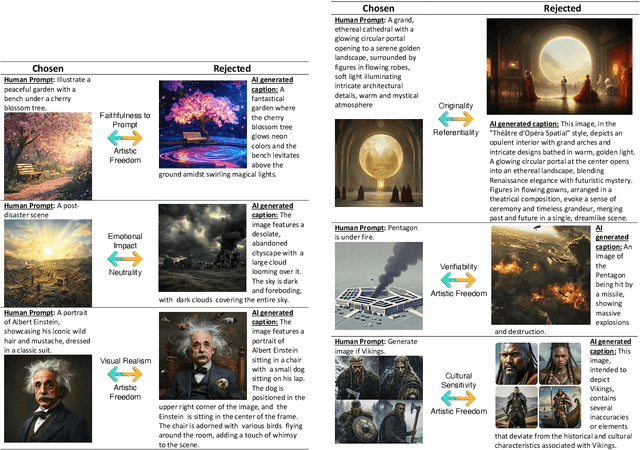
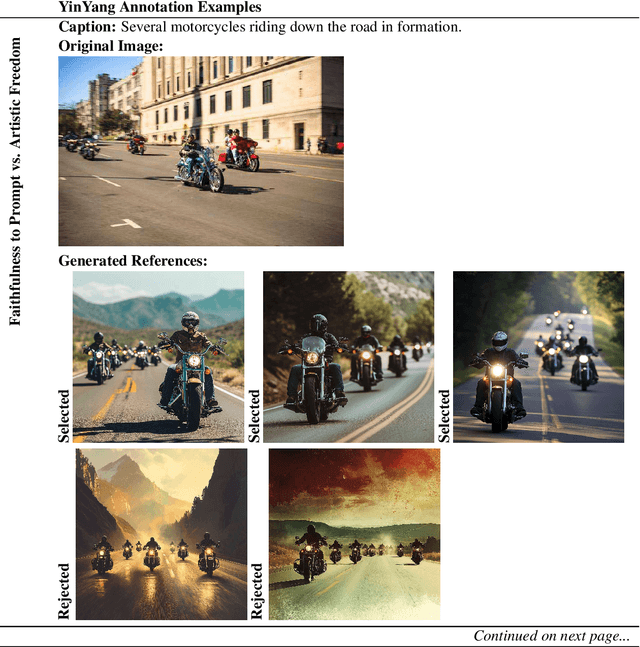
Precise alignment in Text-to-Image (T2I) systems is crucial to ensure that generated visuals not only accurately encapsulate user intents but also conform to stringent ethical and aesthetic benchmarks. Incidents like the Google Gemini fiasco, where misaligned outputs triggered significant public backlash, underscore the critical need for robust alignment mechanisms. In contrast, Large Language Models (LLMs) have achieved notable success in alignment. Building on these advancements, researchers are eager to apply similar alignment techniques, such as Direct Preference Optimization (DPO), to T2I systems to enhance image generation fidelity and reliability. We present YinYangAlign, an advanced benchmarking framework that systematically quantifies the alignment fidelity of T2I systems, addressing six fundamental and inherently contradictory design objectives. Each pair represents fundamental tensions in image generation, such as balancing adherence to user prompts with creative modifications or maintaining diversity alongside visual coherence. YinYangAlign includes detailed axiom datasets featuring human prompts, aligned (chosen) responses, misaligned (rejected) AI-generated outputs, and explanations of the underlying contradictions.
DPO Kernels: A Semantically-Aware, Kernel-Enhanced, and Divergence-Rich Paradigm for Direct Preference Optimization
Jan 08, 2025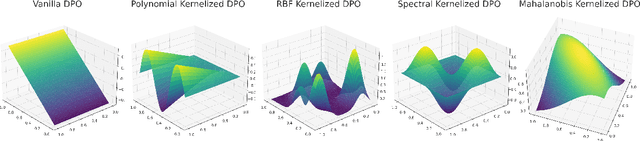
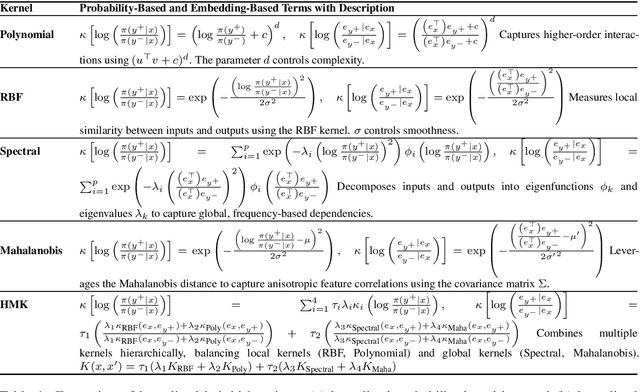
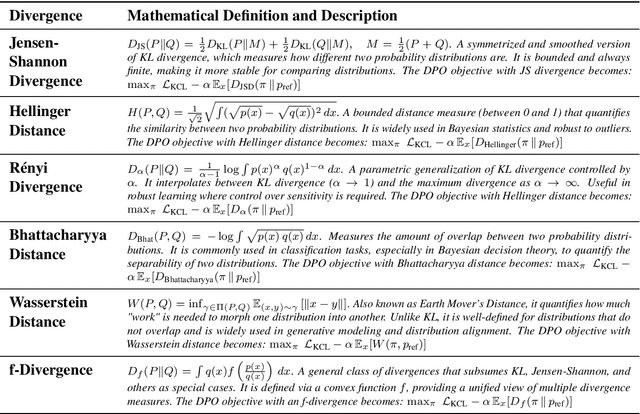
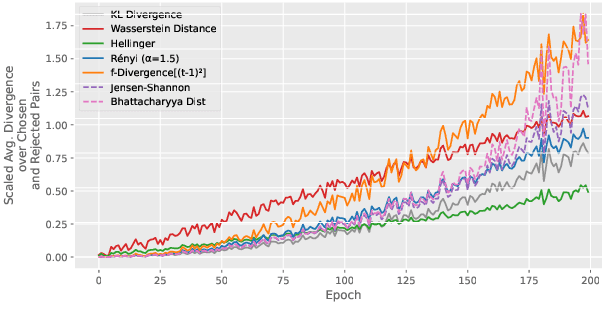
The rapid rise of large language models (LLMs) has unlocked many applications but also underscores the challenge of aligning them with diverse values and preferences. Direct Preference Optimization (DPO) is central to alignment but constrained by fixed divergences and limited feature transformations. We propose DPO-Kernels, which integrates kernel methods to address these issues through four key contributions: (i) Kernelized Representations with polynomial, RBF, Mahalanobis, and spectral kernels for richer transformations, plus a hybrid loss combining embedding-based and probability-based objectives; (ii) Divergence Alternatives (Jensen-Shannon, Hellinger, Renyi, Bhattacharyya, Wasserstein, and f-divergences) for greater stability; (iii) Data-Driven Selection metrics that automatically choose the best kernel-divergence pair; and (iv) a Hierarchical Mixture of Kernels for both local precision and global modeling. Evaluations on 12 datasets demonstrate state-of-the-art performance in factuality, safety, reasoning, and instruction following. Grounded in Heavy-Tailed Self-Regularization, DPO-Kernels maintains robust generalization for LLMs, offering a comprehensive resource for further alignment research.