 Add to Chrome
 Add to Firefox
 Add to Edge
IndicVisionBench: Benchmarking Cultural and Multilingual Understanding in VLMs
Nov 06, 2025
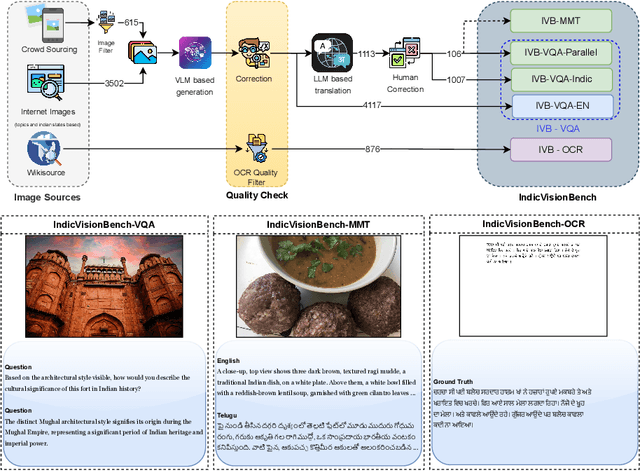
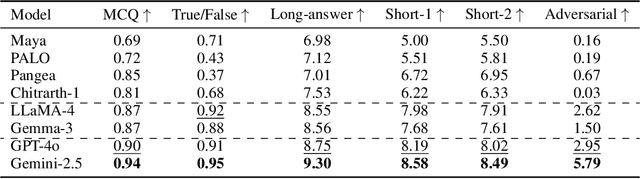
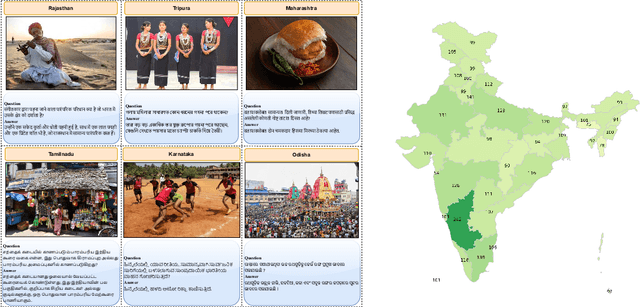

Vision-language models (VLMs) have demonstrated impressive generalization across multimodal tasks, yet most evaluation benchmarks remain Western-centric, leaving open questions about their performance in culturally diverse and multilingual settings. To address this gap, we introduce IndicVisionBench, the first large-scale benchmark centered on the Indian subcontinent. Covering English and 10 Indian languages, our benchmark spans 3 multimodal tasks, including Optical Character Recognition (OCR), Multimodal Machine Translation (MMT), and Visual Question Answering (VQA), covering 6 kinds of question types. Our final benchmark consists of a total of ~5K images and 37K+ QA pairs across 13 culturally grounded topics. In addition, we release a paired parallel corpus of annotations across 10 Indic languages, creating a unique resource for analyzing cultural and linguistic biases in VLMs. We evaluate a broad spectrum of 8 models, from proprietary closed-source systems to open-weights medium and large-scale models. Our experiments reveal substantial performance gaps, underscoring the limitations of current VLMs in culturally diverse contexts. By centering cultural diversity and multilinguality, IndicVisionBench establishes a reproducible evaluation framework that paves the way for more inclusive multimodal research.

Chitrarth: Bridging Vision and Language for a Billion People
Feb 21, 2025Recent multimodal foundation models are primarily trained on English or high resource European language data, which hinders their applicability to other medium and low-resource languages. To address this limitation, we introduce Chitrarth (Chitra: Image; Artha: Meaning), an inclusive Vision-Language Model (VLM), specifically targeting the rich linguistic diversity and visual reasoning across 10 prominent Indian languages. Our model effectively integrates a state-of-the-art (SOTA) multilingual Large Language Model (LLM) with a vision module, primarily trained on multilingual image-text data. Furthermore, we also introduce BharatBench, a comprehensive framework for evaluating VLMs across various Indian languages, ultimately contributing to more diverse and effective AI systems. Our model achieves SOTA results for benchmarks across low resource languages while retaining its efficiency in English. Through our research, we aim to set new benchmarks in multilingual-multimodal capabilities, offering substantial improvements over existing models and establishing a foundation to facilitate future advancements in this arena.