 Add to Chrome
 Add to Firefox
 Add to Edge
Learning Long-Term Temporal Dependencies in Photovoltaic Power Output Prediction Through Multi-Horizon Forecasting
May 18, 2026
The rapid global expansion of solar photovoltaic (PV) capacity-reaching a record 597 GW in 2024-highlights the urgent need for robust forecasting models to mitigate the grid instability caused by the intermittent nature of solar irradiance. While deep learning-based direct forecasting using ground-based sky images (GSI) has emerged as a dominant approach, existing literature is often constrained by single-architecture evaluations and an exclusive focus on single-horizon (point) prediction. This paper proposes a transition from traditional single-horizon estimation toward a multi-horizon forecasting framework, leading to an architecture-independent improvement in accuracy. We hypothesize and demonstrate experimentally that joint optimization over a sequence of future values allows deep neural networks to better capture latent inter-step temporal dependencies by avoiding precocious convergence of the network in terms of both weight gradients and filter diversity. Leveraging this architecture-independent improvement that integrates sequential sky imagery with historical PV generation data, we evaluate the models' abilities to predict power output across multiple discrete future time steps simultaneously. Our methodology is validated through a comparative analysis across diverse deep learning architectures. The results demonstrate that this multi-horizon approach significantly enhances predictive accuracy and robustness across the entire forecast horizon while maintaining computational parsimony. By achieving superior performance with negligible overhead compared to single-horizon models, this work provides a scalable and efficient solution to improve the resilience of modern power grids.

Near-Infrared Depth-Independent Image Dehazing using Haar Wavelets
Mar 26, 2022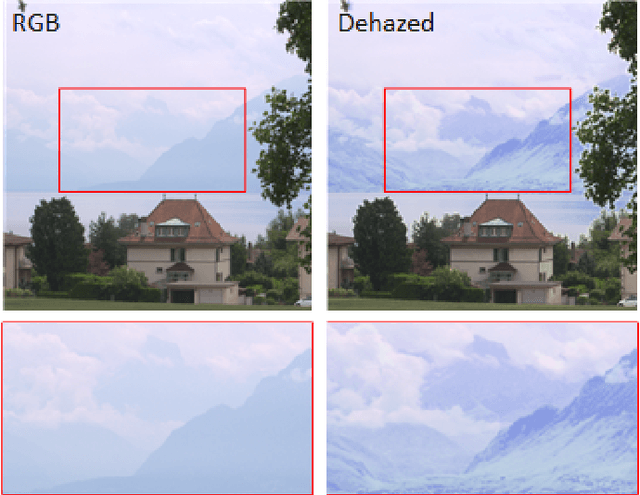
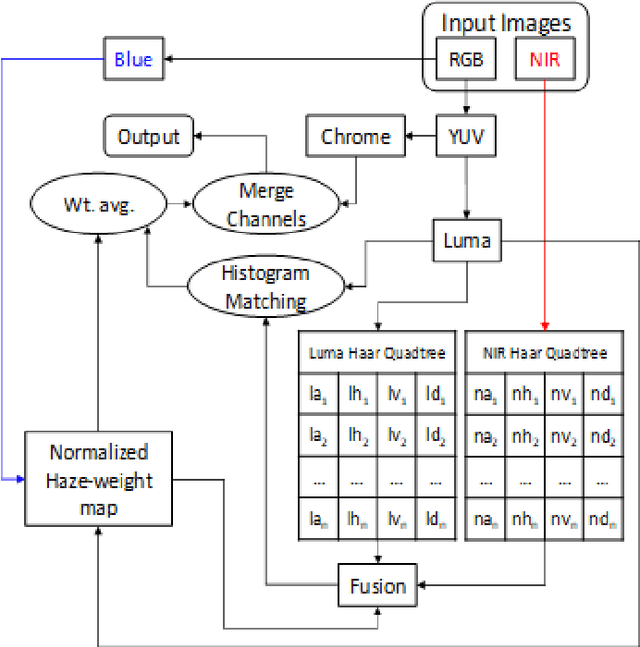
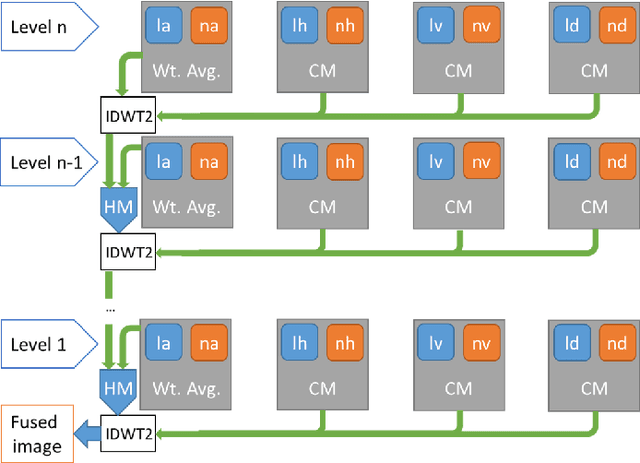
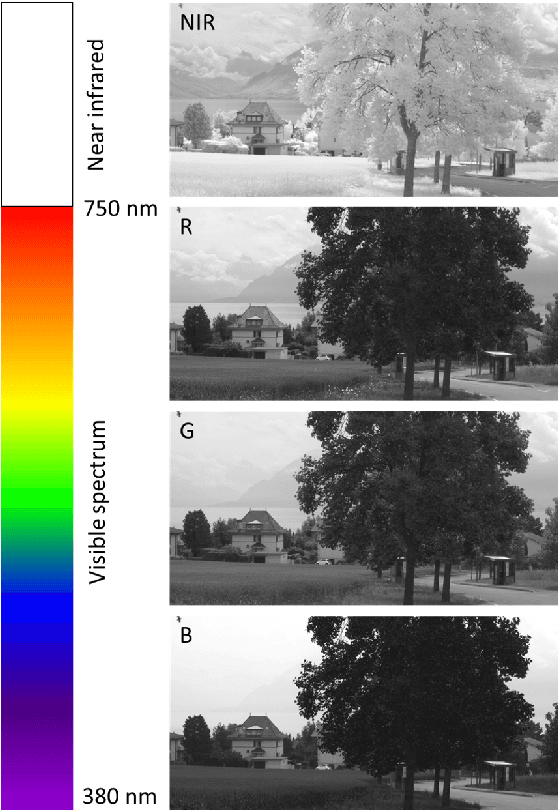
We propose a fusion algorithm for haze removal that combines color information from an RGB image and edge information extracted from its corresponding NIR image using Haar wavelets. The proposed algorithm is based on the key observation that NIR edge features are more prominent in the hazy regions of the image than the RGB edge features in those same regions. To combine the color and edge information, we introduce a haze-weight map which proportionately distributes the color and edge information during the fusion process. Because NIR images are, intrinsically, nearly haze-free, our work makes no assumptions like existing works that rely on a scattering model and essentially designing a depth-independent method. This helps in minimizing artifacts and gives a more realistic sense to the restored haze-free image. Extensive experiments show that the proposed algorithm is both qualitatively and quantitatively better on several key metrics when compared to existing state-of-the-art methods.
* Accepted in 25th International Conference on Pattern Recognition (ICPR 2020)
CCA: Exploring the Possibility of Contextual Camouflage Attack on Object Detection
Aug 19, 2020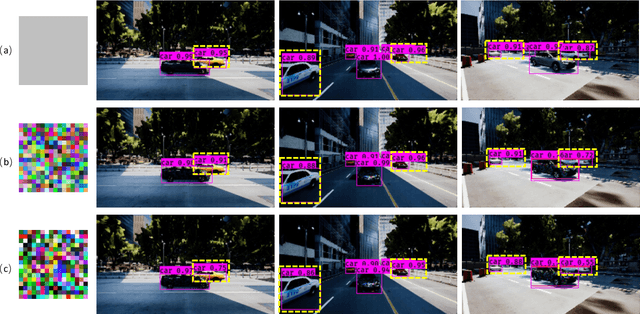
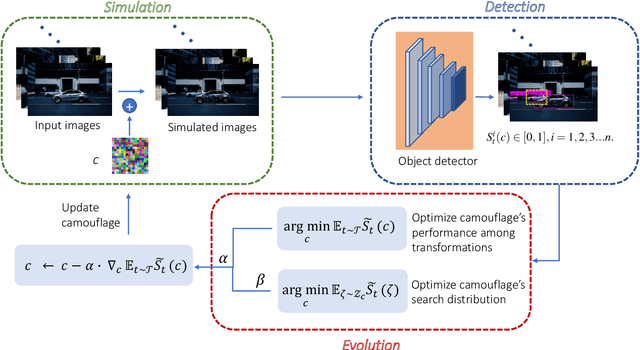
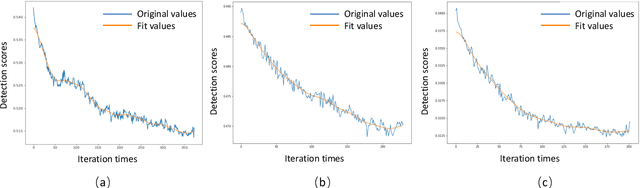
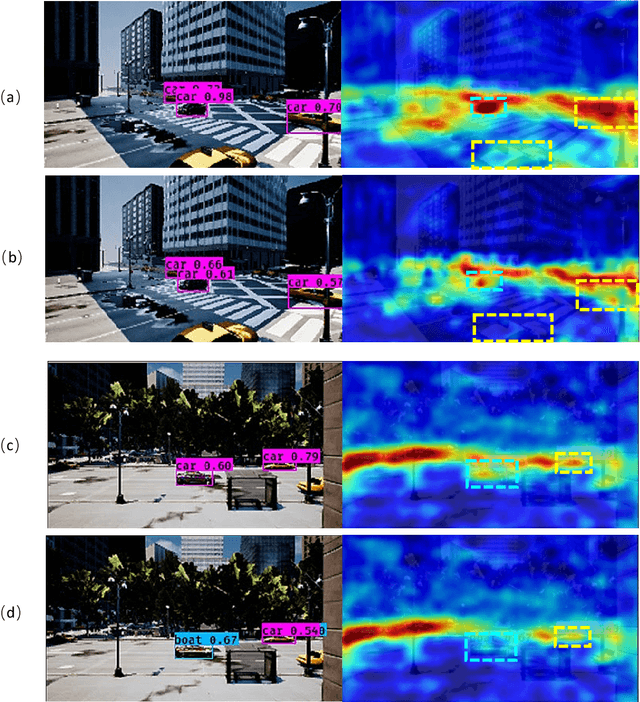
Deep neural network based object detection hasbecome the cornerstone of many real-world applications. Alongwith this success comes concerns about its vulnerability tomalicious attacks. To gain more insight into this issue, we proposea contextual camouflage attack (CCA for short) algorithm to in-fluence the performance of object detectors. In this paper, we usean evolutionary search strategy and adversarial machine learningin interactions with a photo-realistic simulated environment tofind camouflage patterns that are effective over a huge varietyof object locations, camera poses, and lighting conditions. Theproposed camouflages are validated effective to most of the state-of-the-art object detectors.