 Add to Chrome
 Add to Firefox
 Add to Edge
Steered Generation via Gradient-Based Optimization on Sparse Query Features
May 21, 2026
Latent steering exploits internal representations of Large Language Models (LLMs) to guide generation, yet interventions on dense states can entangle distinct semantic features. In this paper, we investigate attention query activations as a high-fidelity site for precise control, hypothesizing that manipulating the attention mechanism itself offers sharper steerability than general state interventions. We introduce Prototype-Based Sparse Steering, a framework that applies Sparse Autoencoders (SAEs) specifically to query activations, to decompose them into interpretable features, then apply gradient-based optimization during inference to align the sparse representation with class prototypes of target behaviors. To validate this architectural insight, we first analyze the mechanism in Textualized Gridworld, a controlled environment for verifiable planning constraints. We demonstrate that optimizing sparse query features enables effective navigation of rigid planning requirements (i.e., safe vs. short paths), confirming the method's ability to satisfy objective rules. We then demonstrate the framework's versatility by training SAEs on a high-dimensional educational domain, where the framework steers the cognitive complexity of feedback (i.e., Bloom's Taxonomy). Our experiments establish that sparse query representations provide the necessary disentanglement for unified, interpretable control over both logical planning and stylistic nuance.

Generating Place-Based Compromises Between Two Points of View
Apr 27, 2026Large Language Models (LLMs) excel academically but struggle with social intelligence tasks, such as creating good compromises. In this paper, we present methods for generating empathically neutral compromises between two opposing viewpoints. We first compared four different prompt engineering methods using Claude 3 Opus and a dataset of 2,400 contrasting views on shared places. A subset of the gen erated compromises was evaluated for acceptability in a 50-participant study. We found that the best method for generating compromises between two views used external empathic similarity between a compromise and each viewpoint as iterative feedback, outperforming stan dard Chain of Thought (CoT) reasoning. The results indicate that the use of empathic neutrality improves the acceptability of compromises. The dataset of generated compromises was then used to train two smaller foundation models via margin-based alignment of human preferences, improving efficiency and removing the need for empathy estimation during inference.
Audited Reasoning Refinement: Fine-Tuning Language Models via LLM-Guided Step-Wise Evaluation and Correction
Sep 15, 2025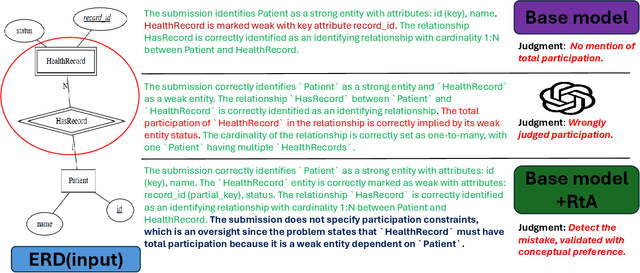
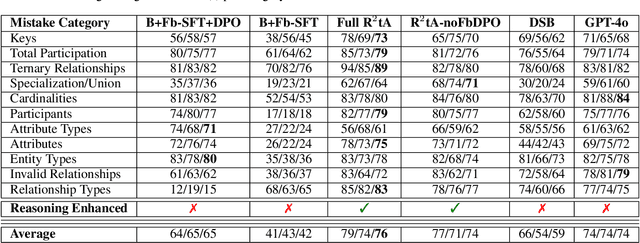
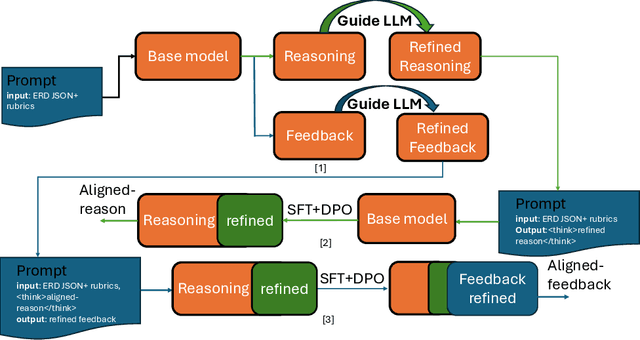
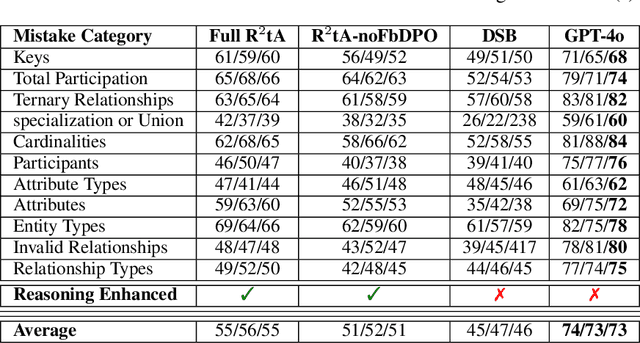
Training a task-specific small reasoning model is challenging when direct human supervision or high-quality labels are scarce. However, LLMs with reasoning capabilities produce abundant intermediate reasoning traces that can be systematically refined to create effective supervision signals. We propose Reason-Refine-then-Align (R2tA), which turns refined model rationales into supervision for training task-specific reasoning models. Our method generates initial reasoning and responses from an open-source base model on task-specific inputs, then refines these traces, fixing hallucinations and inconsistencies, to form a high-fidelity dataset. We perform a two-stage alignment, supervised fine-tuning (SFT), followed by direct preference optimization (DPO) to calibrate the model's intermediate reasoning with human-validated conceptual preferences and then condition the final output on that aligned reasoning. As a case study, we apply R2tA to evaluate extended entity relationship diagrams (EERDs) in database system design, a structurally complex task where prompt-only methods miss or hallucinate errors. We curated a dataset of 600 EERD variants (train/test split of 450/150, respectively) with induced mistakes spanning 11 categories. Empirical evaluation suggests R2tA provides a practical, cost-effective path to scalable LLM adaptation in data-scarce domains, enabling reproducible AI tools for education and beyond.
Steered Generation via Gradient Descent on Sparse Features
Feb 25, 2025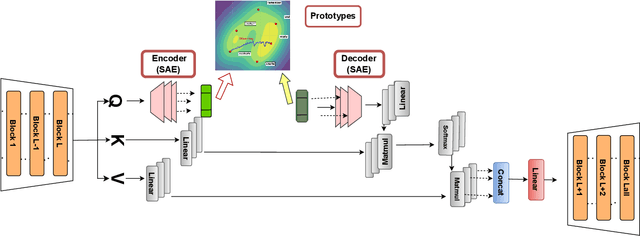
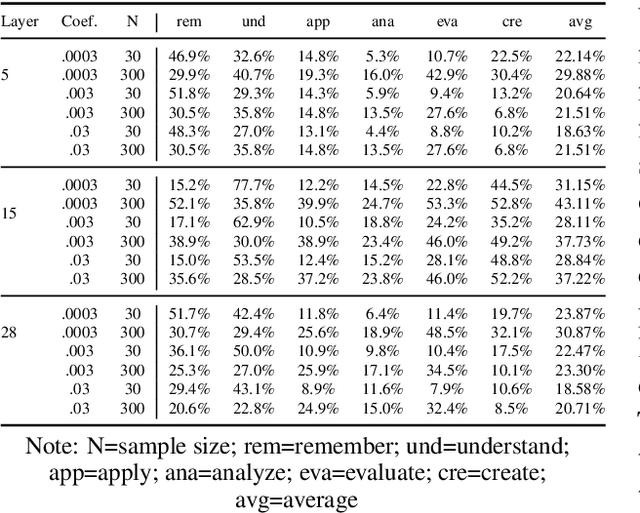

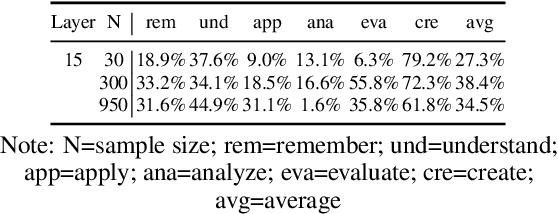
Large language models (LLMs) encode a diverse range of linguistic features within their latent representations, which can be harnessed to steer their output toward specific target characteristics. In this paper, we modify the internal structure of LLMs by training sparse autoencoders to learn a sparse representation of the query embedding, allowing precise control over the model's attention distribution. We demonstrate that manipulating this sparse representation effectively transforms the output toward different stylistic and cognitive targets. Specifically, in an educational setting, we show that the cognitive complexity of LLM-generated feedback can be systematically adjusted by modifying the encoded query representation at a specific layer. To achieve this, we guide the learned sparse embedding toward the representation of samples from the desired cognitive complexity level, using gradient-based optimization in the latent space.
Sample Efficient Multimodal Semantic Augmentation for Incremental Summarization
Mar 08, 2023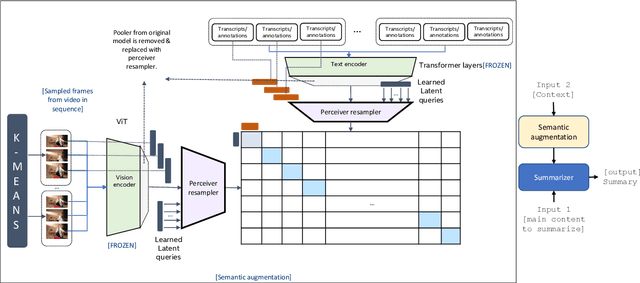
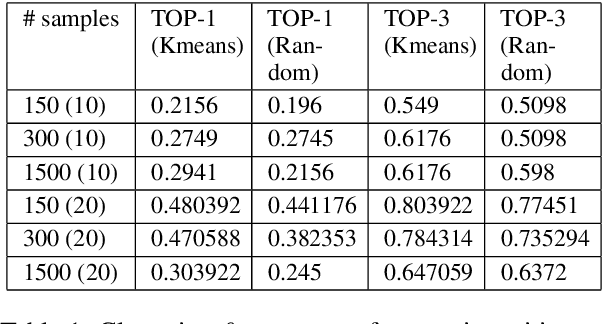
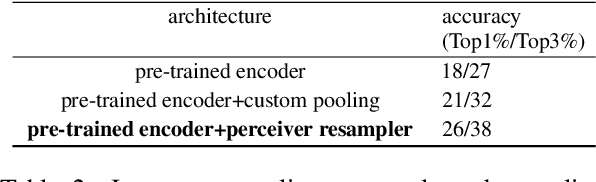
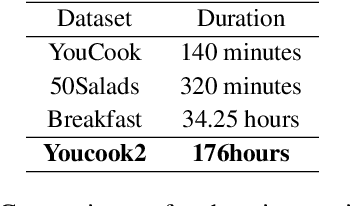
In this work, we develop a prompting approach for incremental summarization of task videos. We develop a sample-efficient few-shot approach for extracting semantic concepts as an intermediate step. We leverage an existing model for extracting the concepts from the images and extend it to videos and introduce a clustering and querying approach for sample efficiency, motivated by the recent advances in perceiver-based architectures. Our work provides further evidence that an approach with richer input context with relevant entities and actions from the videos and using these as prompts could enhance the summaries generated by the model. We show the results on a relevant dataset and discuss possible directions for the work.