 Add to Chrome
 Add to Firefox
 Add to Edge
Human Interaction-Aware 3D Reconstruction from a Single Image
Apr 07, 2026
Reconstructing textured 3D human models from a single image is fundamental for AR/VR and digital human applications. However, existing methods mostly focus on single individuals and thus fail in multi-human scenes, where naive composition of individual reconstructions often leads to artifacts such as unrealistic overlaps, missing geometry in occluded regions, and distorted interactions. These limitations highlight the need for approaches that incorporate group-level context and interaction priors. We introduce a holistic method that explicitly models both group- and instance-level information. To mitigate perspective-induced geometric distortions, we first transform the input into a canonical orthographic space. Our primary component, Human Group-Instance Multi-View Diffusion (HUG-MVD), then generates complete multi-view normals and images by jointly modeling individuals and group context to resolve occlusions and proximity. Subsequently, the Human Group-Instance Geometric Reconstruction (HUG-GR) module optimizes the geometry by leveraging explicit, physics-based interaction priors to enforce physical plausibility and accurately model inter-human contact. Finally, the multi-view images are fused into a high-fidelity texture. Together, these components form our complete framework, HUG3D. Extensive experiments show that HUG3D significantly outperforms both single-human and existing multi-human methods, producing physically plausible, high-fidelity 3D reconstructions of interacting people from a single image. Project page: https://jongheean11.github.io/HUG3D_project

PersonaCraft: Personalized Full-Body Image Synthesis for Multiple Identities from Single References Using 3D-Model-Conditioned Diffusion
Nov 27, 2024
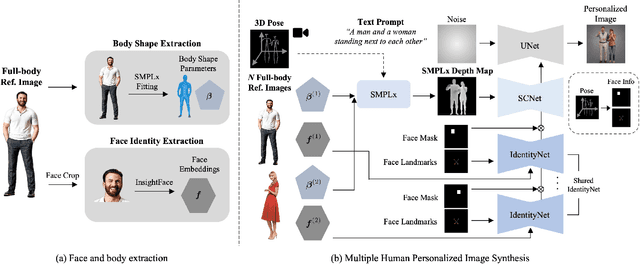


Personalized image generation has been significantly advanced, enabling the creation of highly realistic and customized images. However, existing methods often struggle with generating images of multiple people due to occlusions and fail to accurately personalize full-body shapes. In this paper, we propose PersonaCraft, a novel approach that combines diffusion models with 3D human modeling to address these limitations. Our method effectively manages occlusions by incorporating 3D-aware pose conditioning with SMPLx-ControlNet and accurately personalizes human full-body shapes through SMPLx fitting. Additionally, PersonaCraft enables user-defined body shape adjustments, adding flexibility for individual body customization. Experimental results demonstrate the superior performance of PersonaCraft in generating high-quality, realistic images of multiple individuals while resolving occlusion issues, thus establishing a new standard for multi-person personalized image synthesis. Project page: https://gwang-kim.github.io/persona_craft
Gradient-free Decoder Inversion in Latent Diffusion Models
Sep 27, 2024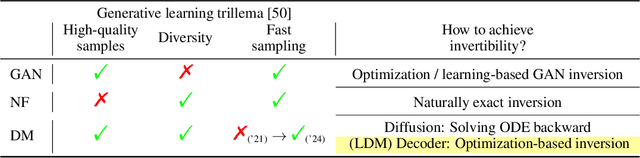
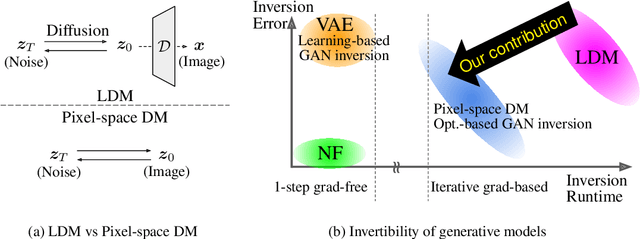
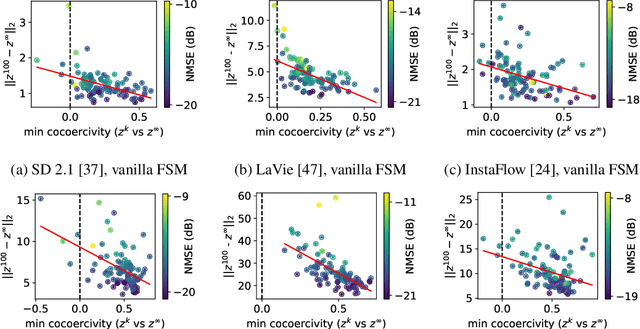
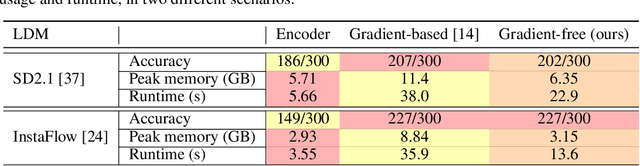
In latent diffusion models (LDMs), denoising diffusion process efficiently takes place on latent space whose dimension is lower than that of pixel space. Decoder is typically used to transform the representation in latent space to that in pixel space. While a decoder is assumed to have an encoder as an accurate inverse, exact encoder-decoder pair rarely exists in practice even though applications often require precise inversion of decoder. Prior works for decoder inversion in LDMs employed gradient descent inspired by inversions of generative adversarial networks. However, gradient-based methods require larger GPU memory and longer computation time for larger latent space. For example, recent video LDMs can generate more than 16 frames, but GPUs with 24 GB memory can only perform gradient-based decoder inversion for 4 frames. Here, we propose an efficient gradient-free decoder inversion for LDMs, which can be applied to diverse latent models. Theoretical convergence property of our proposed inversion has been investigated not only for the forward step method, but also for the inertial Krasnoselskii-Mann (KM) iterations under mild assumption on cocoercivity that is satisfied by recent LDMs. Our proposed gradient-free method with Adam optimizer and learning rate scheduling significantly reduced computation time and memory usage over prior gradient-based methods and enabled efficient computation in applications such as noise-space watermarking while achieving comparable error levels.
On Exact Inversion of DPM-Solvers
Nov 30, 2023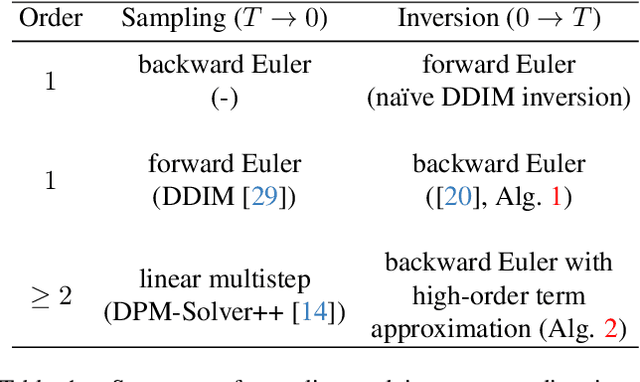
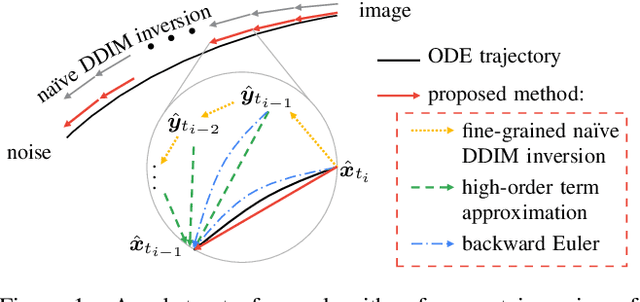
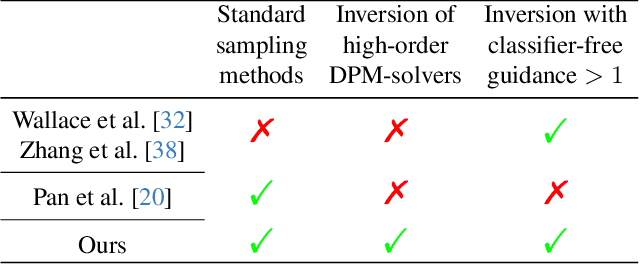
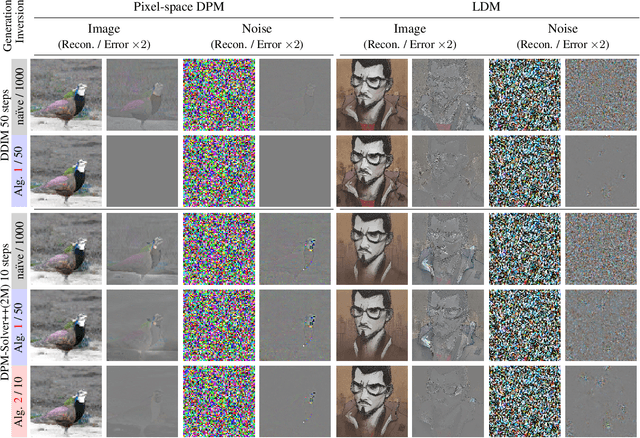
Diffusion probabilistic models (DPMs) are a key component in modern generative models. DPM-solvers have achieved reduced latency and enhanced quality significantly, but have posed challenges to find the exact inverse (i.e., finding the initial noise from the given image). Here we investigate the exact inversions for DPM-solvers and propose algorithms to perform them when samples are generated by the first-order as well as higher-order DPM-solvers. For each explicit denoising step in DPM-solvers, we formulated the inversions using implicit methods such as gradient descent or forward step method to ensure the robustness to large classifier-free guidance unlike the prior approach using fixed-point iteration. Experimental results demonstrated that our proposed exact inversion methods significantly reduced the error of both image and noise reconstructions, greatly enhanced the ability to distinguish invisible watermarks and well prevented unintended background changes consistently during image editing. Project page: \url{https://smhongok.github.io/inv-dpm.html}.