 Add to Chrome
 Add to Firefox
 Add to Edge
Generative versus Discriminative Approaches for Class-Incremental Learning of EMG Signals: Effectiveness of Scale Mixture Modeling
Jun 19, 2026
In electromyogram (EMG)-based motion recognition, it is impractical to predefine all motions that may be required during deployment, necessitating class-incremental learning that sequentially adds new motion classes. The primary challenges in class-incremental learning are catastrophic forgetting, where previously acquired knowledge is overwritten when learning new classes, and the memory cost of retaining past data to counteract it. In particular, for EMG-based motion recognition intended for edge devices with limited computational resources, it is essential to suppress catastrophic forgetting and maintain low memory cost. In this paper, we conducted a comparative evaluation of eight class-incremental learning methods spanning generative and discriminative approaches, including both deep and non-deep learning methods, for EMG signal classification. Using four datasets, we evaluated each method in terms of classification accuracy, backward transfer, and memory cost. The results demonstrated that deep learning-based methods suffered significant accuracy degradation from catastrophic forgetting as the number of tasks increased, whereas generative models maintained stable accuracy with low memory cost. Among generative models, the scale mixture classification model (SMCM), which captures EMG signal variability, achieved the most favorable accuracy-memory trade-off while effectively suppressing catastrophic forgetting across all datasets.

Unsupervised Neural Motion Retargeting for Humanoid Teleoperation
Jun 02, 2024


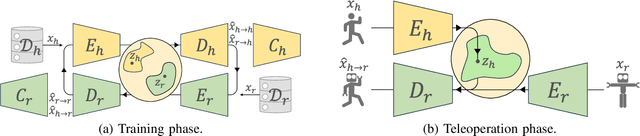
This study proposes an approach to human-to-humanoid teleoperation using GAN-based online motion retargeting, which obviates the need for the construction of pairwise datasets to identify the relationship between the human and the humanoid kinematics. Consequently, it can be anticipated that our proposed teleoperation system will reduce the complexity and setup requirements typically associated with humanoid controllers, thereby facilitating the development of more accessible and intuitive teleoperation systems for users without robotics knowledge. The experiments demonstrated the efficacy of the proposed method in retargeting a range of upper-body human motions to humanoid, including a body jab motion and a basketball shoot motion. Moreover, the human-in-the-loop teleoperation performance was evaluated by measuring the end-effector position errors between the human and the retargeted humanoid motions. The results demonstrated that the error was comparable to those of conventional motion retargeting methods that require pairwise motion datasets. Finally, a box pick-and-place task was conducted to demonstrate the usability of the developed humanoid teleoperation system.