 Add to Chrome
 Add to Firefox
 Add to Edge
Map-Mono-Ego: Map-Grounded Global Human Pose Estimation from Monocular Egocentric Video
May 20, 2026
Monocular egocentric human pose estimation is essential for ubiquitous activity monitoring. However, understanding the user's absolute location within the environment remains a challenge. Existing methods primarily focus on relative motion from an initial position, and tend not to account for the wearer's absolute location within an environment. Furthermore, inherent scale ambiguity in monocular vision leads to severe translational drift, limiting long-term tracking without specialized multi-sensor hardware. To address this, we propose MapMonoEgo, a novel framework achieving globally consistent human pose estimation solely from a monocular camera by leveraging a pre-scanned 3D point cloud. We also introduce AIST-Living dataset, a new dataset pairing egocentric video with ground-truth motion in a scanned environment. Experiments demonstrate that our approach significantly outperforms the state-of-the-art baseline, proving its utility for practical monitoring tasks without specialized hardware.

Unsupervised Neural Motion Retargeting for Humanoid Teleoperation
Jun 02, 2024


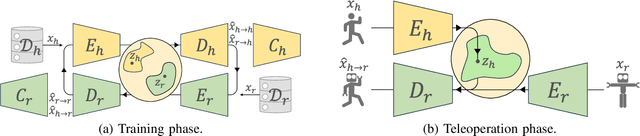
This study proposes an approach to human-to-humanoid teleoperation using GAN-based online motion retargeting, which obviates the need for the construction of pairwise datasets to identify the relationship between the human and the humanoid kinematics. Consequently, it can be anticipated that our proposed teleoperation system will reduce the complexity and setup requirements typically associated with humanoid controllers, thereby facilitating the development of more accessible and intuitive teleoperation systems for users without robotics knowledge. The experiments demonstrated the efficacy of the proposed method in retargeting a range of upper-body human motions to humanoid, including a body jab motion and a basketball shoot motion. Moreover, the human-in-the-loop teleoperation performance was evaluated by measuring the end-effector position errors between the human and the retargeted humanoid motions. The results demonstrated that the error was comparable to those of conventional motion retargeting methods that require pairwise motion datasets. Finally, a box pick-and-place task was conducted to demonstrate the usability of the developed humanoid teleoperation system.