 Add to Chrome
 Add to Firefox
 Add to Edge
ICHOR: A Robust Representation Learning Approach for ASL CBF Maps with Self-Supervised Masked Autoencoders
Mar 05, 2026
Arterial spin labeling (ASL) perfusion MRI allows direct quantification of regional cerebral blood flow (CBF) without exogenous contrast, enabling noninvasive measurements that can be repeated without constraints imposed by contrast injection. ASL is increasingly acquired in research studies and clinical MRI protocols. Building on successes in structural imaging, recent efforts have implemented deep learning based methods to improve image quality, enable automated quality control, and derive robust quantitative and predictive biomarkers with ASL derived CBF. However, progress has been limited by variable image quality, substantial inter-site, vendor and protocol differences, and limited availability of labeled datasets needed to train models that generalize across cohorts. To address these challenges, we introduce ICHOR, a self supervised pre-training approach for ASL CBF maps that learns transferable representations using 3D masked autoencoders. ICHOR is pretrained via masked image modeling using a Vision Transformer backbone and can be used as a general-purpose encoder for downstream ASL tasks. For pre-training, we curated one of the largest ASL datasets to date, comprising 11,405 ASL CBF scans from 14 studies spanning multiple sites and acquisition protocols. We evaluated the pre-trained ICHOR encoder on three downstream diagnostic classification tasks and one ASL CBF map quality prediction regression task. Across all evaluations, ICHOR outperformed existing neuroimaging self-supervised pre-training methods adapted to ASL. Pre-trained weights and code will be made publicly available.

A New Similarity Measure for Non-Local Means Filtering of MRI Images
Oct 26, 2011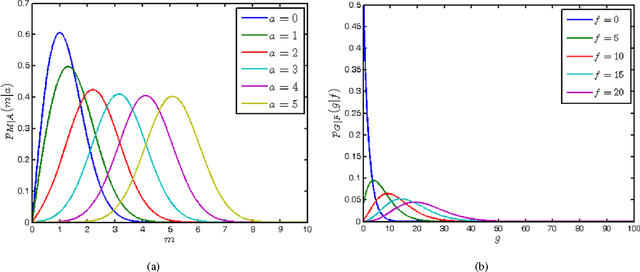
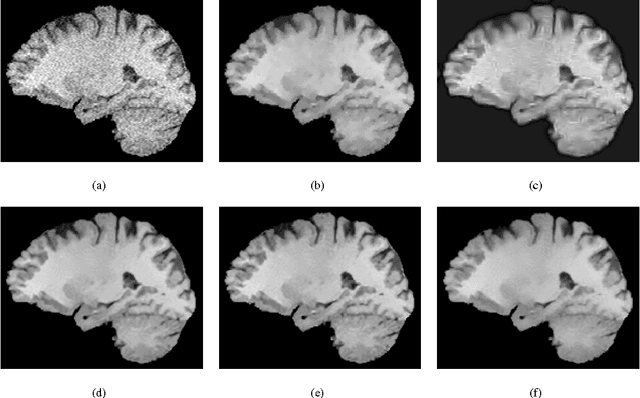
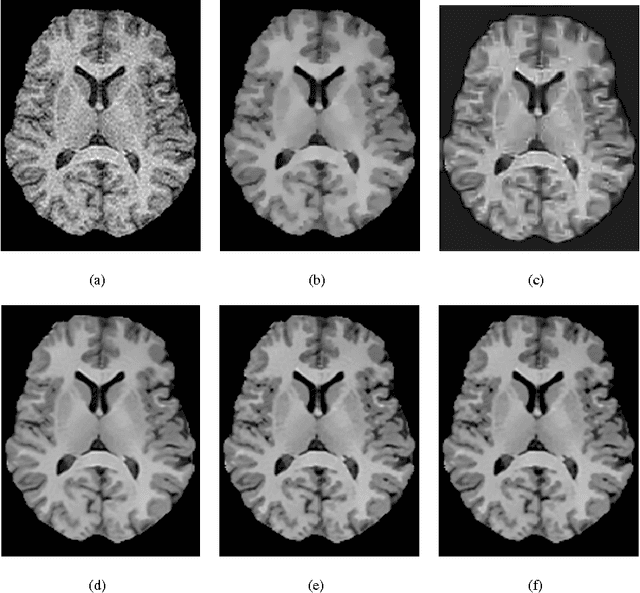
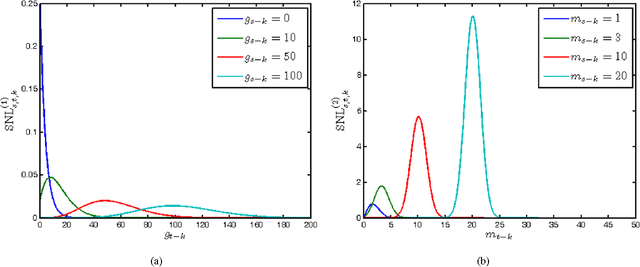
The acquisition of MRI images offers a trade-off in terms of acquisition time, spatial/temporal resolution and signal-to-noise ratio (SNR). Thus, for instance, increasing the time efficiency of MRI often comes at the expense of reduced SNR. This, in turn, necessitates the use of post-processing tools for noise rejection, which makes image de-noising an indispensable component of computer assistance diagnosis. In the field of MRI, a multitude of image de-noising methods have been proposed hitherto. In this paper, the application of a particular class of de-noising algorithms - known as non-local mean (NLM) filters - is investigated. Such filters have been recently applied for MRI data enhancement and they have been shown to provide more accurate results as compared to many alternative de-noising algorithms. Unfortunately, virtually all existing methods for NLM filtering have been derived under the assumption of additive white Gaussian (AWG) noise contamination. Since this assumption is known to fail at low values of SNR, an alternative formulation of NLM filtering is required, which would take into consideration the correct Rician statistics of MRI noise. Accordingly, the contribution of the present paper is two-fold. First, it points out some principal disadvantages of the earlier methods of NLM filtering of MRI images and suggests means to rectify them. Second, the paper introduces a new similarity measure for NLM filtering of MRI Images, which is derived under bona fide statistical assumptions and results in more accurate reconstruction of MR scans as compared to alternative NLM approaches. Finally, the utility and viability of the proposed method is demonstrated through a series of numerical experiments using both in silico and in vivo MRI data.