 Add to Chrome
 Add to Firefox
 Add to Edge
Joint Trajectory and Resource Optimization for Aerial RIS-assisted Integrated TNT Networks
Apr 14, 2026
Integrated terrestrial and non-terrestrial networks (ITNTNs) are regarded as a key architectural paradigm for sixth-generation (6G) wireless systems. This paper investigates a dual-aerial reconfigurable intelligent surface (RIS)-assisted ITNTN, where a terrestrial base station (TBS) and a satellite (SAT) jointly serve terrestrial and satellite users with the aid of an unmanned aerial vehicle (UAV)-mounted RIS and a high-altitude platform (HAP)-mounted RIS. We formulate an average sum-rate maximization problem by jointly optimizing the TBS and SAT precoders, the RIS phase shift matrices, and the three-dimensional trajectories of the UAV and the HAP, subject to transmit power, unit-modulus, and mobility constraints. The resulting optimization problem is highly non-convex due to the strong coupling among the transmit precoders, RIS phase shifts, and aerial platform mobility. To efficiently address this challenge, we propose a block coordinate descent (BCD) framework that integrates weighted minimum mean square error (WMMSE) optimization for precoder design, a manifold-based Riemannian conjugate gradient (RCG) method for RIS phase-shift optimization, and successive convex approximation (SCA) for trajectory optimization. The proposed algorithm is shown to converge to a stationary point. The simulation results show that the proposed joint design achieves an approximately $7.05 \%$ higher average sum-rate compared to the random RIS scheme, highlighting the effectiveness of dual-aerial RIS deployment and joint communication-mobility optimization in ITNTNs.

Multiple Antenna Selection and Successive Signal Detection for SM-based IRS-aided Communication
Apr 28, 2021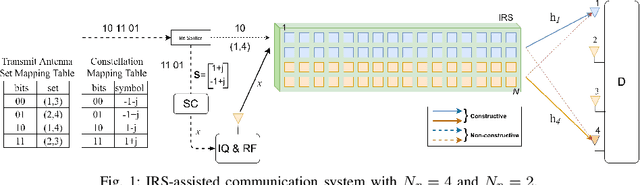
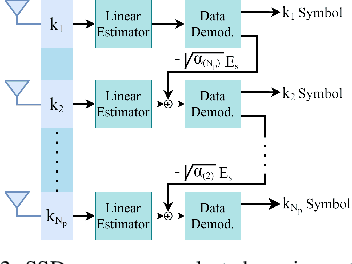
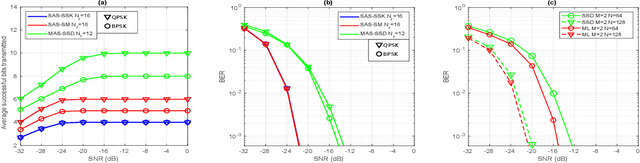
Intelligent reflecting surface (IRS) is being considered as a prospective candidate for next-generation wireless communication due to its ability to significantly improve coverage and spectral efficiency by controlling the propagation environment. One of the ways IRS increases spectral efficiency is by adjusting phase shifts to perform passive beamforming. In this letter, we integrate the concept of IRS-aided communication to the domain of multi-direction beamforming, whereby multiple receive antennas are selected to convey more information bits than existing spatial modulation (SM) techniques at any specific time. To complement this system, we also propose a successive signal detection (SSD) technique at the receiver. Numerical results show that the proposed design is able to improve the average successful bits transmitted (ASBT) by the system, which outperforms other state-of-the-art methods proposed in the literature.