 Add to Chrome
 Add to Firefox
 Add to Edge
GROKE: Vision-Free Navigation Instruction Evaluation via Graph Reasoning on OpenStreetMap
Jan 12, 2026
The evaluation of navigation instructions remains a persistent challenge in Vision-and-Language Navigation (VLN) research. Traditional reference-based metrics such as BLEU and ROUGE fail to capture the functional utility of spatial directives, specifically whether an instruction successfully guides a navigator to the intended destination. Although existing VLN agents could serve as evaluators, their reliance on high-fidelity visual simulators introduces licensing constraints and computational costs, and perception errors further confound linguistic quality assessment. This paper introduces GROKE(Graph-based Reasoning over OSM Knowledge for instruction Evaluation), a vision-free training-free hierarchical LLM-based framework for evaluating navigation instructions using OpenStreetMap data. Through systematic ablation studies, we demonstrate that structured JSON and textual formats for spatial information substantially outperform grid-based and visual graph representations. Our hierarchical architecture combines sub-instruction planning with topological graph navigation, reducing navigation error by 68.5% compared to heuristic and sampling baselines on the Map2Seq dataset. The agent's execution success, trajectory fidelity, and decision patterns serve as proxy metrics for functional navigability given OSM-visible landmarks and topology, establishing a scalable and interpretable evaluation paradigm without visual dependencies. Code and data are available at https://anonymous.4open.science/r/groke.

Rainfall-runoff prediction using a Gustafson-Kessel clustering based Takagi-Sugeno Fuzzy model
Aug 22, 2021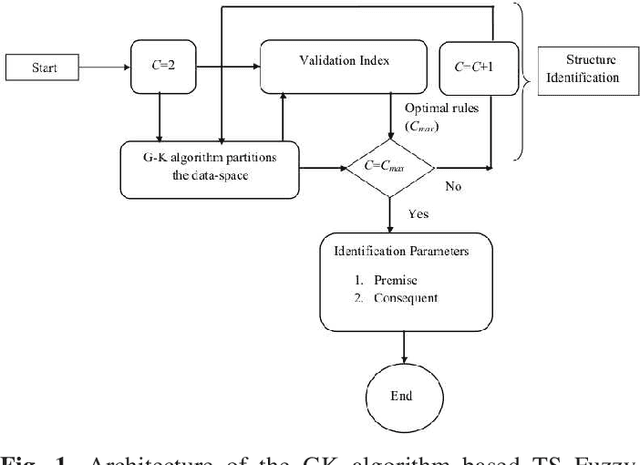
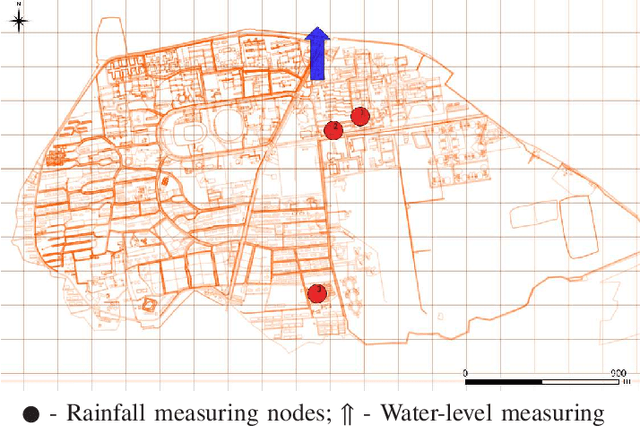
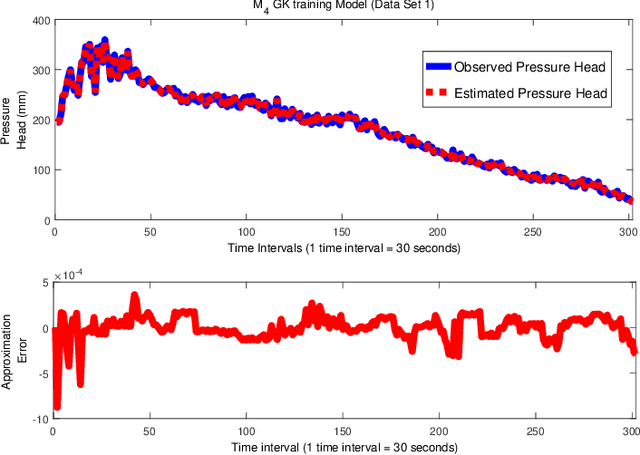
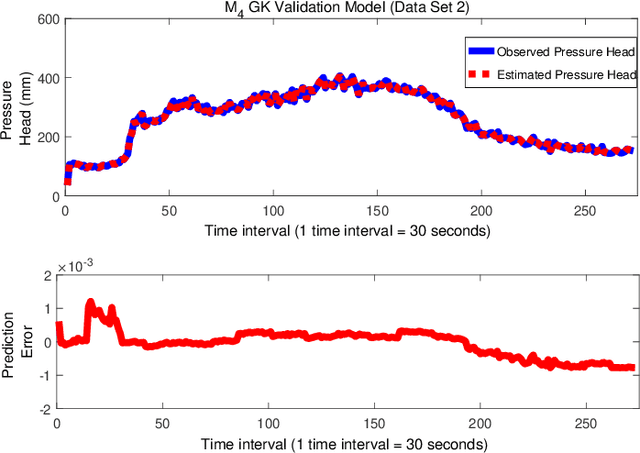
A rainfall-runoff model predicts surface runoff either using a physically-based approach or using a systems-based approach. Takagi-Sugeno (TS) Fuzzy models are systems-based approaches and a popular modeling choice for hydrologists in recent decades due to several advantages and improved accuracy in prediction over other existing models. In this paper, we propose a new rainfall-runoff model developed using Gustafson-Kessel (GK) clustering-based TS Fuzzy model. We present comparative performance measures of GK algorithms with two other clustering algorithms: (i) Fuzzy C-Means (FCM), and (ii)Subtractive Clustering (SC). Our proposed TS Fuzzy model predicts surface runoff using: (i) observed rainfall in a drainage basin and (ii) previously observed precipitation flow in the basin outlet. The proposed model is validated using the rainfall-runoff data collected from the sensors installed on the campus of the Indian Institute of Technology, Kharagpur. The optimal number of rules of the proposed model is obtained by different validation indices. A comparative study of four performance criteria: RootMean Square Error (RMSE), Coefficient of Efficiency (CE), Volumetric Error (VE), and Correlation Coefficient of Determination(R) have been quantitatively demonstrated for each clustering algorithm.