 Add to Chrome
 Add to Firefox
 Add to Edge
ECO-ID: Event-Camera based Optical System for Secure Multi-User Ultra-Low Latency Identification
Aug 17, 2026
Time-critical interactive systems increasingly require ultra-low-latency device identification for multiple users, yet prevailing approaches such as passwords, QR codes, and RFID/NFC are constrained by human input, frame-based sensing, or near-contact range. This paper presents ECO-ID, an event-camera-based optical system for multi-user, ultra-low-latency identification over visible light communication (VLC). Leveraging microsecond-resolution, asynchronous observations of brightness transitions, ECO-ID employs a spatiotemporal coding design: disjoint LED subsets provide spatial separation among users, while user-specific timing delays encode identities without inter-user synchronization. The optical channel and event-driven sensing reduce full-scene capture relative to frame cameras and limit the RF attack surface, while enabling rapid token verification with freshness and replay protection. We implement a prototype and demonstrate that ECO-ID can practically achieve approximately 99.8\% localization and 98.7\% identification with 0.64 ms mean latency, while theoretically supporting identification at the scale of tens of concurrent users. Overall, ECO-ID provides a fast, privacy-conscious, and security-aware alternative for scalable multi-user identification in time-critical interactive environments.

Exploiting RIS Optimization Limits for Multi-User Beamforming and Signal Suppression
Jun 16, 2026This paper presents a unified framework for exploiting the boundaries of reconfigurable intelligent surfaces (RIS) joint optimization in multi-user wireless systems, where a single RIS accommodates diverse objectives.We first propose an adaptive gradient-scaling mechanism that accelerates the convergence of the underlying optimization algorithm while maintaining stable performance across varying channel and system parameters. The proposed mechanism enables the solver to reach a reasonably good solution rapidly without requiring manual tuning of step sizes or algorithmic hyperparameters when system inputs change. We then propose a low-complexity beamformer recovery method tailored for single-user scenarios, which circumvents the full matrix decomposition required by traditional approaches, thereby significantly reducing computational overhead. Building on these foundations, we develop an element allocation strategy that enables user-specific prioritization through assignment of RIS subsets. This is further extended by a modular add-drop mechanism that supports partial-panel optimization in general multi-user settings. The framework is evaluated across three representative scenarios: (i) signal amplification for all users, (ii) signal suppression for all users, and (iii) selective amplification and suppression. To characterize performance limits, we derive power trade-off boundaries using scalarized joint optimization, which closely align with Monte Carlo simulations. Our unified joint optimization method consistently yield solutions near these boundaries, confirming its near-optimality. Extensive simulations under realistic channel models demonstrate that the proposed approach outperforms conventional semidefinite relaxation techniques, offering a scalable and effective RIS control strategy for cooperative and competitive multi-user environments.
A Novel Rotated Constellation-based LLR Detector for Flexible NOMA based OFDM-IM Scheme
Apr 29, 2023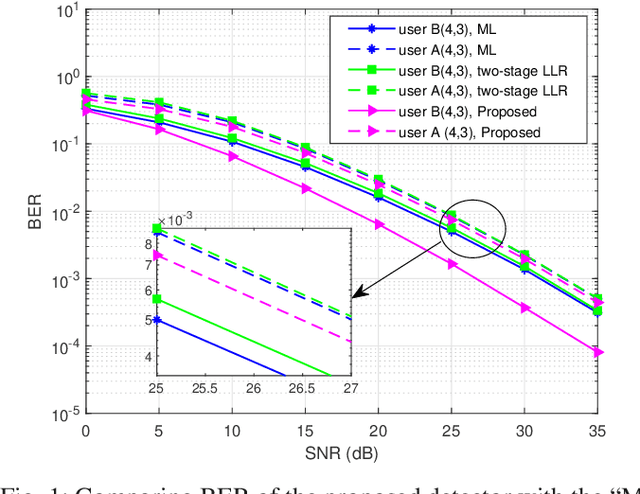
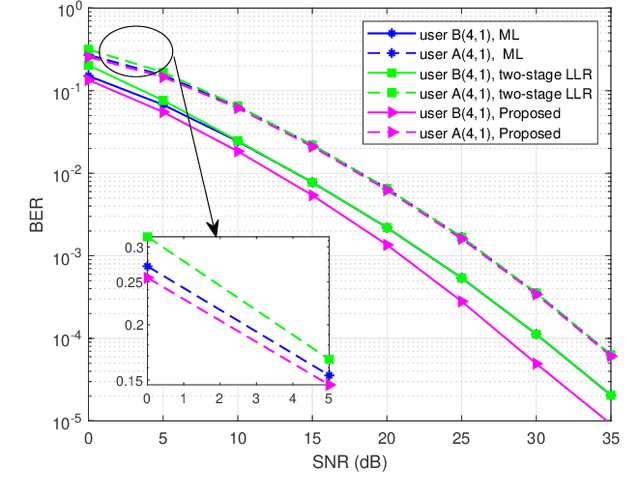
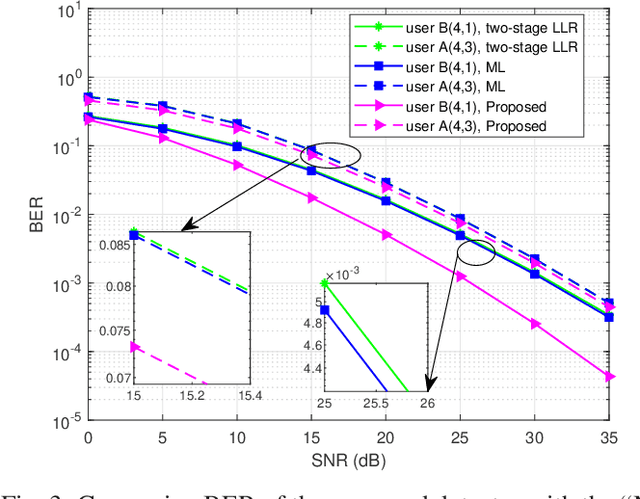
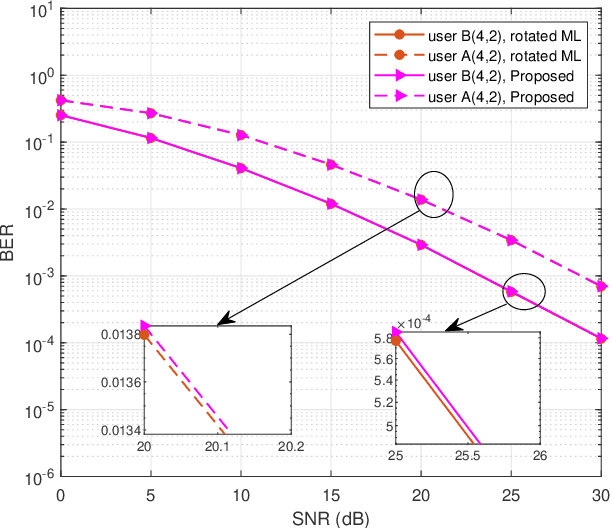
OFDM-IM NOMA is a newly created flexible scheme for future generation communication systems. For the downlink OFDM-IM NOMA system, a low-complexity "rotated constellation based log likelihood ratio (LLR) detector" has been proposed in this work. This detector is able to significantly reduce the complexity by employing the rotating constellation-based concept and the log-likelihood ratio-based algorithm together. Complexity analysis and simulation results show that the proposed detector achieves significantly lower computational complexity and much better error performance than the earlier introduced detectors under different scenarios for the OFDM-IM NOMA scheme.