 Add to Chrome
 Add to Firefox
 Add to Edge
Exploiting RIS Optimization Limits for Multi-User Beamforming and Signal Suppression
Jun 16, 2026
This paper presents a unified framework for exploiting the boundaries of reconfigurable intelligent surfaces (RIS) joint optimization in multi-user wireless systems, where a single RIS accommodates diverse objectives.We first propose an adaptive gradient-scaling mechanism that accelerates the convergence of the underlying optimization algorithm while maintaining stable performance across varying channel and system parameters. The proposed mechanism enables the solver to reach a reasonably good solution rapidly without requiring manual tuning of step sizes or algorithmic hyperparameters when system inputs change. We then propose a low-complexity beamformer recovery method tailored for single-user scenarios, which circumvents the full matrix decomposition required by traditional approaches, thereby significantly reducing computational overhead. Building on these foundations, we develop an element allocation strategy that enables user-specific prioritization through assignment of RIS subsets. This is further extended by a modular add-drop mechanism that supports partial-panel optimization in general multi-user settings. The framework is evaluated across three representative scenarios: (i) signal amplification for all users, (ii) signal suppression for all users, and (iii) selective amplification and suppression. To characterize performance limits, we derive power trade-off boundaries using scalarized joint optimization, which closely align with Monte Carlo simulations. Our unified joint optimization method consistently yield solutions near these boundaries, confirming its near-optimality. Extensive simulations under realistic channel models demonstrate that the proposed approach outperforms conventional semidefinite relaxation techniques, offering a scalable and effective RIS control strategy for cooperative and competitive multi-user environments.

Passive Mechanical Vibration Processor for Wireless Vibration Sensing
May 18, 2023
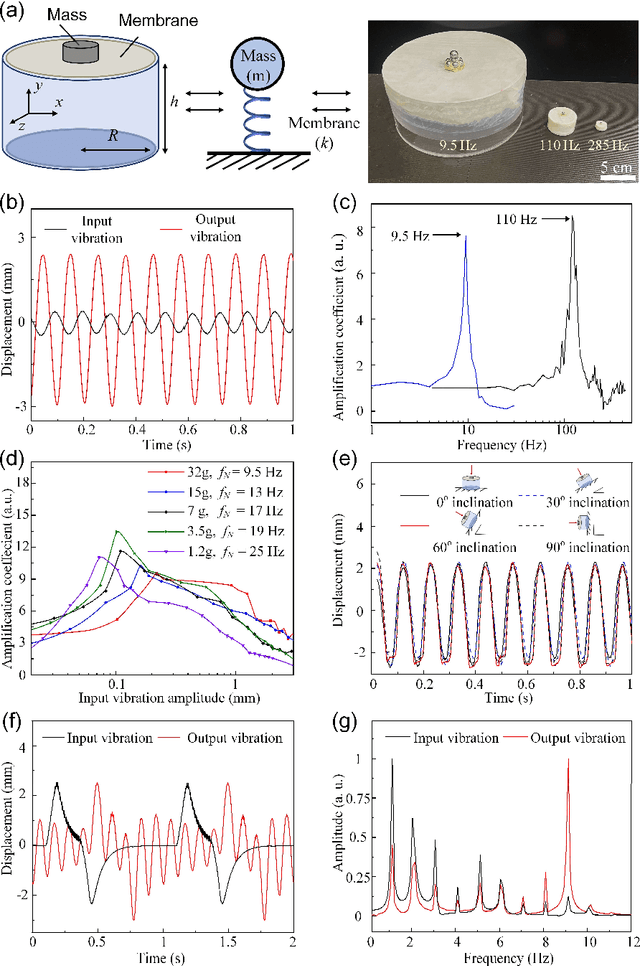
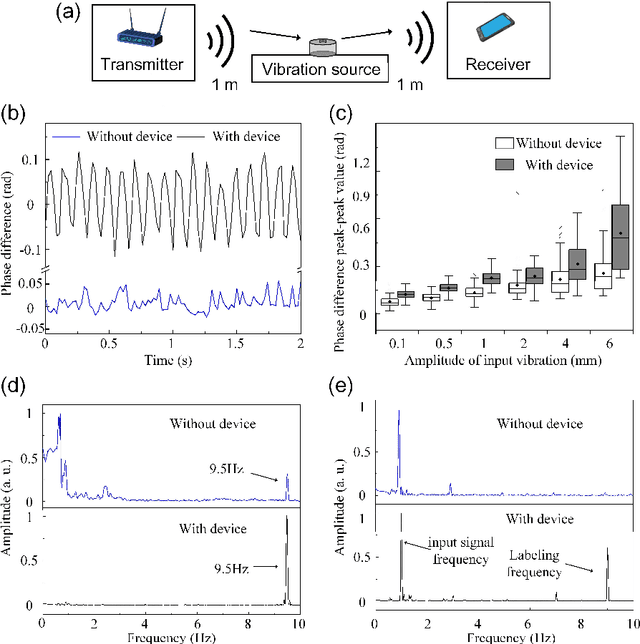
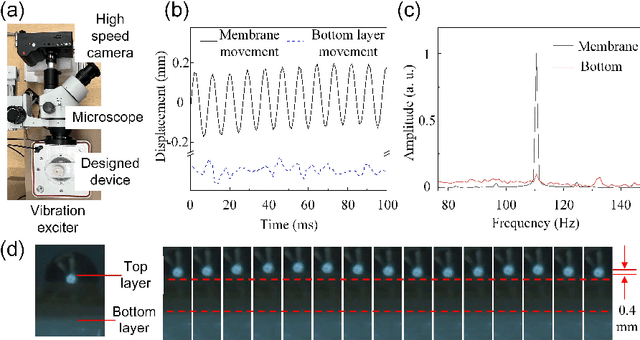
Real-time, low-cost, and wireless mechanical vibration monitoring is necessary for industrial applications to track the operation status of equipment, environmental applications to proactively predict natural disasters, as well as day-to-day applications such as vital sign monitoring. Despite this urgent need, existing solutions, such as laser vibrometers, commercial Wi-Fi devices, and cameras, lack wide practical deployment due to their limited sensitivity and functionality. In this work, we propose and verify that a fully passive, resonance-based vibration processing device attached to the vibrating surface can improve the sensitivity of wireless vibration measurement methods by more than 10 times at designated frequencies. Additionally, the device realizes an analog real-time vibration filtering/labeling effect, and the device also provides a platform for surface editing, which adds more functionalities to the current non-contact sensing systems. Finally, the working frequency of the device is widely adjustable over orders of magnitudes, broadening its applicability to different applications.