 Add to Chrome
 Add to Firefox
 Add to Edge
EuraGovExam: A Multilingual Multimodal Benchmark from Real-World Civil Service Exams
Mar 28, 2026
We present EuraGovExam, a multilingual and multimodal benchmark sourced from real-world civil service examinations across five representative Eurasian regions: South Korea, Japan, Taiwan, India, and the European Union. Designed to reflect the authentic complexity of public-sector assessments, the dataset contains over 8,000 high-resolution scanned multiple-choice questions covering 17 diverse academic and administrative domains. Unlike existing benchmarks, EuraGovExam embeds all question content--including problem statements, answer choices, and visual elements--within a single image, providing only a minimal standardized instruction for answer formatting. This design demands that models perform layout-aware, cross-lingual reasoning directly from visual input. All items are drawn from real exam documents, preserving rich visual structures such as tables, multilingual typography, and form-like layouts. Evaluation results show that even state-of-the-art vision-language models (VLMs) achieve only 86% accuracy, underscoring the benchmark's difficulty and its power to diagnose the limitations of current models. By emphasizing cultural realism, visual complexity, and linguistic diversity, EuraGovExam establishes a new standard for evaluating VLMs in high-stakes, multilingual, image-grounded settings. It also supports practical applications in e-governance, public-sector document analysis, and equitable exam preparation.

Transparent Networks for Multivariate Time Series
Oct 14, 2024Transparent models, which are machine learning models that produce inherently interpretable predictions, are receiving significant attention in high-stakes domains. However, despite much real-world data being collected as time series, there is a lack of studies on transparent time series models. To address this gap, we propose a novel transparent neural network model for time series called Generalized Additive Time Series Model (GATSM). GATSM consists of two parts: 1) independent feature networks to learn feature representations, and 2) a transparent temporal module to learn temporal patterns across different time steps using the feature representations. This structure allows GATSM to effectively capture temporal patterns and handle dynamic-length time series while preserving transparency. Empirical experiments show that GATSM significantly outperforms existing generalized additive models and achieves comparable performance to black-box time series models, such as recurrent neural networks and Transformer. In addition, we demonstrate that GATSM finds interesting patterns in time series. The source code is available at https://github.com/gim4855744/GATSM.
Diffusion-C: Unveiling the Generative Challenges of Diffusion Models through Corrupted Data
Dec 14, 2023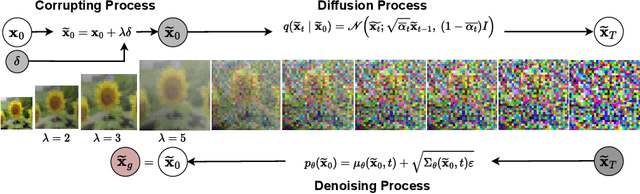
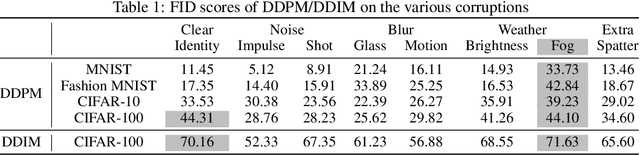

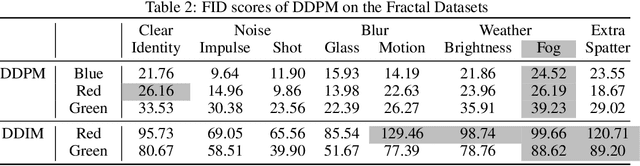
In our contemporary academic inquiry, we present "Diffusion-C," a foundational methodology to analyze the generative restrictions of Diffusion Models, particularly those akin to GANs, DDPM, and DDIM. By employing input visual data that has been subjected to a myriad of corruption modalities and intensities, we elucidate the performance characteristics of those Diffusion Models. The noise component takes center stage in our analysis, hypothesized to be a pivotal element influencing the mechanics of deep learning systems. In our rigorous expedition utilizing Diffusion-C, we have discerned the following critical observations: (I) Within the milieu of generative models under the Diffusion taxonomy, DDPM emerges as a paragon, consistently exhibiting superior performance metrics. (II) Within the vast spectrum of corruption frameworks, the fog and fractal corruptions notably undermine the functional robustness of both DDPM and DDIM. (III) The vulnerability of Diffusion Models to these particular corruptions is significantly influenced by topological and statistical similarities, particularly concerning the alignment between mean and variance. This scholarly work highlights Diffusion-C's core understandings regarding the impacts of various corruptions, setting the stage for future research endeavors in the realm of generative models.