 Add to Chrome
 Add to Firefox
 Add to Edge
LLM-based Visual Code Completion for Aerospace Geometric Design
Jun 15, 2026
Recent advances in both Large Language Models (LLMs) and Vision Language Models (VLMs) have seen a step change in their ability to perform visual code completion, but the aerospace industry, which prioritizes safety and explainabilty over rapid LLM adoption, currently has no publicly announced LLM-based geometric design copilot systems in commercial use by aerospace Original Equipment Manufacturers (OEMs). This paper presents a LLM-based visual programming copilot application for aerospace engineering design tasks, using a visual programming variant of the ReAct methodology and GPT 5.4. In addition to the copilot, we describe Wingbuilder, a new Grasshopper plugin library with custom components for aerospace-specific geometry abstraction, and an associated Aerospace Visual Programming Dataset (AVPD) with 18 aerospace expert designed tasks at different levels of difficulty alongside ground truth solutions. We evaluate our copilot application with a user trial involving two experienced aerospace engineers from a large aircraft manufacturing company. We find our copilot visual programming ReAct methodology was successful in generating suggestions that participants found helpful, but slow ReAct inference times limit its usefulness to more complex time-consuming tasks where waiting for good copilot solution suggestion was worthwhile. Participants reported they liked the tool and would be willing to use it in the future.

Activation-Based Active Learning for In-Context Learning: Challenges and Insights
Jun 03, 2026Deep active learning has previously been explored for LLM in-context sample selection, but not with methods that utilise recent advances in understanding of transformer activations. In this paper, we test the hypothesis that model activations could provide a fine-grained signal to optimise the selection of in-context examples. We present the most comprehensive analysis to date of MLP activation-based deep active learning methods applied to in-context learning, including how different attention masking strategies impact active learning across diverse classification and generative datasets, using both Llama-3.2-3B and Qwen2.5-3B base models. However, we find a negative result: MLP outputs, viewed through the lenses of massive activations or the first four moments, do not correlate with example quality or task performance. Specifically, the absolute Spearman correlation coefficient is at most 0.33 for all tasks and models we tested, showing that such activation-based sampling should not be used for in-context learning. We hypothesise that this may be due to superposition, whereby models represent more features than they have dimensionality, suggesting that methods like Sparse Autoencoders (SAEs) may be a promising future direction.
Hybrid Adversarial Defence for Natural Language Understanding Tasks
Jun 03, 2026Large Language Models (LLMs) are vulnerable both to hallucination and adversarial manipulation. Although these problems are closely related, existing defences typically address them separately. We investigate a hybrid defence framework that combines entropy-based models, designed to reduce hallucinations, with uncertainty-based models and geometric-based models, designed to reduce vulnerability. Under in-domain tests on Natural Language Understanding datasets (FEVER, HotpotQA, CSQA, SIQA) we find our hybrid model improves both clean-task performance (up to 43.34\% increase in accuracy) and adversarial robustness (up to 64.92\% improvement in accuracy and 62.27\% reduction in attack success rate). For out-of-distribution datasets (AeroEngQA, CPIQA) we see similar adversarial robustness from our hybrid model (up to 57.14\% improvement in accuracy). For prompt injection (SafeGuard) and jailbreak detection (AdvBench, DAN) datasets our hybrid model is also very strong (up to 51\% reduction in attack success rate compared to state of the art baseline models). Overall, our results show that combining entropy, uncertainty and geometric features provides a more effective defence strategy than using any single feature alone for both in-domain and out-of-distribution tasks.
Prompt position really matters in few-shot and zero-shot NLU tasks
May 23, 2023Prompt-based models have made remarkable advancements in the fields of zero-shot and few-shot learning, attracting a lot of attention from researchers. Developing an effective prompt template plays a critical role. However, prior studies have mainly focused on prompt vocabulary selection or embedding initialization with the reserved prompt position fixed. In this empirical study, we conduct the most comprehensive analysis to date of prompt position option for natural language understanding tasks. Our findings quantify the substantial impact prompt position has on model performance. We observe that the prompt position used in prior studies is often sub-optimal for both zero-shot and few-shot settings. These findings suggest prompt position optimisation as an interesting research direction alongside the existing focus on prompt engineering.
Combining Machine Learning and Human Experts to Predict Match Outcomes in Football: A Baseline Model
Dec 08, 2020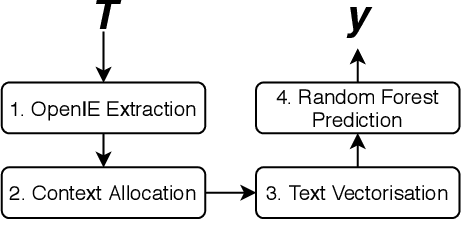
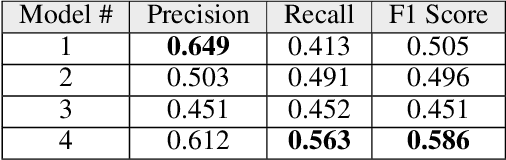
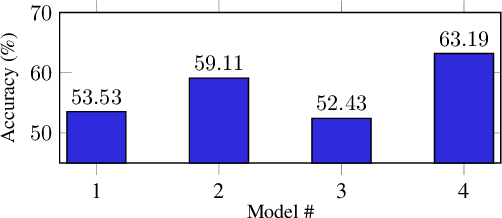
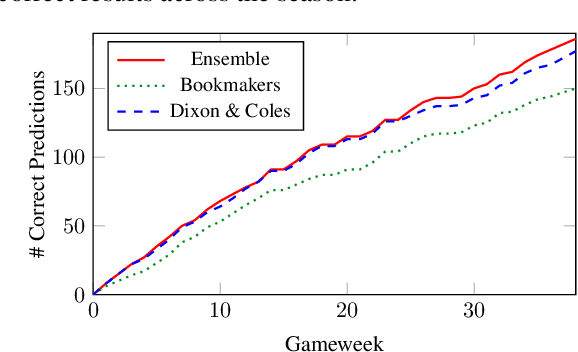
In this paper, we present a new application-focused benchmark dataset and results from a set of baseline Natural Language Processing and Machine Learning models for prediction of match outcomes for games of football (soccer). By doing so we give a baseline for the prediction accuracy that can be achieved exploiting both statistical match data and contextual articles from human sports journalists. Our dataset is focuses on a representative time-period over 6 seasons of the English Premier League, and includes newspaper match previews from The Guardian. The models presented in this paper achieve an accuracy of 63.18% showing a 6.9% boost on the traditional statistical methods.
Exploiting Synergy Between Ontologies and Recommender Systems
Apr 08, 2002Recommender systems learn about user preferences over time, automatically finding things of similar interest. This reduces the burden of creating explicit queries. Recommender systems do, however, suffer from cold-start problems where no initial information is available early on upon which to base recommendations. Semantic knowledge structures, such as ontologies, can provide valuable domain knowledge and user information. However, acquiring such knowledge and keeping it up to date is not a trivial task and user interests are particularly difficult to acquire and maintain. This paper investigates the synergy between a web-based research paper recommender system and an ontology containing information automatically extracted from departmental databases available on the web. The ontology is used to address the recommender systems cold-start problem. The recommender system addresses the ontology's interest-acquisition problem. An empirical evaluation of this approach is conducted and the performance of the integrated systems measured.
Interface agents: A review of the field
Mar 09, 2002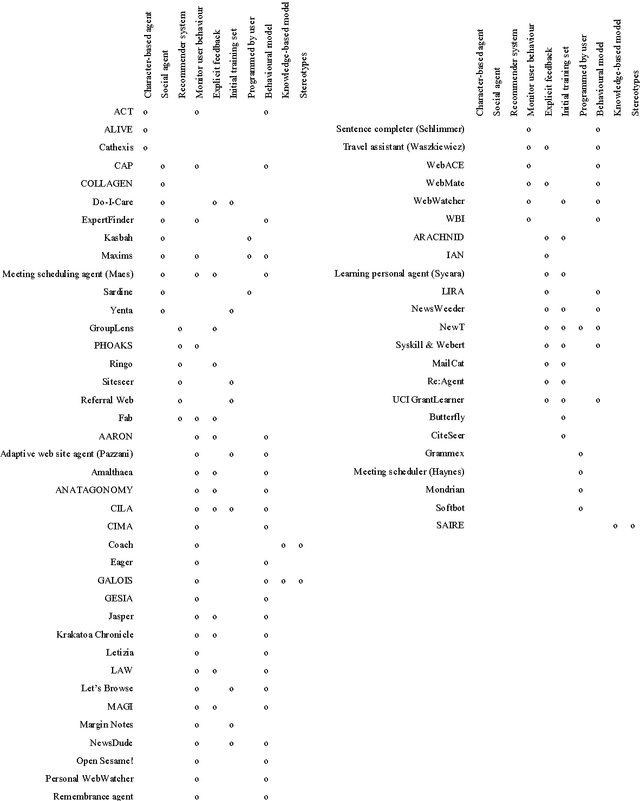
This paper reviews the origins of interface agents, discusses challenges that exist within the interface agent field and presents a survey of current attempts to find solutions to these challenges. A history of agent systems from their birth in the 1960's to the current day is described, along with the issues they try to address. A taxonomy of interface agent systems is presented, and today's agent systems categorized accordingly. Lastly, an analysis of the machine learning and user modelling techniques used by today's agents is presented.