 Add to Chrome
 Add to Firefox
 Add to Edge
LakeQuest: A Three-Domain Benchmark for Grounded Question Answering across Data Lakes
Jul 14, 2026
While modern question answering (QA) systems excel on clean, schema-aligned corpora, real-world knowledge is rarely so neatly packaged. Answering questions over enterprise and scientific data lakes requires systems to navigate heterogeneous, weakly structured collections of tables, passages, and linked metadata. Current benchmarks abstract away this noisy discovery process, failing to evaluate end-to-end performance. To bridge this gap, we introduce LakeQuest, a human-validated benchmark of 9,846 QA pairs designed to evaluate the end-to-end retrieve-and-synthesize pipeline over realistic data lakes. LakeQuest spans three diverse domains (AI/ML metadata, retail banking, and multimodal biomedical drug information) and pairs every question with exact, modality-aware evidence pointers. By isolating source discovery from cross-modal synthesis, LakeQuest exposes critical failure modes in modern QA systems. Our baseline evaluations, including standard Retrieval-Augmented Generation (RAG) and agentic tool-use methods, reveal that high-quality retrieval does not guarantee correct reasoning. Systems consistently struggle with relation chaining in metadata graphs, policy grounding in bank ledgers, and joint tabular QA in biomedical contexts, highlighting the need for robust discovery and faithful cross-file composition mechanisms in future agentic QA systems.

VRKitchen2.0-IndoorKit: A Tutorial for Augmented Indoor Scene Building in Omniverse
Jun 23, 2022
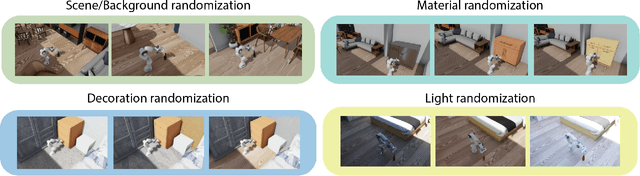
With the recent progress of simulations by 3D modeling software and game engines, many researchers have focused on Embodied AI tasks in the virtual environment. However, the research community lacks a platform that can easily serve both indoor scene synthesis and model benchmarking with various algorithms. Meanwhile, computer graphics-related tasks need a toolkit for implementing advanced synthesizing techniques. To facilitate the study of indoor scene building methods and their potential robotics applications, we introduce INDOORKIT: a built-in toolkit for NVIDIA OMNIVERSE that provides flexible pipelines for indoor scene building, scene randomizing, and animation controls. Besides, combining Python coding in the animation software INDOORKIT assists researchers in creating real-time training and controlling avatars and robotics. The source code for this toolkit is available at https://github.com/realvcla/VRKitchen2.0-Tutorial, and the tutorial along with the toolkit is available at https://vrkitchen20-tutorial.readthedocs.io/en/