 Add to Chrome
 Add to Firefox
 Add to Edge
Intensional Anaphora
Aug 12, 2026
Intensional operators are often treated as quantifiers over possible worlds, parallel to the treatment of determiners as quantifiers over individuals. Yet individuals introduced in intensional contexts cannot serve as antecedents to later pronouns as easily as those introduced in merely quantificational contexts. For instance, "Everyone is eating a cheeseburger" may be followed by "They are large", where "they" refers to the cheeseburgers being eaten. However, as Stone (1999) points out, the similar "Andrea might be eating a cheeseburger" does not support later anaphoric references such as "It is large" or "They are large". Stone (1999), Stone and Hardt (1999), and Brasoveanu (2010) address this by requiring a pronoun's value (its referents) to exist in the world of evaluation, ruling out anaphora from non-veridical intensional contexts. We show, however, both cases where such anaphora is disallowed even when the pronoun's referents clearly exist and cases where it is allowed even though they might not exist. We argue that intensional anaphora is best captured using a description-based rather than value-based account. A pronoun presupposes that its corresponding antecedent description is instantiated in each world of the context set. Thus, there must be a cheeseburger being eaten by Andrea in every candidate world for "It is large" to be felicitous after "Andrea might be eating a cheeseburger". We implement our proposal via a new logic, building on Keshet (2018) and Abney and Keshet (2022), called Plural Intensional Presuppositional predicate calculus (PIP). Each PIP formula translates directly into standard first-order predicate calculus with set abstraction, providing a classical foundation for this work.
* 49 pages. Published in Semantics and Pragmatics

A Summary of the First Workshop on Language Technology for Language Documentation and Revitalization
Apr 27, 2020
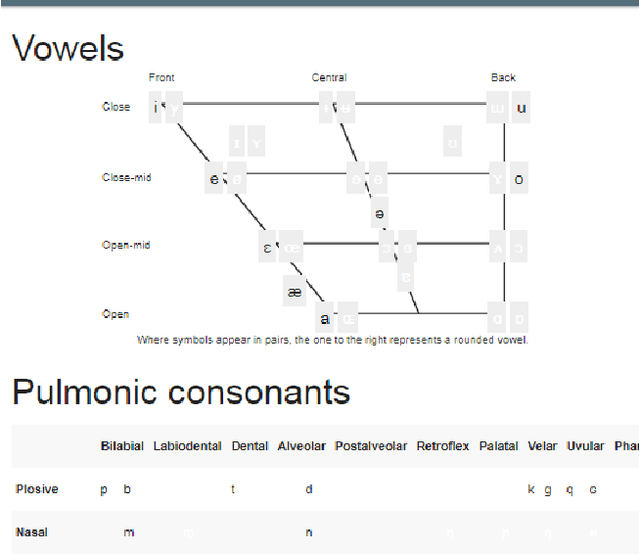
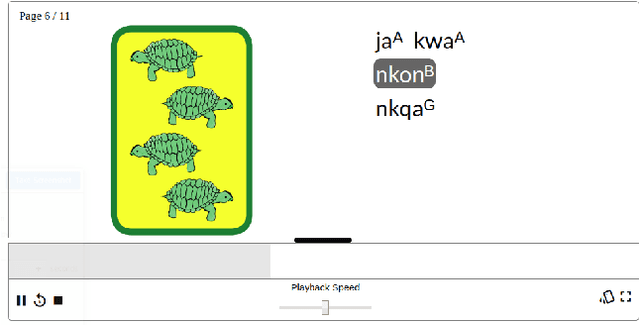
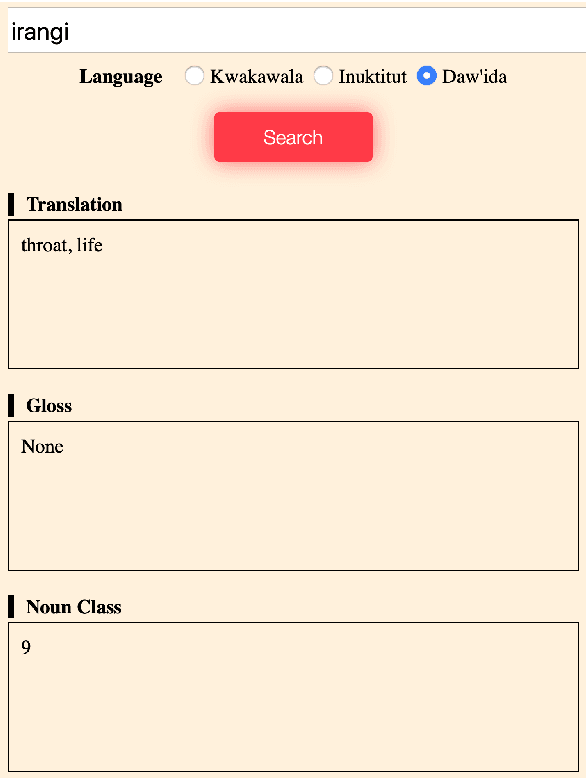
Despite recent advances in natural language processing and other language technology, the application of such technology to language documentation and conservation has been limited. In August 2019, a workshop was held at Carnegie Mellon University in Pittsburgh to attempt to bring together language community members, documentary linguists, and technologists to discuss how to bridge this gap and create prototypes of novel and practical language revitalization technologies. This paper reports the results of this workshop, including issues discussed, and various conceived and implemented technologies for nine languages: Arapaho, Cayuga, Inuktitut, Irish Gaelic, Kidaw'ida, Kwak'wala, Ojibwe, San Juan Quiahije Chatino, and Seneca.
Stochastic Attribute-Value Grammars
Oct 23, 1996
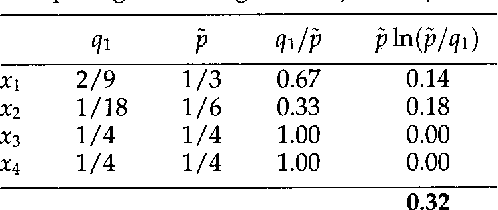
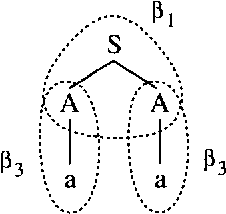
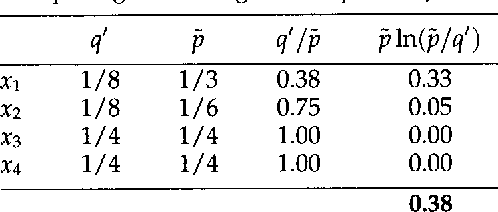
Probabilistic analogues of regular and context-free grammars are well-known in computational linguistics, and currently the subject of intensive research. To date, however, no satisfactory probabilistic analogue of attribute-value grammars has been proposed: previous attempts have failed to define a correct parameter-estimation algorithm. In the present paper, I define stochastic attribute-value grammars and give a correct algorithm for estimating their parameters. The estimation algorithm is adapted from Della Pietra, Della Pietra, and Lafferty (1995). To estimate model parameters, it is necessary to compute the expectations of certain functions under random fields. In the application discussed by Della Pietra, Della Pietra, and Lafferty (representing English orthographic constraints), Gibbs sampling can be used to estimate the needed expectations. The fact that attribute-value grammars generate constrained languages makes Gibbs sampling inapplicable, but I show how a variant of Gibbs sampling, the Metropolis-Hastings algorithm, can be used instead.