 Add to Chrome
 Add to Firefox
 Add to Edge
VASA-3D: Lifelike Audio-Driven Gaussian Head Avatars from a Single Image
Dec 16, 2025
We propose VASA-3D, an audio-driven, single-shot 3D head avatar generator. This research tackles two major challenges: capturing the subtle expression details present in real human faces, and reconstructing an intricate 3D head avatar from a single portrait image. To accurately model expression details, VASA-3D leverages the motion latent of VASA-1, a method that yields exceptional realism and vividness in 2D talking heads. A critical element of our work is translating this motion latent to 3D, which is accomplished by devising a 3D head model that is conditioned on the motion latent. Customization of this model to a single image is achieved through an optimization framework that employs numerous video frames of the reference head synthesized from the input image. The optimization takes various training losses robust to artifacts and limited pose coverage in the generated training data. Our experiment shows that VASA-3D produces realistic 3D talking heads that cannot be achieved by prior art, and it supports the online generation of 512x512 free-viewpoint videos at up to 75 FPS, facilitating more immersive engagements with lifelike 3D avatars.

Deformable Kernels: Adapting Effective Receptive Fields for Object Deformation
Oct 07, 2019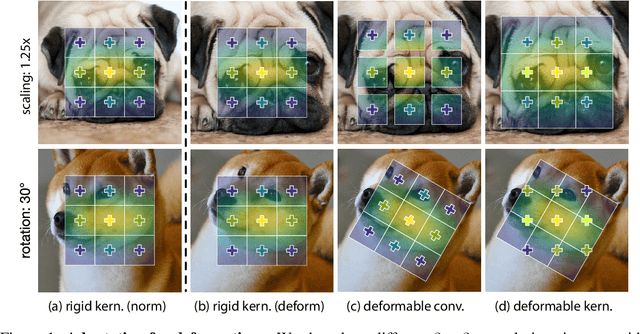
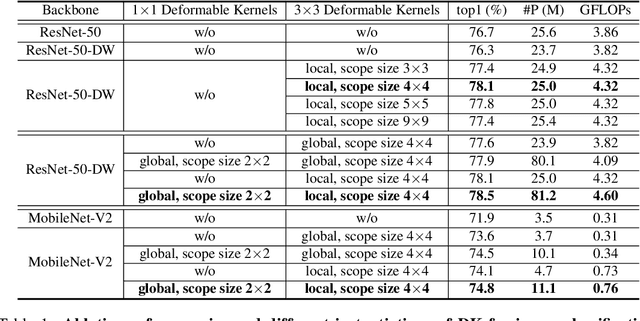
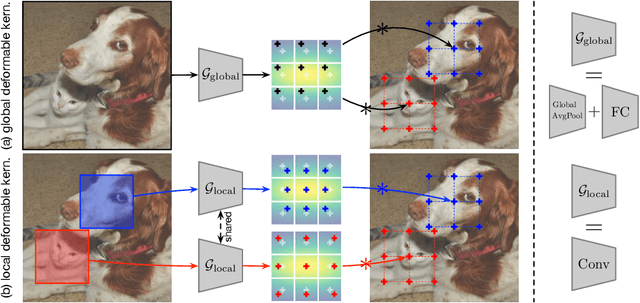
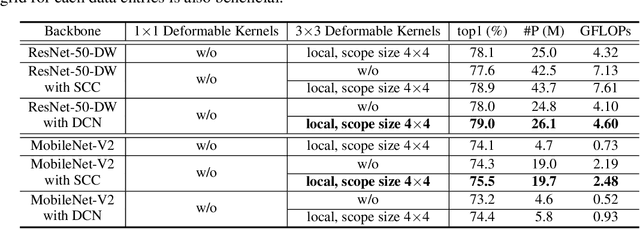
Convolutional networks are not aware of an object's geometric variations, which leads to inefficient utilization of model and data capacity. To overcome this issue, recent works on deformation modeling seek to spatially reconfigure the data towards a common arrangement such that semantic recognition suffers less from deformation. This is typically done by augmenting static operators with learned free-form sampling grids in the image space, dynamically tuned to the data and task for adapting the receptive field. Yet adapting the receptive field does not quite reach the actual goal -- what really matters to the network is the "effective" receptive field (ERF), which reflects how much each pixel contributes. It is thus natural to design other approaches to adapt the ERF directly during runtime. In this work, we instantiate one possible solution as Deformable Kernels (DKs), a family of novel and generic convolutional operators for handling object deformations by directly adapting the ERF while leaving the receptive field untouched. At the heart of our method is the ability to resample the original kernel space towards recovering the deformation of objects. This approach is justified with theoretical insights that the ERF is strictly determined by data sampling locations and kernel values. We implement DKs as generic drop-in replacements of rigid kernels and conduct a series of empirical studies whose results conform with our theories. Over several tasks and standard base models, our approach compares favorably against prior works that adapt during runtime. In addition, further experiments suggest a working mechanism orthogonal and complementary to previous works.