 Add to Chrome
 Add to Firefox
 Add to Edge
A Super-Learner with Large Language Models for Medical Emergency Advising
Nov 15, 2025
Medical decision-support and advising systems are critical for emergency physicians to quickly and accurately assess patients' conditions and make diagnosis. Artificial Intelligence (AI) has emerged as a transformative force in healthcare in recent years and Large Language Models (LLMs) have been employed in various fields of medical decision-support systems. We studied responses of a group of different LLMs to real cases in emergency medicine. The results of our study on five most renown LLMs showed significant differences in capabilities of Large Language Models for diagnostics acute diseases in medical emergencies with accuracy ranging between 58% and 65%. This accuracy significantly exceeds the reported accuracy of human doctors. We built a super-learner MEDAS (Medical Emergency Diagnostic Advising System) of five major LLMs - Gemini, Llama, Grok, GPT, and Claude). The super-learner produces higher diagnostic accuracy, 70%, even with a quite basic meta-learner. However, at least one of the integrated LLMs in the same super-learner produces 85% correct diagnoses. The super-learner integrates a cluster of LLMs using a meta-learner capable of learning different capabilities of each LLM to leverage diagnostic accuracy of the model by collective capabilities of all LLMs in the cluster. The results of our study showed that aggregated diagnostic accuracy provided by a meta-learning approach exceeds that of any individual LLM, suggesting that the super-learner can take advantage of the combined knowledge of the medical datasets used to train the group of LLMs.

Weak Labeling for Cropland Mapping in Africa
Jan 13, 2024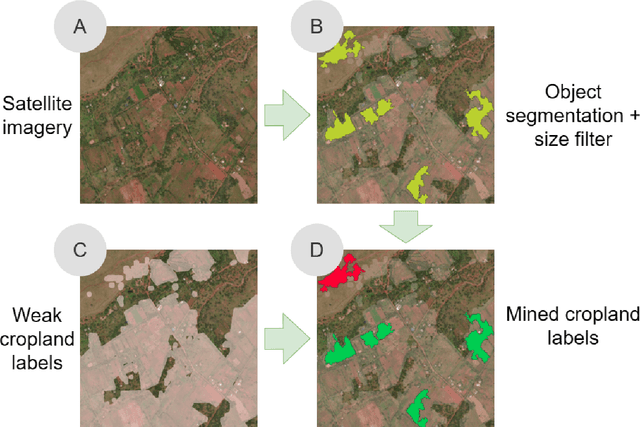
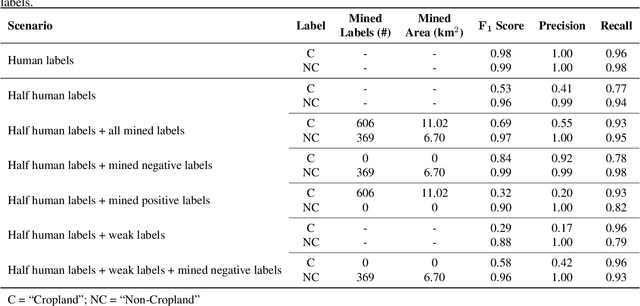
Cropland mapping can play a vital role in addressing environmental, agricultural, and food security challenges. However, in the context of Africa, practical applications are often hindered by the limited availability of high-resolution cropland maps. Such maps typically require extensive human labeling, thereby creating a scalability bottleneck. To address this, we propose an approach that utilizes unsupervised object clustering to refine existing weak labels, such as those obtained from global cropland maps. The refined labels, in conjunction with sparse human annotations, serve as training data for a semantic segmentation network designed to identify cropland areas. We conduct experiments to demonstrate the benefits of the improved weak labels generated by our method. In a scenario where we train our model with only 33 human-annotated labels, the F_1 score for the cropland category increases from 0.53 to 0.84 when we add the mined negative labels.