 Add to Chrome
 Add to Firefox
 Add to Edge
Arbitrary Ratio Feature Compression via Next Token Prediction
Feb 12, 2026
Feature compression is increasingly important for improving the efficiency of downstream tasks, especially in applications involving large-scale or multi-modal data. While existing methods typically rely on dedicated models for achieving specific compression ratios, they are often limited in flexibility and generalization. In particular, retraining is necessary when adapting to a new compression ratio. To address this limitation, we propose a novel and flexible Arbitrary Ratio Feature Compression (ARFC) framework, which supports any compression ratio with a single model, eliminating the need for multiple specialized models. At its core, the Arbitrary Ratio Compressor (ARC) is an auto-regressive model that performs compression via next-token prediction. This allows the compression ratio to be controlled at inference simply by adjusting the number of generated tokens. To enhance the quality of the compressed features, two key modules are introduced. The Mixture of Solutions (MoS) module refines the compressed tokens by utilizing multiple compression results (solutions), reducing uncertainty and improving robustness. The Entity Relation Graph Constraint (ERGC) is integrated into the training process to preserve semantic and structural relationships during compression. Extensive experiments on cross-modal retrieval, image classification, and image retrieval tasks across multiple datasets demonstrate that our method consistently outperforms existing approaches at various compression ratios. Notably, in some cases, it even surpasses the performance of the original, uncompressed features. These results validate the effectiveness and versatility of ARFC for practical, resource-constrained scenarios.

Temporal Correlation Meets Embedding: Towards a 2nd Generation of JDE-based Real-Time Multi-Object Tracking
Jul 19, 2024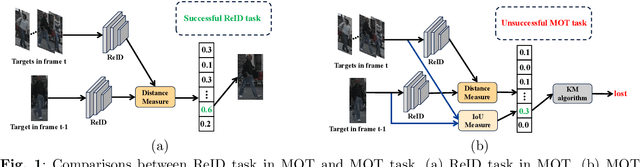
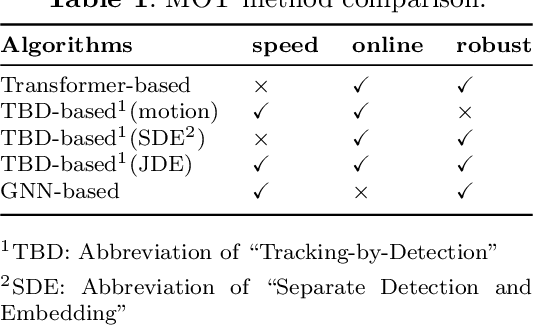
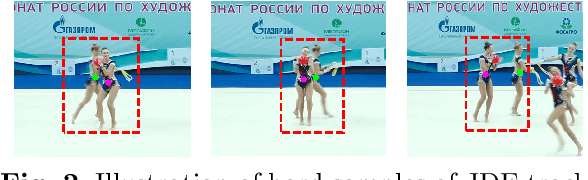
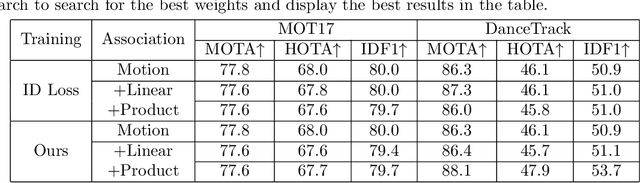
Joint Detection and Embedding(JDE) trackers have demonstrated excellent performance in Multi-Object Tracking(MOT) tasks by incorporating the extraction of appearance features as auxiliary tasks through embedding Re-Identification task(ReID) into the detector, achieving a balance between inference speed and tracking performance. However, solving the competition between the detector and the feature extractor has always been a challenge. Also, the issue of directly embedding the ReID task into MOT has remained unresolved. The lack of high discriminability in appearance features results in their limited utility. In this paper, we propose a new learning approach using cross-correlation to capture temporal information of objects. The feature extraction network is no longer trained solely on appearance features from each frame but learns richer motion features by utilizing feature heatmaps from consecutive frames, addressing the challenge of inter-class feature similarity. Furthermore, we apply our learning approach to a more lightweight feature extraction network, and treat the feature matching scores as strong cues rather than auxiliary cues, employing a appropriate weight calculation to reflect the compatibility between our obtained features and the MOT task. Our tracker, named TCBTrack, achieves state-of-the-art performance on multiple public benchmarks, i.e., MOT17, MOT20, and DanceTrack datasets. Specifically, on the DanceTrack test set, we achieve 56.8 HOTA, 58.1 IDF1 and 92.5 MOTA, making it the best online tracker that can achieve real-time performance. Comparative evaluations with other trackers prove that our tracker achieves the best balance between speed, robustness and accuracy.