 Add to Chrome
 Add to Firefox
 Add to Edge
From RAN Control to Agentic Intelligence: Architecture and Vision for Energy Efficient AI-RAN
Jun 20, 2026
Future 6G networks will rely on highly distributed, AI-native Radio Access Networks (RANs), where communication and AI workloads share a common infrastructure. This evolution, combined with increasing deployment density and continuous AI processing, is expected to significantly increase RAN energy consumption. While Open RAN (O-RAN) introduces a programmable and modular control framework through the RAN Intelligent Controller (RIC) and Service Management and Orchestration (SMO), current approaches remain largely policy-driven, limiting adaptive energy-aware coordination across multiple applications. In parallel, AI-RAN promotes the convergence of AI and RAN infrastructures through AI-for-RAN, AI-on-RAN, and AI-and-RAN paradigms, yet efficient mechanisms to jointly orchestrate performance, latency, and energy remain an open challenge. This article proposes an agentic AI-native RAN architecture that bridges O-RAN's structured control with AI-RAN's unified vision. Leveraging semantic intent abstraction and Large Language Model (LLM)-driven coordination, the framework enables adaptive orchestration, conflict resolution, and energy-aware multi-objective optimization across heterogeneous workloads. Through representative AI-for-RAN and AI-on-RAN use cases, we show how such coordination can improve resource efficiency and reduce operational energy consumption, paving the way toward sustainable 6G networks.

The association problem in wireless networks: a Policy Gradient Reinforcement Learning approach
Jun 11, 2013
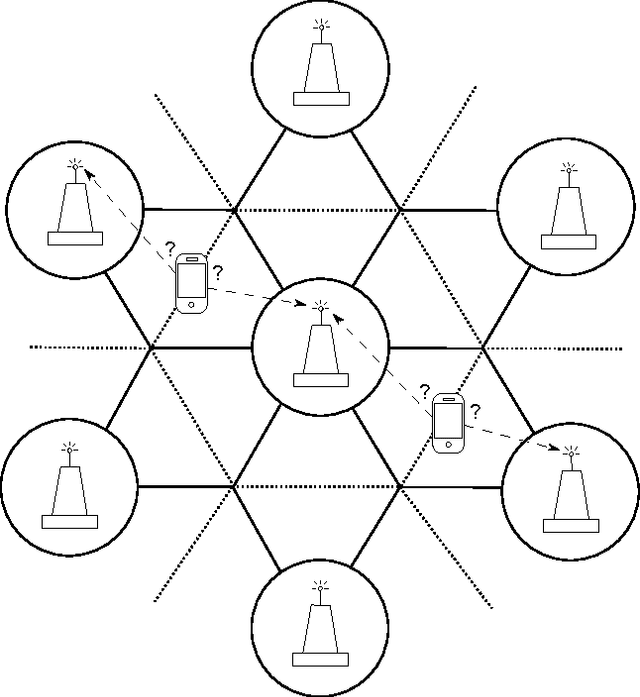
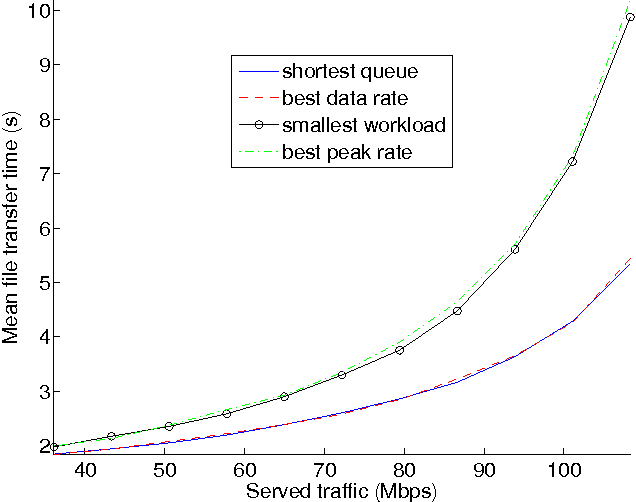
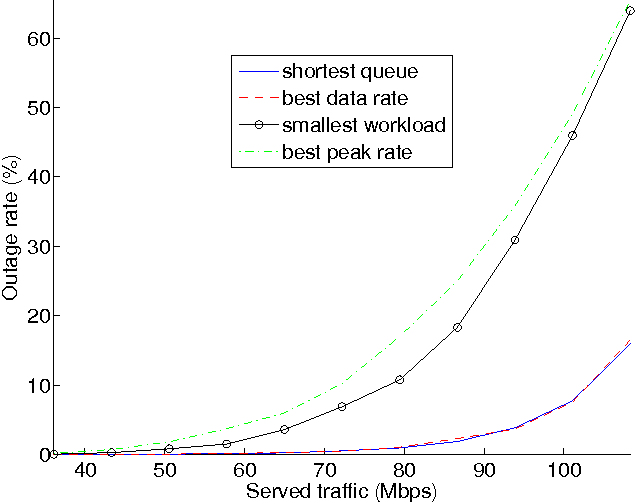
The purpose of this paper is to develop a self-optimized association algorithm based on PGRL (Policy Gradient Reinforcement Learning), which is both scalable, stable and robust. The term robust means that performance degradation in the learning phase should be forbidden or limited to predefined thresholds. The algorithm is model-free (as opposed to Value Iteration) and robust (as opposed to Q-Learning). The association problem is modeled as a Markov Decision Process (MDP). The policy space is parameterized. The parameterized family of policies is then used as expert knowledge for the PGRL. The PGRL converges towards a local optimum and the average cost decreases monotonically during the learning process. The properties of the solution make it a good candidate for practical implementation. Furthermore, the robustness property allows to use the PGRL algorithm in an "always-on" learning mode.