 Add to Chrome
 Add to Firefox
 Add to Edge
Measuring Progress Toward AGI: A Cognitive Framework
May 27, 2026
Despite widespread discussion of AGI, there is no clear framework for measuring progress toward it. This ambiguity fuels subjective claims, makes it difficult to track progress, and risks hindering responsible governance. As a starting point to address this gap, we present a framework for understanding system capabilities in relation to human cognitive abilities. Drawing from decades of research in psychology, neuroscience, and cognitive science, we introduce a Cognitive Taxonomy that deconstructs general intelligence into 10 key cognitive faculties. We then propose a rigorous evaluation protocol in which a system's performance is measured across a suite of targeted, held-out cognitive tasks, generating a 'cognitive profile' that can be used to understand a system's strengths and weaknesses. We hope this framework will provide a practical roadmap and an initial step toward more rigorous, empirical evaluation of AGI.

Open-Ended Learning Leads to Generally Capable Agents
Jul 31, 2021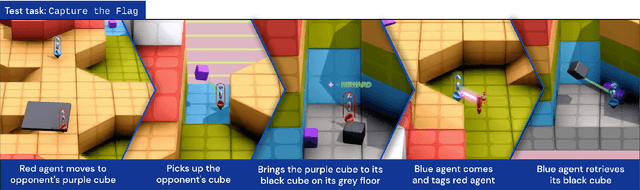
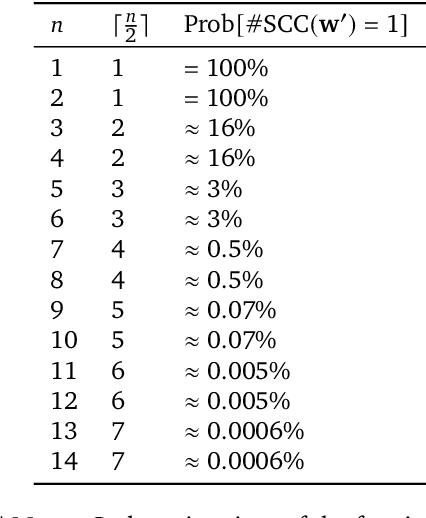
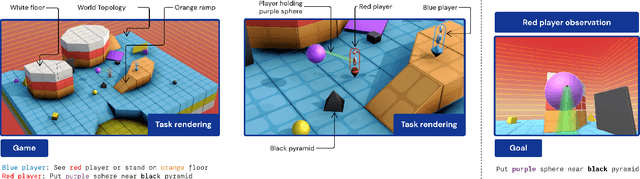
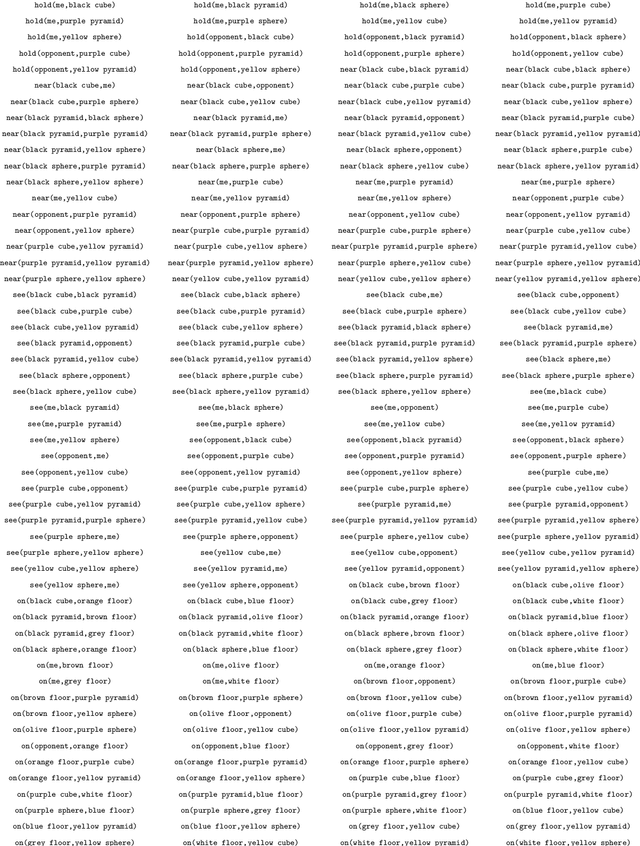
In this work we create agents that can perform well beyond a single, individual task, that exhibit much wider generalisation of behaviour to a massive, rich space of challenges. We define a universe of tasks within an environment domain and demonstrate the ability to train agents that are generally capable across this vast space and beyond. The environment is natively multi-agent, spanning the continuum of competitive, cooperative, and independent games, which are situated within procedurally generated physical 3D worlds. The resulting space is exceptionally diverse in terms of the challenges posed to agents, and as such, even measuring the learning progress of an agent is an open research problem. We propose an iterative notion of improvement between successive generations of agents, rather than seeking to maximise a singular objective, allowing us to quantify progress despite tasks being incomparable in terms of achievable rewards. We show that through constructing an open-ended learning process, which dynamically changes the training task distributions and training objectives such that the agent never stops learning, we achieve consistent learning of new behaviours. The resulting agent is able to score reward in every one of our humanly solvable evaluation levels, with behaviour generalising to many held-out points in the universe of tasks. Examples of this zero-shot generalisation include good performance on Hide and Seek, Capture the Flag, and Tag. Through analysis and hand-authored probe tasks we characterise the behaviour of our agent, and find interesting emergent heuristic behaviours such as trial-and-error experimentation, simple tool use, option switching, and cooperation. Finally, we demonstrate that the general capabilities of this agent could unlock larger scale transfer of behaviour through cheap finetuning.