 Add to Chrome
 Add to Firefox
 Add to Edge
Adaptive Gait Generation for Multi-Terrain Exoskeletons via Constrained Kernelized Movement Primitives
May 04, 2026
Lower limb exoskeletons (LLEs) present the potential to make motor-impaired individuals walk again. Their application in real-world environments is still limited by the lack of effective adaptive gait planning. Indeed, current exoskeletons are meant to walk only on a flat and even terrain. Generating environment-aware, physiologically consistent gait trajectories in real-time is an open challenge. To overcome this, we propose a novel Kernelized Movement Primitives (KMP)-based framework for adaptive gait generation (AGG) across multiple indoor terrains. The proposed approach learns a probabilistic representation of human gait in both the joint and task spaces from a limited number of human demonstrations, representing natural gait characteristics and ensuring kinematic feasibility. In addition, the learned trajectories are adapted using environmental information extracted from an onboard RGB-D camera by treating the AGG as a linearly constrained optimization problem with via-points. The proposed method has been thoroughly validated first in simulations for gait generation in different scenarios, such as flat-ground walking, slopes, stairs, and obstacles crossing. Finally, the effectiveness and robustness of the method have been demonstrated with experiments on a commercial LLE in real-world scenarios. The results obtained demonstrate the feasibility of an environment-aware gait planning system for a new generation of intelligent lower limb exoskeletons for assisting people with disabilities in their every-day life.

GEGLU-Transformer for IMU-to-EMG Estimation with Few-Shot Adaptation
Apr 28, 2026Reliable estimation of neuromuscular activation is a key enabler for adaptive and personalized control in wearable robotics. However, surface electromyography (EMG) remains difficult to deploy robustly outside laboratory settings due to electrode sensitivity, signal non-stationarity, and strong subject dependence. In this work, we propose an adaptive IMU-to-EMG learning framework that reconstructs continuous muscle activation envelopes from wearable inertial measurements across heterogeneous movement conditions. The approach combines a Transformer encoder with Gaussian Error Gated Linear Units (GEGLU-Transformer) to enhance cross-subject generalization and enable rapid subject-specific personalization. Under a strict leave-one-subject-out (LOSO) protocol on a multi-condition lower-limb biomechanics dataset, the proposed architecture achieves r = 0.706 +/- 0.139 and R^2 = 0.474 +/- 0.208 without subject-specific adaptation. With only 0.5% adaptation data, performance increases to r = 0.761 +/- 0.030 and R^2 = 0.559 +/- 0.047, demonstrating rapid adaptation and early performance saturation. These results support attention-based architectures combined with lightweight adaptation as a practical and scalable alternative to direct EMG sensing for real-world wearable robotic applications.
Fast human motion prediction for human-robot collaboration with wearable interfaces
May 28, 2019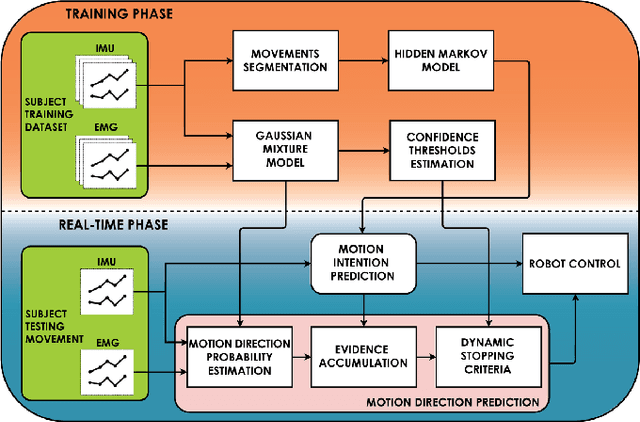
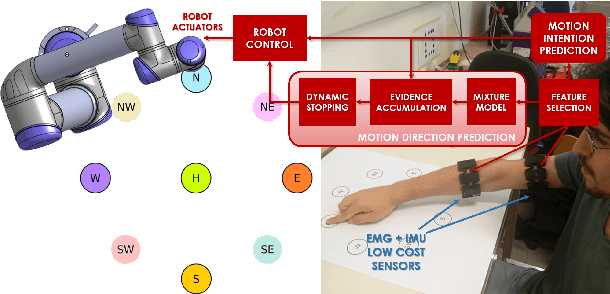
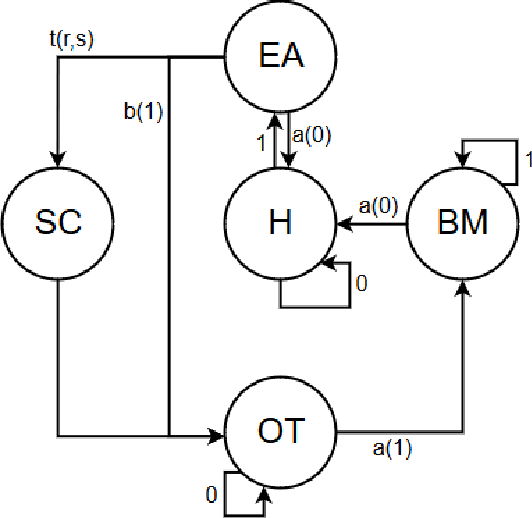
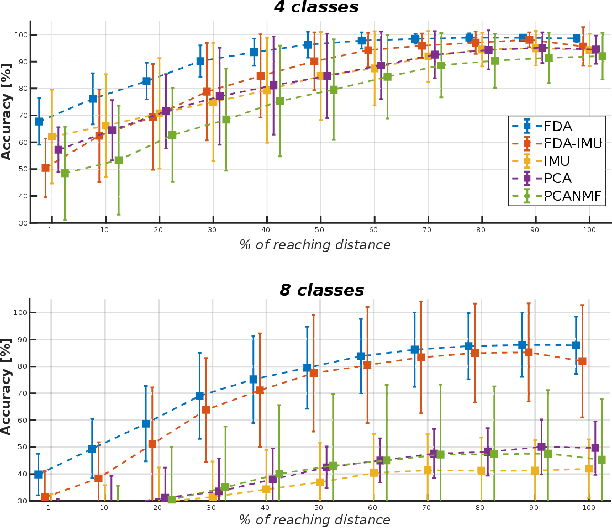
In this paper, we aim at improving human motion prediction during human-robot collaboration in industrial facilities by exploiting contributions from both physical and physiological signals. Improved human-machine collaboration could prove useful in several areas, while it is crucial for interacting robots to understand human movement as soon as possible to avoid accidents and injuries. In this perspective, we propose a novel human-robot interface capable to anticipate the user intention while performing reaching movements on a working bench in order to plan the action of a collaborative robot. The proposed interface can find many applications in the Industry 4.0 framework, where autonomous and collaborative robots will be an essential part of innovative facilities. A motion intention prediction and a motion direction prediction levels have been developed to improve detection speed and accuracy. A Gaussian Mixture Model (GMM) has been trained with IMU and EMG data following an evidence accumulation approach to predict reaching direction. Novel dynamic stopping criteria have been proposed to flexibly adjust the trade-off between early anticipation and accuracy according to the application. The output of the two predictors has been used as external inputs to a Finite State Machine (FSM) to control the behaviour of a physical robot according to user's action or inaction. Results show that our system outperforms previous methods, achieving a real-time classification accuracy of $94.3\pm2.9\%$ after $160.0msec\pm80.0msec$ from movement onset.