 Add to Chrome
 Add to Firefox
 Add to Edge
A Structured Benchmark for Text-Guided Anomaly Detection: When Language Stops Conditioning the Decision
Jun 01, 2026
Industrial anomaly detection has historically been a unimodal task. Recent multimodal vision-language models have produced systems that admit textual input alongside the image and are presented as enabling text-guided zero- and few-shot inspection. Yet these methods are evaluated with protocols inherited from unimodal benchmarks that hold the textual condition constant and therefore cannot measure whether language conditions the decision; whether reported gains reflect text guidance or strong pretrained visual features remains open. We introduce Text-Guided Anomaly Detection (TGAD), a structured benchmark that progressively increases the functional role of language across three scenarios: a controlled prompt-sensitivity setting on MVTec AD; a component-tagged extension of MVTec AD that requires the model to restrict its assessment to an instructed part; and the new Assembled Panel Dataset (APD), a realistic industrial setting that requires both defect-type and component-location knowledge. We evaluate one representative model per paradigm: generative large vision-language, training-free discriminative, and embedding-adaptive discriminative. In all three, the textual interface conditions the decision only superficially: prompt content is absorbed unless the object noun is removed (the generative model's I-AUROC drops from 97.4 to 82.6); component-level instructions do not constrain the decision once defects outside the instructed part are admitted as normal (from 90.3 to 66.3); and when both combine on APD, image-level discrimination collapses below the MVTec level, in one case below chance (71.2, 50.5, 31.5). These results suggest that standard benchmarks overstate the text-guided capabilities of current multimodal anomaly detection systems, and that a protocol of this kind is a prerequisite for models that can be reliably controlled through language for industrial deployment.

MARS: a Multimodal Alignment and Ranking System for Few-Shot Segmentation
Apr 10, 2025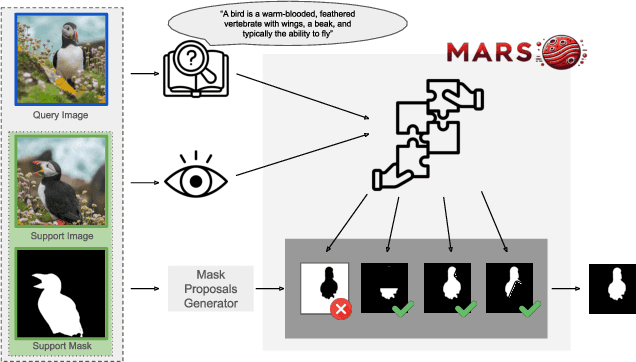
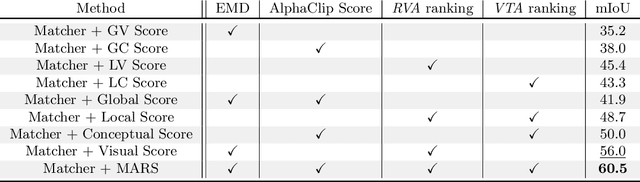
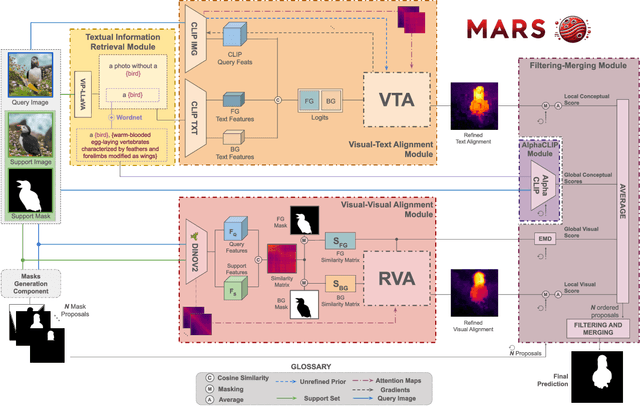

Current Few Shot Segmentation literature lacks a mask selection method that goes beyond visual similarity between the query and example images, leading to suboptimal predictions. We present MARS, a plug-and-play ranking system that leverages multimodal cues to filter and merge mask proposals robustly. Starting from a set of mask predictions for a single query image, we score, filter, and merge them to improve results. Proposals are evaluated using multimodal scores computed at local and global levels. Extensive experiments on COCO-20i, Pascal-5i, LVIS-92i, and FSS-1000 demonstrate that integrating all four scoring components is crucial for robust ranking, validating our contribution. As MARS can be effortlessly integrated with various mask proposal systems, we deploy it across a wide range of top-performer methods and achieve new state-of-the-art results on multiple existing benchmarks. Code will be available upon acceptance.
POPNASv2: An Efficient Multi-Objective Neural Architecture Search Technique
Oct 06, 2022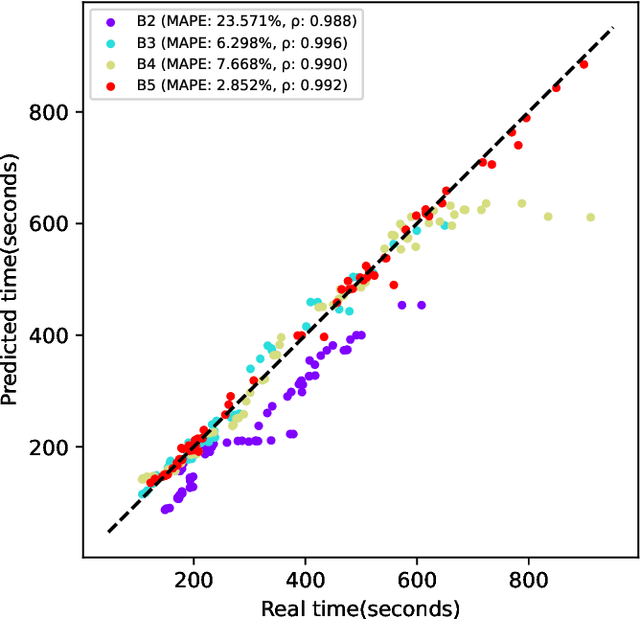
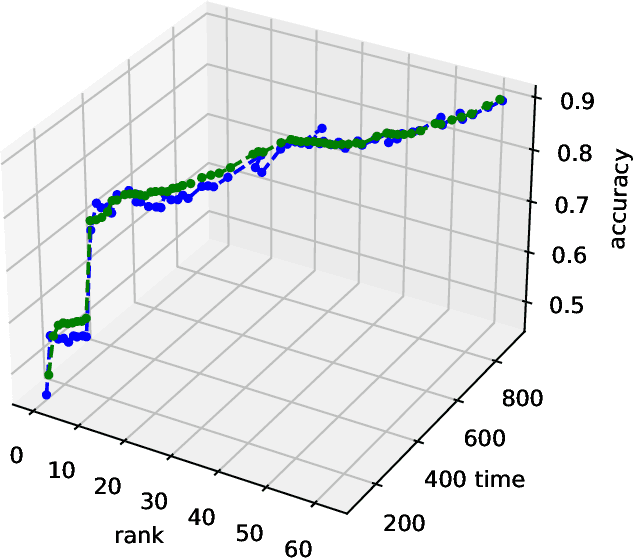
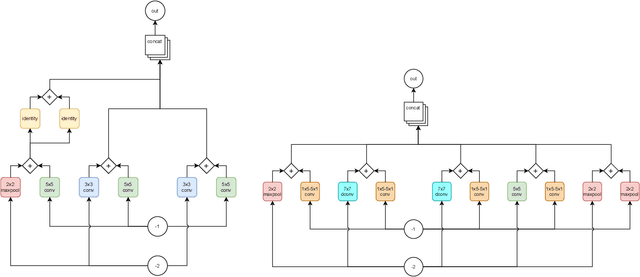
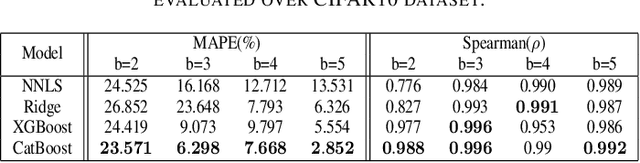
Automating the research for the best neural network model is a task that has gained more and more relevance in the last few years. In this context, Neural Architecture Search (NAS) represents the most effective technique whose results rival the state of the art hand-crafted architectures. However, this approach requires a lot of computational capabilities as well as research time, which makes prohibitive its usage in many real-world scenarios. With its sequential model-based optimization strategy, Progressive Neural Architecture Search (PNAS) represents a possible step forward to face this resources issue. Despite the quality of the found network architectures, this technique is still limited in research time. A significant step in this direction has been done by Pareto-Optimal Progressive Neural Architecture Search (POPNAS), which expands PNAS with a time predictor to enable a trade-off between search time and accuracy, considering a multi-objective optimization problem. This paper proposes a new version of the Pareto-Optimal Progressive Neural Architecture Search, called POPNASv2. Our approach enhances its first version and improves its performance. We expanded the search space by adding new operators and improved the quality of both predictors to build more accurate Pareto fronts. Moreover, we introduced cell equivalence checks and enriched the search strategy with an adaptive greedy exploration step. Our efforts allow POPNASv2 to achieve PNAS-like performance with an average 4x factor search time speed-up.
A Generative Federated Learning Framework for Differential Privacy
Sep 24, 2021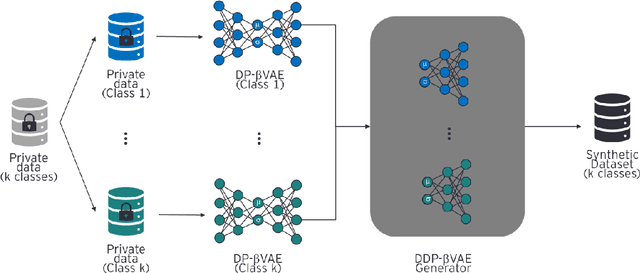
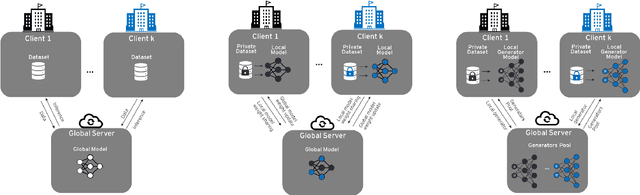
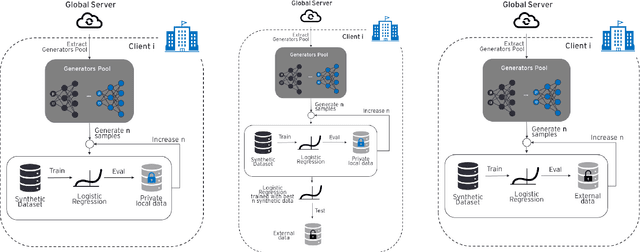
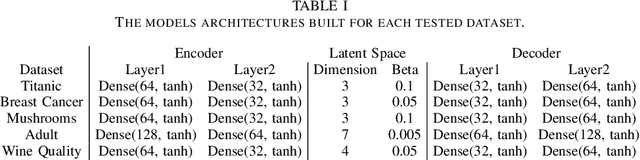
In machine learning, differential privacy and federated learning concepts are gaining more and more importance in an increasingly interconnected world. While the former refers to the sharing of private data characterized by strict security rules to protect individual privacy, the latter refers to distributed learning techniques in which a central server exchanges information with different clients for machine learning purposes. In recent years, many studies have shown the possibility of bypassing the privacy shields of these systems and exploiting the vulnerabilities of machine learning models, making them leak the information with which they have been trained. In this work, we present the 3DGL framework, an alternative to the current federated learning paradigms. Its goal is to share generative models with high levels of $\varepsilon$-differential privacy. In addition, we propose DDP-$\beta$VAE, a deep generative model capable of generating synthetic data with high levels of utility and safety for the individual. We evaluate the 3DGL framework based on DDP-$\beta$VAE, showing how the overall system is resilient to the principal attacks in federated learning and improves the performance of distributed learning algorithms.