 Add to Chrome
 Add to Firefox
 Add to Edge
Opportunities in AI/ML for the Rubin LSST Dark Energy Science Collaboration
Jan 20, 2026
The Vera C. Rubin Observatory's Legacy Survey of Space and Time (LSST) will produce unprecedented volumes of heterogeneous astronomical data (images, catalogs, and alerts) that challenge traditional analysis pipelines. The LSST Dark Energy Science Collaboration (DESC) aims to derive robust constraints on dark energy and dark matter from these data, requiring methods that are statistically powerful, scalable, and operationally reliable. Artificial intelligence and machine learning (AI/ML) are already embedded across DESC science workflows, from photometric redshifts and transient classification to weak lensing inference and cosmological simulations. Yet their utility for precision cosmology hinges on trustworthy uncertainty quantification, robustness to covariate shift and model misspecification, and reproducible integration within scientific pipelines. This white paper surveys the current landscape of AI/ML across DESC's primary cosmological probes and cross-cutting analyses, revealing that the same core methodologies and fundamental challenges recur across disparate science cases. Since progress on these cross-cutting challenges would benefit multiple probes simultaneously, we identify key methodological research priorities, including Bayesian inference at scale, physics-informed methods, validation frameworks, and active learning for discovery. With an eye on emerging techniques, we also explore the potential of the latest foundation model methodologies and LLM-driven agentic AI systems to reshape DESC workflows, provided their deployment is coupled with rigorous evaluation and governance. Finally, we discuss critical software, computing, data infrastructure, and human capital requirements for the successful deployment of these new methodologies, and consider associated risks and opportunities for broader coordination with external actors.

Accelerating lensed quasars discovery and modeling with physics-informed variational autoencoders
Dec 17, 2024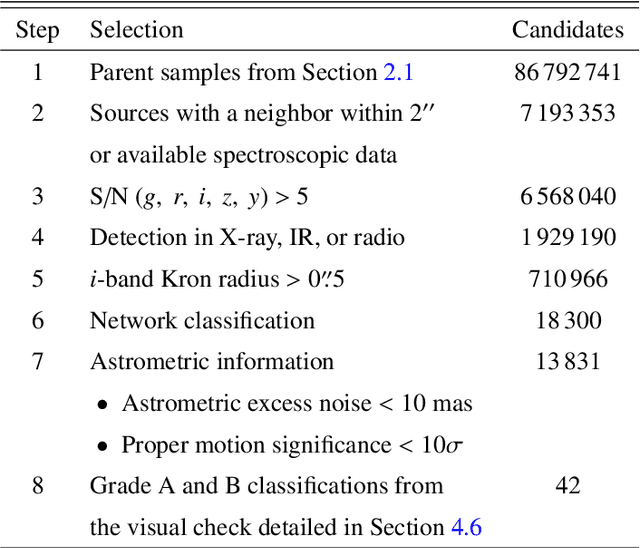
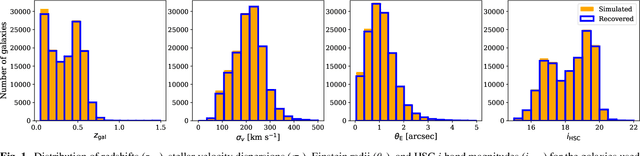
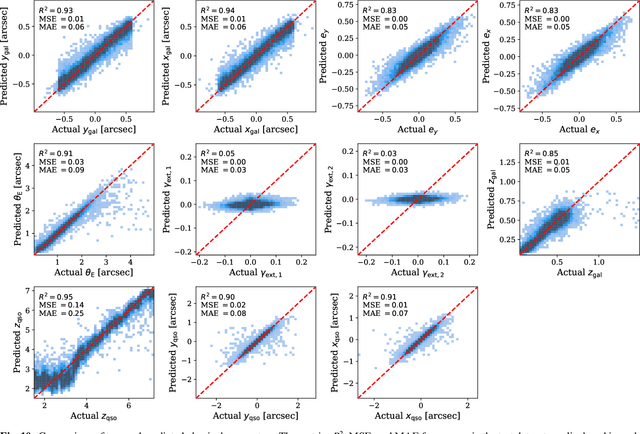
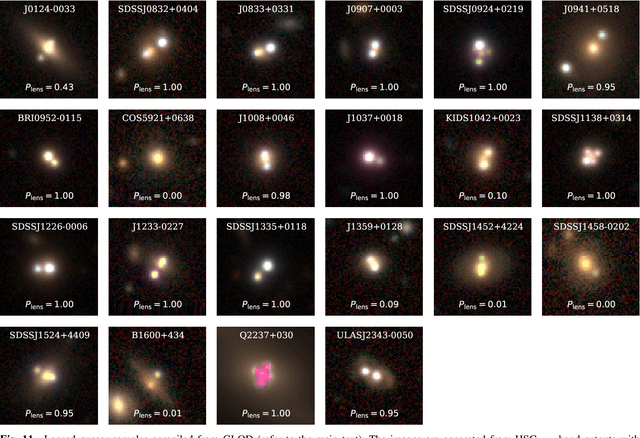
Strongly lensed quasars provide valuable insights into the rate of cosmic expansion, the distribution of dark matter in foreground deflectors, and the characteristics of quasar hosts. However, detecting them in astronomical images is difficult due to the prevalence of non-lensing objects. To address this challenge, we developed a generative deep learning model called VariLens, built upon a physics-informed variational autoencoder. This model seamlessly integrates three essential modules: image reconstruction, object classification, and lens modeling, offering a fast and comprehensive approach to strong lens analysis. VariLens is capable of rapidly determining both (1) the probability that an object is a lens system and (2) key parameters of a singular isothermal ellipsoid (SIE) mass model -- including the Einstein radius ($\theta_\mathrm{E}$), lens center, and ellipticity -- in just milliseconds using a single CPU. A direct comparison of VariLens estimates with traditional lens modeling for 20 known lensed quasars within the Subaru Hyper Suprime-Cam (HSC) footprint shows good agreement, with both results consistent within $2\sigma$ for systems with $\theta_\mathrm{E}<3$ arcsecs. To identify new lensed quasar candidates, we begin with an initial sample of approximately 80 million sources, combining HSC data with multiwavelength information from various surveys. After applying a photometric preselection aimed at locating $z>1.5$ sources, the number of candidates is reduced to 710,966. Subsequently, VariLens highlights 13,831 sources, each showing a high likelihood of being a lens. A visual assessment of these objects results in 42 promising candidates that await spectroscopic confirmation. These results underscore the potential of automated deep learning pipelines to efficiently detect and model strong lenses in large datasets.
Streamlined Lensed Quasar Identification in Multiband Images via Ensemble Networks
Jul 03, 2023


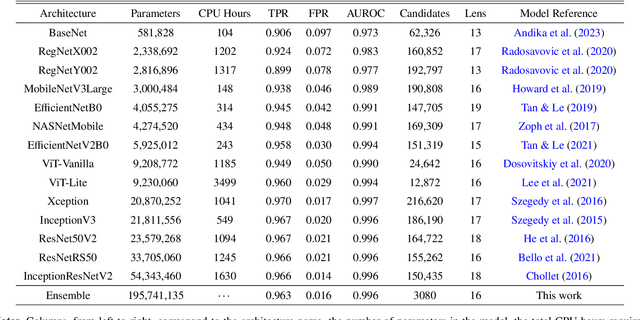
Quasars experiencing strong lensing offer unique viewpoints on subjects like the cosmic expansion rate, the dark matter profile within the foreground deflectors, and the quasar host galaxies. Unfortunately, identifying them in astronomical images is challenging since they are overwhelmed by the abundance of non-lenses. To address this, we have developed a novel approach by ensembling cutting-edge convolutional networks (CNNs) -- i.e., ResNet, Inception, NASNet, MobileNet, EfficientNet, and RegNet -- along with vision transformers (ViTs) trained on realistic galaxy-quasar lens simulations based on the Hyper Suprime-Cam (HSC) multiband images. While the individual model exhibits remarkable performance when evaluated against the test dataset, achieving an area under the receiver operating characteristic curve of $>$97.4% and a median false positive rate of 3.1%, it struggles to generalize in real data, indicated by numerous spurious sources picked by each classifier. A significant improvement is achieved by averaging these CNNs and ViTs, resulting in the impurities being downsized by factors up to 40. Subsequently, combining the HSC images with the UKIRT, VISTA, and unWISE data, we retrieve approximately 60 million sources as parent samples and reduce this to 892,609 after employing a photometry preselection to discover $z>1.5$ lensed quasars with Einstein radii of $\theta_\mathrm{E}<5$ arcsec. Afterward, the ensemble classifier indicates 3991 sources with a high probability of being lenses, for which we visually inspect, yielding 161 prevailing candidates awaiting spectroscopic confirmation. These outcomes suggest that automated deep learning pipelines hold great potential in effectively detecting strong lenses in vast datasets with minimal manual visual inspection involved.