 Add to Chrome
 Add to Firefox
 Add to Edge
15 Years of Augmented Human(s) Research: Where Do We Stand?
Apr 04, 2026
The Augmented Human vision broadly seeks to improve or expand baseline human functioning through the restoration or extension of physical, intellectual, and social capabilities. However, given the rapid pace of technology development, we ask: what exactly does Augmented Human research involve, what are its core themes, and how has the Augmented Human(s) conference series evolved over time? To answer this, we conducted a scientometric analysis on the past 15 years of the Augmented Human(s) conference (N=735 paper), focusing on: geographical aspects, submissions and citation timelines, author frequency and popularity, and topic modeling. We find that: (a) Number of papers in the conference exhibit a bimodal distribution, peaking in 2015 and 2025, but showing periods of stagnant growth; (b) key topics over time include Haptics, Wearable Sensing, Vision & Eye Tracking, Embodied Interaction, and Sports / Motion; (c) some seminal papers on AH are not published in AH(s), but rather at related venues (e.g., CHI); (d) the conference has an active Japanese HCI community despite its historical Eurocentric location dominance. We contribute a closer look at the trajectory of the AH(s) field, and raise considerations of definitional and research scope ambiguities given the core problems/enhancements the field seeks to address.

An Approach to Elicit Human-Understandable Robot Expressions to Support Human-Robot Interaction
Oct 01, 2024Understanding the intentions of robots is essential for natural and seamless human-robot collaboration. Ensuring that robots have means for non-verbal communication is a basis for intuitive and implicit interaction. For this, we contribute an approach to elicit and design human-understandable robot expressions. We outline the approach in the context of non-humanoid robots. We paired human mimicking and enactment with research from gesture elicitation in two phases: first, to elicit expressions, and second, to ensure they are understandable. We present an example application through two studies (N=16 \& N=260) of our approach to elicit expressions for a simple 6-DoF robotic arm. We show that it enabled us to design robot expressions that signal curiosity and interest in getting attention. Our main contribution is an approach to generate and validate understandable expressions for robots, enabling more natural human-robot interaction.
"AI enhances our performance, I have no doubt this one will do the same": The Placebo effect is robust to negative descriptions of AI
Sep 28, 2023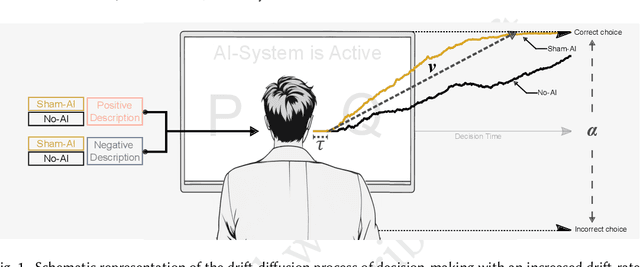
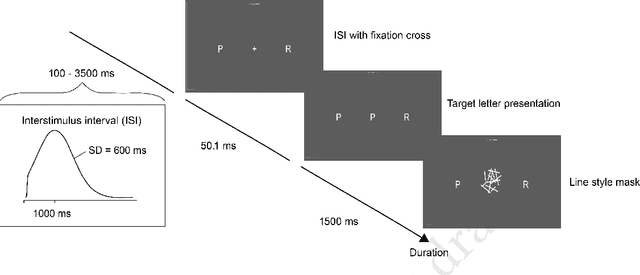
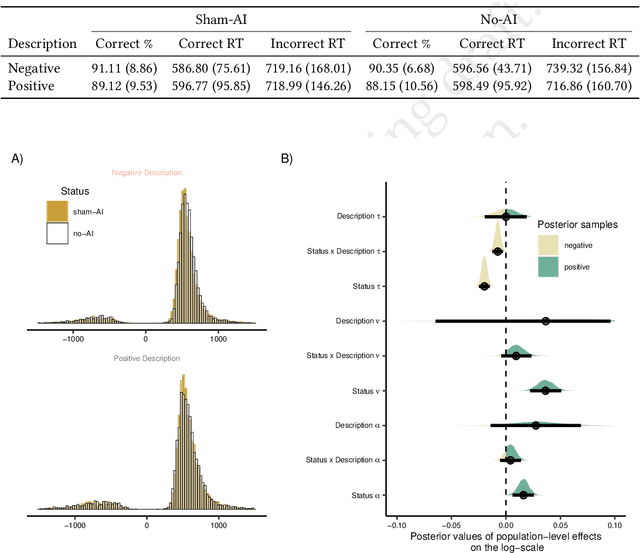
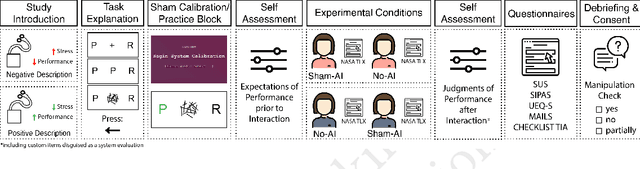
Heightened AI expectations facilitate performance in human-AI interactions through placebo effects. While lowering expectations to control for placebo effects is advisable, overly negative expectations could induce nocebo effects. In a letter discrimination task, we informed participants that an AI would either increase or decrease their performance by adapting the interface, but in reality, no AI was present in any condition. A Bayesian analysis showed that participants had high expectations and performed descriptively better irrespective of the AI description when a sham-AI was present. Using cognitive modeling, we could trace this advantage back to participants gathering more information. A replication study verified that negative AI descriptions do not alter expectations, suggesting that performance expectations with AI are biased and robust to negative verbal descriptions. We discuss the impact of user expectations on AI interactions and evaluation and provide a behavioral placebo marker for human-AI interaction