 Add to Chrome
 Add to Firefox
 Add to Edge
MonoRace: Winning Champion-Level Drone Racing with Robust Monocular AI
Jan 21, 2026
Autonomous drone racing represents a major frontier in robotics research. It requires an Artificial Intelligence (AI) that can run on board light-weight flying robots under tight resource and time constraints, while pushing the physical system to its limits. The state of the art in this area consists of a system with a stereo camera and an inertial measurement unit (IMU) that beat human drone racing champions in a controlled indoor environment. Here, we present MonoRace: an onboard drone racing approach that uses a monocular, rolling-shutter camera and IMU that generalizes to a competition environment without any external motion tracking system. The approach features robust state estimation that combines neural-network-based gate segmentation with a drone model. Moreover, it includes an offline optimization procedure that leverages the known geometry of gates to refine any state estimation parameter. This offline optimization is based purely on onboard flight data and is important for fine-tuning the vital external camera calibration parameters. Furthermore, the guidance and control are performed by a neural network that foregoes inner loop controllers by directly sending motor commands. This small network runs on the flight controller at 500Hz. The proposed approach won the 2025 Abu Dhabi Autonomous Drone Racing Competition (A2RL), outperforming all competing AI teams and three human world champion pilots in a direct knockout tournament. It set a new milestone in autonomous drone racing research, reaching speeds up to 100 km/h on the competition track and successfully coping with problems such as camera interference and IMU saturation.

Self-Supervised Monocular Visual Drone Model Identification through Improved Occlusion Handling
Apr 30, 2025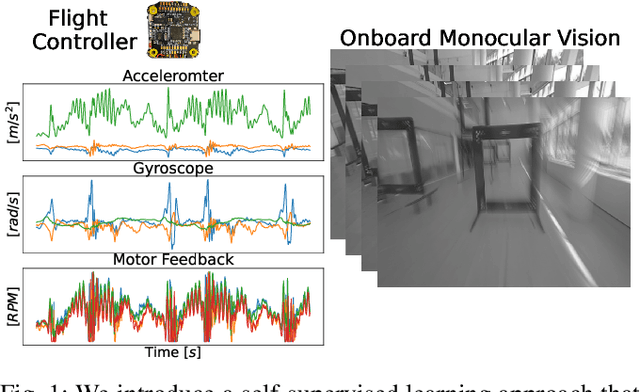
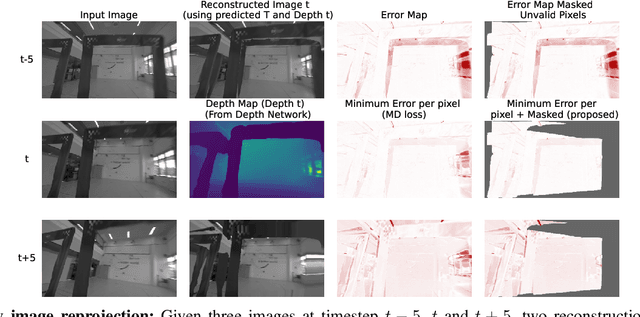
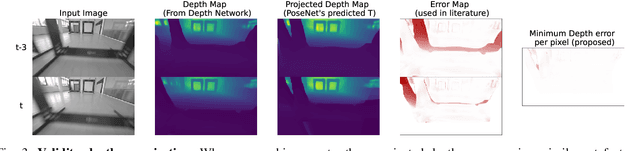
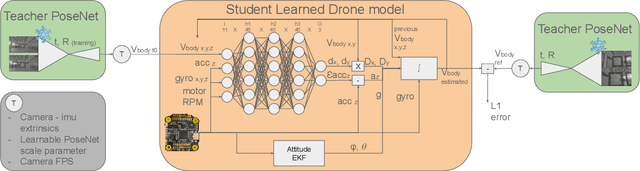
Ego-motion estimation is vital for drones when flying in GPS-denied environments. Vision-based methods struggle when flight speed increases and close-by objects lead to difficult visual conditions with considerable motion blur and large occlusions. To tackle this, vision is typically complemented by state estimation filters that combine a drone model with inertial measurements. However, these drone models are currently learned in a supervised manner with ground-truth data from external motion capture systems, limiting scalability to different environments and drones. In this work, we propose a self-supervised learning scheme to train a neural-network-based drone model using only onboard monocular video and flight controller data (IMU and motor feedback). We achieve this by first training a self-supervised relative pose estimation model, which then serves as a teacher for the drone model. To allow this to work at high speed close to obstacles, we propose an improved occlusion handling method for training self-supervised pose estimation models. Due to this method, the root mean squared error of resulting odometry estimates is reduced by an average of 15%. Moreover, the student neural drone model can be successfully obtained from the onboard data. It even becomes more accurate at higher speeds compared to its teacher, the self-supervised vision-based model. We demonstrate the value of the neural drone model by integrating it into a traditional filter-based VIO system (ROVIO), resulting in superior odometry accuracy on aggressive 3D racing trajectories near obstacles. Self-supervised learning of ego-motion estimation represents a significant step toward bridging the gap between flying in controlled, expensive lab environments and real-world drone applications. The fusion of vision and drone models will enable higher-speed flight and improve state estimation, on any drone in any environment.