 Add to Chrome
 Add to Firefox
 Add to Edge
MonoRace: Winning Champion-Level Drone Racing with Robust Monocular AI
Jan 21, 2026
Autonomous drone racing represents a major frontier in robotics research. It requires an Artificial Intelligence (AI) that can run on board light-weight flying robots under tight resource and time constraints, while pushing the physical system to its limits. The state of the art in this area consists of a system with a stereo camera and an inertial measurement unit (IMU) that beat human drone racing champions in a controlled indoor environment. Here, we present MonoRace: an onboard drone racing approach that uses a monocular, rolling-shutter camera and IMU that generalizes to a competition environment without any external motion tracking system. The approach features robust state estimation that combines neural-network-based gate segmentation with a drone model. Moreover, it includes an offline optimization procedure that leverages the known geometry of gates to refine any state estimation parameter. This offline optimization is based purely on onboard flight data and is important for fine-tuning the vital external camera calibration parameters. Furthermore, the guidance and control are performed by a neural network that foregoes inner loop controllers by directly sending motor commands. This small network runs on the flight controller at 500Hz. The proposed approach won the 2025 Abu Dhabi Autonomous Drone Racing Competition (A2RL), outperforming all competing AI teams and three human world champion pilots in a direct knockout tournament. It set a new milestone in autonomous drone racing research, reaching speeds up to 100 km/h on the competition track and successfully coping with problems such as camera interference and IMU saturation.

One Net to Rule Them All: Domain Randomization in Quadcopter Racing Across Different Platforms
Apr 30, 2025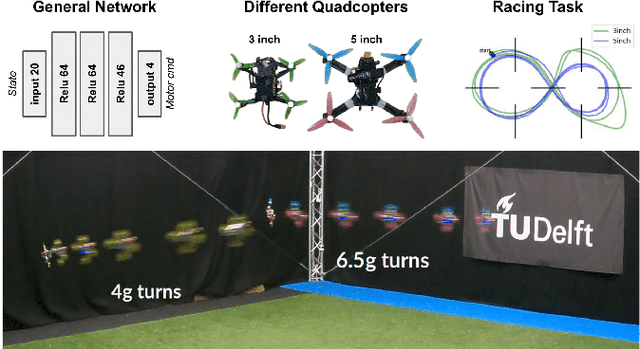
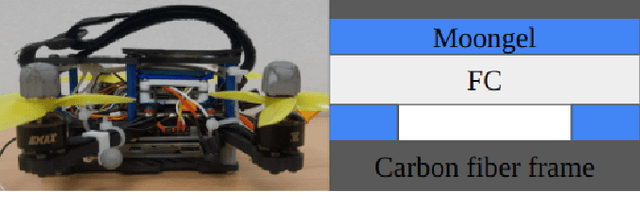
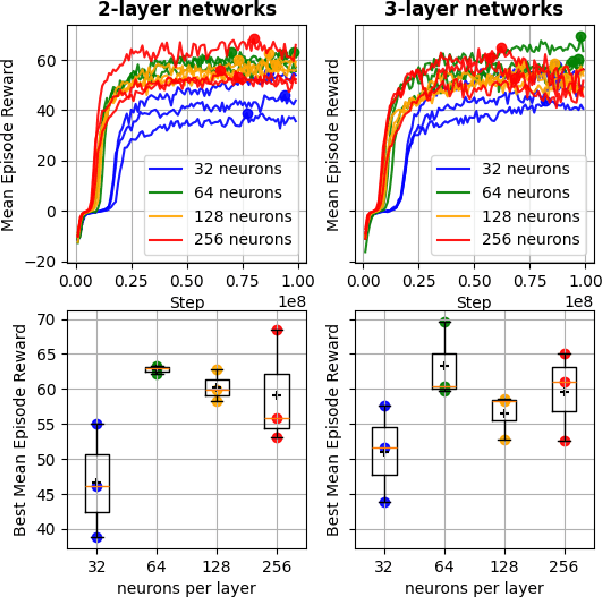
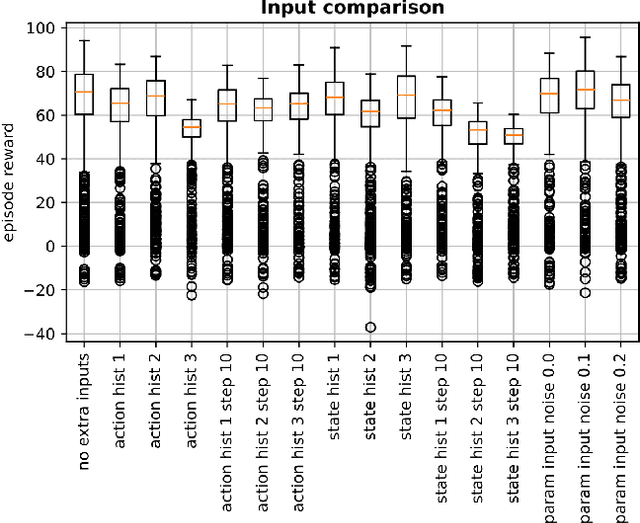
In high-speed quadcopter racing, finding a single controller that works well across different platforms remains challenging. This work presents the first neural network controller for drone racing that generalizes across physically distinct quadcopters. We demonstrate that a single network, trained with domain randomization, can robustly control various types of quadcopters. The network relies solely on the current state to directly compute motor commands. The effectiveness of this generalized controller is validated through real-world tests on two substantially different crafts (3-inch and 5-inch race quadcopters). We further compare the performance of this generalized controller with controllers specifically trained for the 3-inch and 5-inch drone, using their identified model parameters with varying levels of domain randomization (0%, 10%, 20%, 30%). While the generalized controller shows slightly slower speeds compared to the fine-tuned models, it excels in adaptability across different platforms. Our results show that no randomization fails sim-to-real transfer while increasing randomization improves robustness but reduces speed. Despite this trade-off, our findings highlight the potential of domain randomization for generalizing controllers, paving the way for universal AI controllers that can adapt to any platform.