 Add to Chrome
 Add to Firefox
 Add to Edge
GraphReview: Scientific Paper Evaluation via LLM-Based Graph Message Passing
May 26, 2026
Scientific paper evaluation often involves not only assessing a manuscript itself, but also relating it to contemporaneous research and prior literature. However, existing LLM-based methods typically model these signals separately and lack a unified mechanism for propagating review evidence across papers. We propose $\textbf{GraphReview}$, a graph-based LLM framework that formulates paper evaluation as review-signal message passing over a semantic paper graph. The graph jointly captures intrinsic quality, synchronic links among contemporaneous papers, and diachronic links to prior work. LLMs are used to estimate node-level quality priors and generate edge-level comparative evidence through pairwise paper comparisons, while Personalized PageRank integrates review signals for quality ranking, decision prediction, and review generation. To produce higher-quality graph evidence, we propose reward-induced maximum likelihood objectives for training the LLM backbones. Experiments show that GraphReview consistently outperforms the strongest baseline, achieving average improvements of 29.7% on decision and ranking metrics, including gains of 23.7% in Accuracy and 57.6% in Spearman's $ρ$. It also produces higher-quality review texts and generalizes effectively across time periods and conference venues. The code is available at https://github.com/ECNU-Text-Computing/GraphReview.

Measuring Book Impact Based on the Multi-granularity Online Review Mining
Mar 26, 2016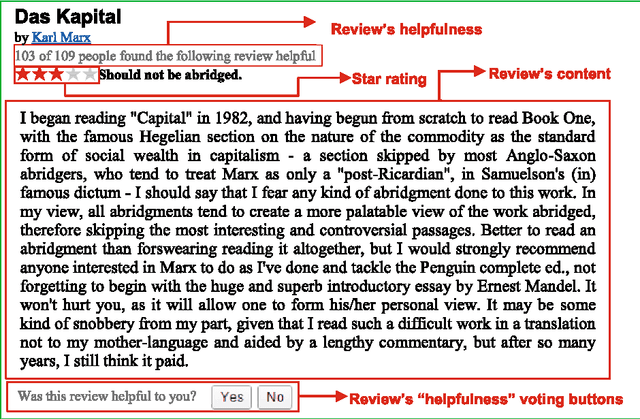
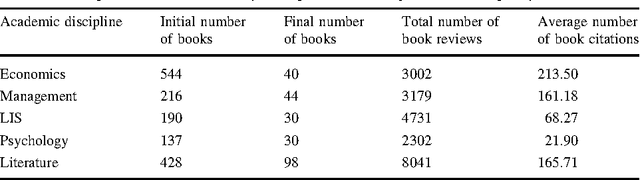
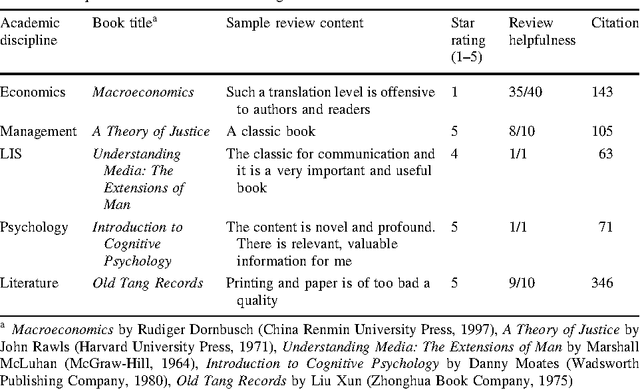
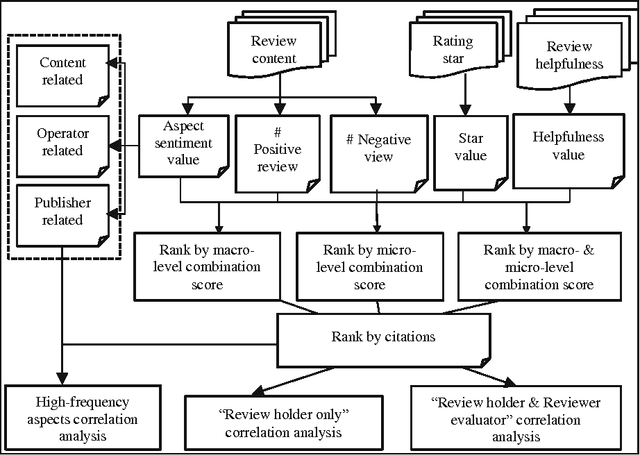
As with articles and journals, the customary methods for measuring books' academic impact mainly involve citations, which is easy but limited to interrogating traditional citation databases and scholarly book reviews, Researchers have attempted to use other metrics, such as Google Books, libcitation, and publisher prestige. However, these approaches lack content-level information and cannot determine the citation intentions of users. Meanwhile, the abundant online review resources concerning academic books can be used to mine deeper information and content utilizing altmetric perspectives. In this study, we measure the impacts of academic books by multi-granularity mining online reviews, and we identify factors that affect a book's impact. First, online reviews of a sample of academic books on Amazon.cn are crawled and processed. Then, multi-granularity review mining is conducted to identify review sentiment polarities and aspects' sentiment values. Lastly, the numbers of positive reviews and negative reviews, aspect sentiment values, star values, and information regarding helpfulness are integrated via the entropy method, and lead to the calculation of the final book impact scores. The results of a correlation analysis of book impact scores obtained via our method versus traditional book citations show that, although there are substantial differences between subject areas, online book reviews tend to reflect the academic impact. Thus, we infer that online reviews represent a promising source for mining book impact within the altmetric perspective and at the multi-granularity content level. Moreover, our proposed method might also be a means by which to measure other books besides academic publications.