 Add to Chrome
 Add to Firefox
 Add to Edge
SolARED: Solar Active Region Emergence Dataset for Machine Learning Aided Predictions
Jan 19, 2026
The development of accurate forecasts of solar eruptive activity has become increasingly important for preventing potential impacts on space technologies and exploration. Therefore, it is crucial to detect Active Regions (ARs) before they start forming on the solar surface. This will enable the development of early-warning capabilities for upcoming space weather disturbances. For this reason, we prepared the Solar Active Region Emergence Dataset (SolARED). The dataset is derived from full-disk maps of the Doppler velocity, magnetic field, and continuum intensity, obtained by the Helioseismic and Magnetic Imager (HMI) onboard the Solar Dynamics Observatory (SDO). SolARED includes time series of remapped, tracked, and binned data that characterize the evolution of acoustic power of solar oscillations, unsigned magnetic flux, and continuum intensity for 50 large ARs before, during, and after their emergence on the solar surface, as well as surrounding areas observed on the solar disc between 2010 and 2023. The resulting ML-ready SolARED dataset is designed to support enhancements of predictive capabilities, enabling the development of operational forecasts for the emergence of active regions. The SolARED dataset is available at https://sun.njit.edu/sarportal/, through an interactive visualization web application.

Forecasting Continuum Intensity for Solar Active Region Emergence Prediction using Transformers
Jan 19, 2026Early and accurate prediction of solar active region (AR) emergence is crucial for space weather forecasting. Building on established Long Short-Term Memory (LSTM) based approaches for forecasting the continuum intensity decrease associated with AR emergence, this work expands the modeling with new architectures and targets. We investigate a sliding-window Transformer architecture to forecast continuum intensity evolution up to 12 hours ahead using data from 46 ARs observed by SDO/HMI. We conduct a systematic ablation study to evaluate two key components: (1) the inclusion of a temporal 1D convolutional (Conv1D) front-end and (2) a novel `Early Detection' architecture featuring attention biases and a timing-aware loss function. Our best-performing model, combining the Early Detection architecture without the Conv1D layer, achieved a Root Mean Square Error (RMSE) of 0.1189 (representing a 10.6% improvement over the LSTM baseline) and an average advance warning time of 4.73 hours (timing difference of -4.73h), even under a stricter emergence criterion than previous studies. While the Transformer demonstrates superior aggregate timing and accuracy, we note that this high-sensitivity detection comes with increased variance compared to smoother baseline models. However, this volatility is a necessary trade-off for operational warning systems: the model's ability to detect micro-changes in precursor signals enables significantly earlier detection, outweighing the cost of increased noise. Our results demonstrate that Transformer architectures modified with early detection biases, when used without temporal smoothing layers, provide a high-sensitivity alternative for forecasting AR emergence that prioritizes advance warning over statistical smoothness.
Hierarchical Mamba Meets Hyperbolic Geometry: A New Paradigm for Structured Language Embeddings
May 25, 2025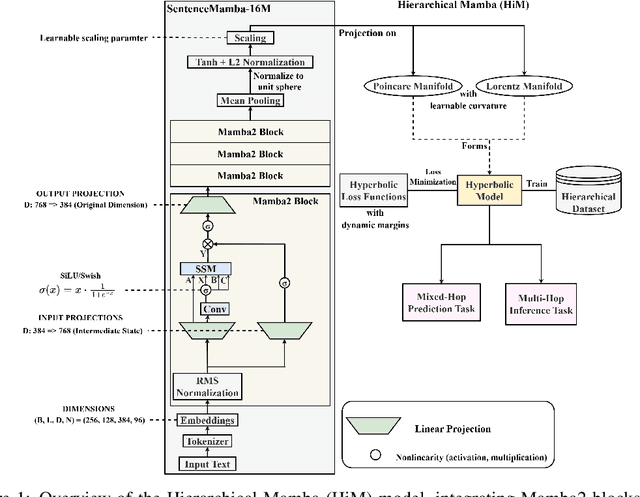
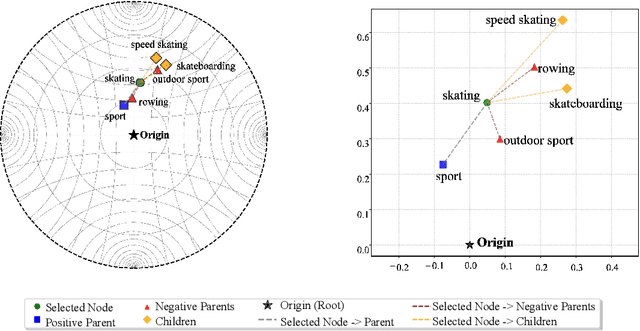
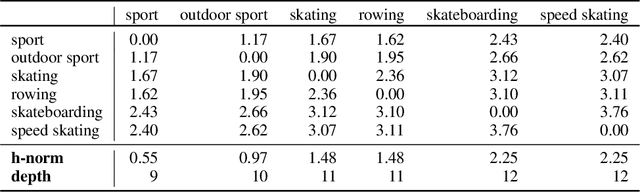
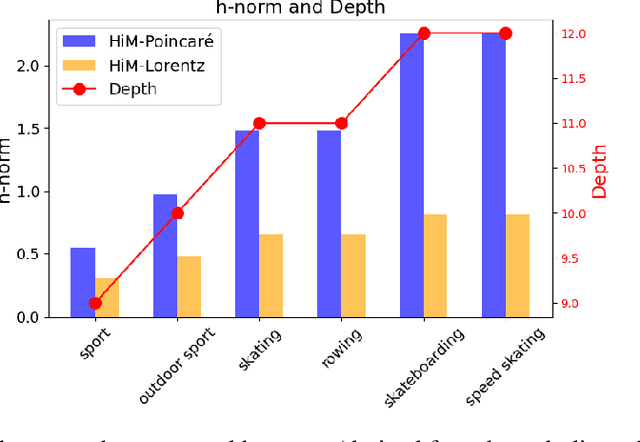
Selective state-space models have achieved great success in long-sequence modeling. However, their capacity for language representation, especially in complex hierarchical reasoning tasks, remains underexplored. Most large language models rely on flat Euclidean embeddings, limiting their ability to capture latent hierarchies. To address this limitation, we propose Hierarchical Mamba (HiM), integrating efficient Mamba2 with exponential growth and curved nature of hyperbolic geometry to learn hierarchy-aware language embeddings for deeper linguistic understanding. Mamba2-processed sequences are projected to the Poincare ball (via tangent-based mapping) or Lorentzian manifold (via cosine and sine-based mapping) with "learnable" curvature, optimized with a combined hyperbolic loss. Our HiM model facilitates the capture of relational distances across varying hierarchical levels, enabling effective long-range reasoning. This makes it well-suited for tasks like mixed-hop prediction and multi-hop inference in hierarchical classification. We evaluated our HiM with four linguistic and medical datasets for mixed-hop prediction and multi-hop inference tasks. Experimental results demonstrated that: 1) Both HiM models effectively capture hierarchical relationships for four ontological datasets, surpassing Euclidean baselines. 2) HiM-Poincare captures fine-grained semantic distinctions with higher h-norms, while HiM-Lorentz provides more stable, compact, and hierarchy-preserving embeddings favoring robustness over detail.
A Comparative Study on Dynamic Graph Embedding based on Mamba and Transformers
Dec 15, 2024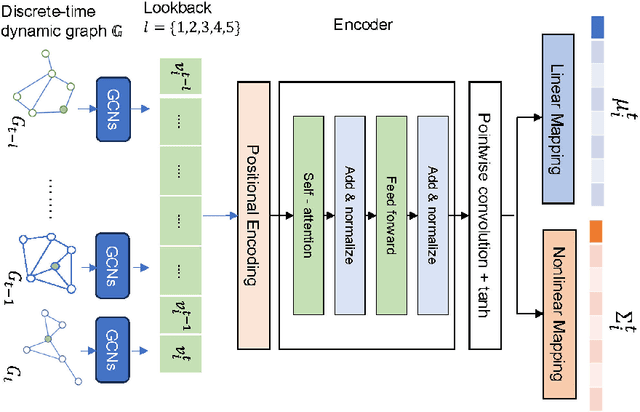
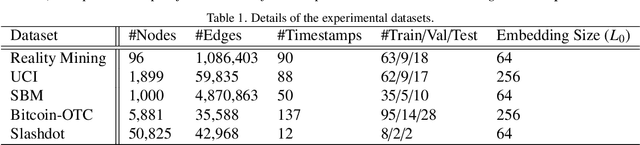
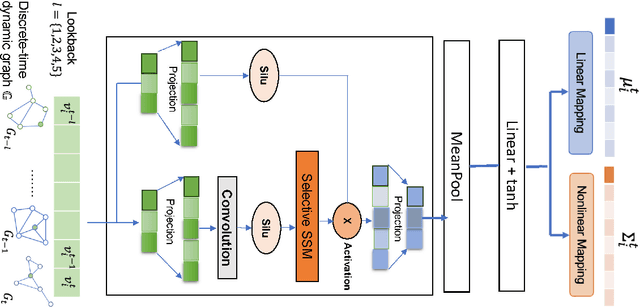
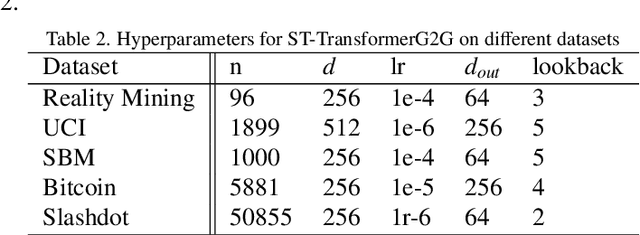
Dynamic graph embedding has emerged as an important technique for modeling complex time-evolving networks across diverse domains. While transformer-based models have shown promise in capturing long-range dependencies in temporal graph data, they face scalability challenges due to quadratic computational complexity. This study presents a comparative analysis of dynamic graph embedding approaches using transformers and the recently proposed Mamba architecture, a state-space model with linear complexity. We introduce three novel models: TransformerG2G augment with graph convolutional networks, DG-Mamba, and GDG-Mamba with graph isomorphism network edge convolutions. Our experiments on multiple benchmark datasets demonstrate that Mamba-based models achieve comparable or superior performance to transformer-based approaches in link prediction tasks while offering significant computational efficiency gains on longer sequences. Notably, DG-Mamba variants consistently outperform transformer-based models on datasets with high temporal variability, such as UCI, Bitcoin, and Reality Mining, while maintaining competitive performance on more stable graphs like SBM. We provide insights into the learned temporal dependencies through analysis of attention weights and state matrices, revealing the models' ability to capture complex temporal patterns. By effectively combining state-space models with graph neural networks, our work addresses key limitations of previous approaches and contributes to the growing body of research on efficient temporal graph representation learning. These findings offer promising directions for scaling dynamic graph embedding to larger, more complex real-world networks, potentially enabling new applications in areas such as social network analysis, financial modeling, and biological system dynamics.