 Add to Chrome
 Add to Firefox
 Add to Edge
Review of Machine Learning Models for Solar Energetic Particle Prediction
Jun 17, 2026
Solar energetic particle (SEP) events have attracted increasing attention due to their significant radiation hazards for aviation, spacecraft electronics, and human missions beyond Earth's magnetosphere. From a scientific perspective, SEP events are intriguing because they arise from a set of physical processes extending from the solar surface and corona through the heliosphere, offering insight into particle acceleration and transport mechanisms that are widely applicable across astrophysics. Therefore, advancing our ability to understand and predict SEP events is essential both for deepening our knowledge of such mechanisms and for safeguarding space technologies and exploration. Traditionally, researchers have modeled SEPs using physics-based simulations and empirical methods. More recently, machine learning (ML) has emerged as a new tool for understanding and predicting SEP events. The purpose of this manuscript is to review the currently available ML models for SEP prediction, identify the datasets used for training, compare their architectures, inputs, and outputs, and, based on these insights, outline good practices and recommendations for future research.

Forecasting SEP Events During Solar Cycles 23 and 24 Using Interpretable Machine Learning
Mar 04, 2024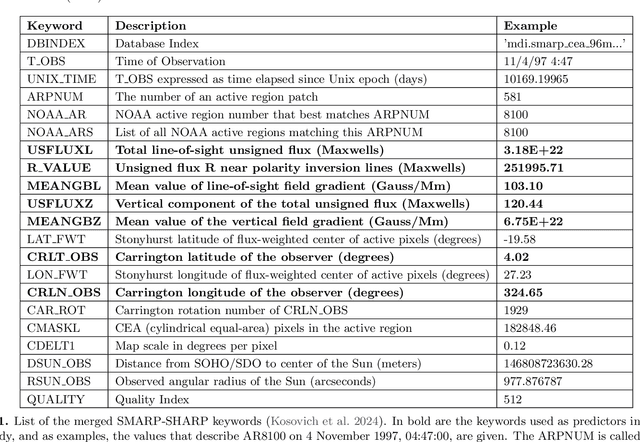
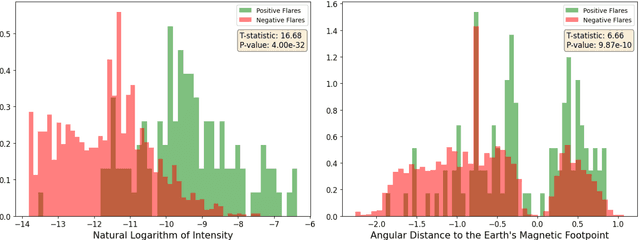
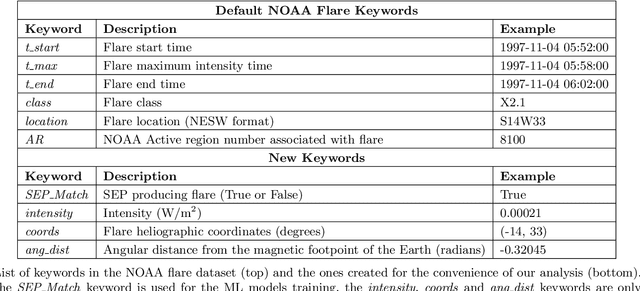
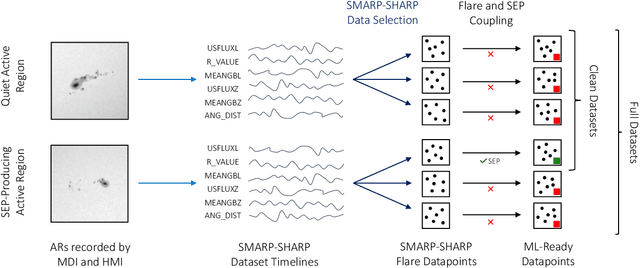
Prediction of the Solar Energetic Particle (SEP) events garner increasing interest as space missions extend beyond Earth's protective magnetosphere. These events, which are, in most cases, products of magnetic reconnection-driven processes during solar flares or fast coronal-mass-ejection-driven shock waves, pose significant radiation hazards to aviation, space-based electronics, and particularly, space exploration. In this work, we utilize the recently developed dataset that combines the Solar Dynamics Observatory/Helioseismic and Magnetic Imager's (SDO/HMI) Space weather HMI Active Region Patches (SHARP) and the Solar and Heliospheric Observatory/Michelson Doppler Imager's (SoHO/MDI) Space Weather MDI Active Region Patches (SMARP). We employ a suite of machine learning strategies, including Support Vector Machines (SVM) and regression models, to evaluate the predictive potential of this new data product for a forecast of post-solar flare SEP events. Our study indicates that despite the augmented volume of data, the prediction accuracy reaches 0.7 +- 0.1, which aligns with but does not exceed these published benchmarks. A linear SVM model with training and testing configurations that mimic an operational setting (positive-negative imbalance) reveals a slight increase (+ 0.04 +- 0.05) in the accuracy of a 14-hour SEP forecast compared to previous studies. This outcome emphasizes the imperative for more sophisticated, physics-informed models to better understand the underlying processes leading to SEP events.