 Add to Chrome
 Add to Firefox
 Add to Edge
The Social Cost of an AI Teammate: How an Artificial Teammate Reshapes Human-Human Communication in Small-Team Decision-Making
Jul 29, 2026
Conversational AI is increasingly positioned as a teammate rather than a tool, yet we know little about how its presence reshapes communication among the humans on the team. We examined sociocognitive communication dynamics in team decision-making using Group Communication Analysis (GCA), team surveys, and lexical analyses of team discourse. Teams completed a high-stakes moral-dilemma decision task in a randomized controlled study: 16 teams of two students plus an AI teammate, and 17 all-human teams of three. Across six GCA dimensions and survey outcomes, we find that the AI teammate was the single most talkative and self-cohesive member of every treatment team, yet its contributions carried the least new information and the lowest density. The presence of AI also reshaped communication amongst humans. In AI-human teams, human teammates showed lower responsivity and social impact toward one another and reported lower levels of belonging and status. Greater AI dominance in the conversation was associated with students feeling less valued as team members. Additionally, this social cost is immediate and present at baseline; it does not emerge over the course of the conversation. Drawing on these results, we discuss a research agenda extending to voice-based and longitudinal settings.

TRAIL: A Platform for Configurable Human--AI Teaming Experiments
Jul 13, 2026An AI teammate's design properties (personality, communication style, when it speaks) can shape a team's trust, coordination, and decisions. Studying this rigorously demands infrastructure no existing tool provides: reproducible configuration of an AI teammate embedded in instrumented, real-time collaboration sustained over time. We present the Team Research and AI Integration Lab (TRAIL), a web platform that makes the AI teammate a configurable, reproducible design object, pairing a Big Five persona with a selective-participation message pipeline, dual memory, chained longitudinal experiments, and export-ready analytics. In a real six-session classroom deployment (about 51 students), TRAIL sustained longitudinal chaining, held the AI to a stable minority of the conversation, and enabled export-driven AI-human text-similarity analysis. A single blind persona change produced a design-consistent double dissociation: a cognitive-scaffolding agent drew stronger contribution ratings and closer linguistic alignment; a socially-supportive agent, a warmer team climate and lower over-reliance.
The AI Collaborator: Bridging Human-AI Interaction in Educational and Professional Settings
May 16, 2024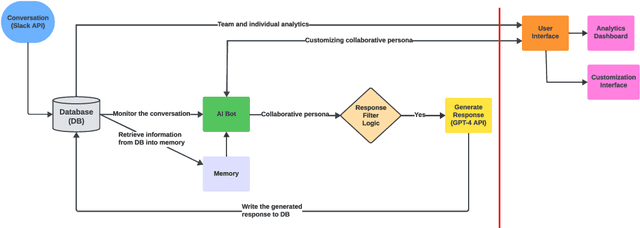
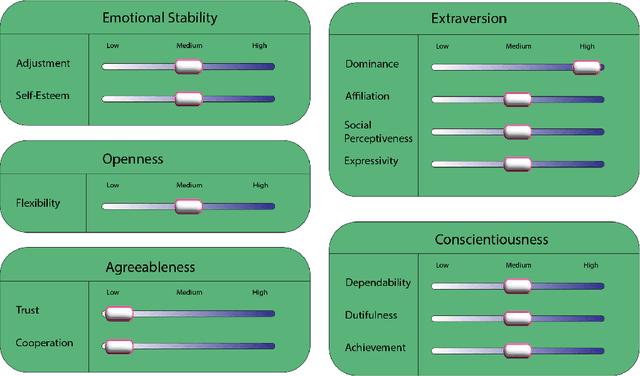
AI Collaborator, powered by OpenAI's GPT-4, is a groundbreaking tool designed for human-AI collaboration research. Its standout feature is the ability for researchers to create customized AI personas for diverse experimental setups using a user-friendly interface. This functionality is essential for simulating various interpersonal dynamics in team settings. AI Collaborator excels in mimicking different team behaviors, enabled by its advanced memory system and a sophisticated personality framework. Researchers can tailor AI personas along a spectrum from dominant to cooperative, enhancing the study of their impact on team processes. The tool's modular design facilitates integration with digital platforms like Slack, making it versatile for various research scenarios. AI Collaborator is thus a crucial resource for exploring human-AI team dynamics more profoundly.