 Add to Chrome
 Add to Firefox
 Add to Edge
DuSCN-FusionNet: An Interpretable Dual-Channel Structural Covariance Fusion Framework for ADHD Classification Using Structural MRI
Mar 27, 2026
Attention Deficit Hyperactivity Disorder (ADHD) is a highly prevalent neurodevelopmental condition; however, its neurobiological diagnosis remains challenging due to the lack of reliable imaging-based biomarkers, particularly anatomical markers. Structural MRI (sMRI) provides a non-invasive modality for investigating brain alterations associated with ADHD; nevertheless, most deep learning approaches function as black-box systems, limiting clinical trust and interpretability. In this work, we propose DuSCN-FusionNet, an interpretable sMRI-based framework for ADHD classification that leverages dual-channel Structural Covariance Networks (SCNs) to capture inter-regional morphological relationships. ROI-wise mean intensity and intra-regional variability descriptors are used to construct intensity-based and heterogeneity-based SCNs, which are processed through an SCN-CNN encoder. In parallel, auxiliary ROI-wise variability features and global statistical descriptors are integrated via late-stage fusion to enhance performance. The model is evaluated using stratified 10-fold cross-validation with a 5-seed ensemble strategy, achieving a mean balanced accuracy of 80.59% and an AUC of 0.778 on the Peking University site of the ADHD-200 dataset. DuSCN-FusionNet further achieves precision, recall, and F1-scores of 81.66%, 80.59%, and 80.27%, respectively. Moreover, Grad-CAM is adapted to the SCN domain to derive ROI-level importance scores, enabling the identification of structurally relevant brain regions as potential biomarkers.

D-GATNet: Interpretable Temporal Graph Attention Learning for ADHD Identification Using Dynamic Functional Connectivity
Mar 27, 2026Attention Deficit Hyperactivity Disorder (ADHD) is a prevalent neurodevelopmental disorder whose neuroimaging-based diagnosis remains challenging due to complex time-varying disruptions in brain connectivity. Functional MRI (fMRI) provides a powerful non-invasive modality for identifying functional alterations. Existing deep learning (DL) studies employ diverse neuroimaging features; however, static functional connectivity remains widely used, whereas dynamic connectivity modeling is comparatively underexplored. Moreover, many DL models lack interpretability. In this work, we propose D-GATNet, an interpretable temporal graph-based framework for automated ADHD classification using dynamic functional connectivity (dFC). Sliding-window Pearson correlation constructs sequences of functional brain graphs with regions of interest as nodes and connectivity strengths as edges. Spatial dependencies are learned via a multi-layer Graph Attention Network, while temporal dynamics are modeled using 1D convolution followed by temporal attention. Interpretability is achieved through graph attention weights revealing dominant ROI interactions, ROI importance scores identifying influential regions, and temporal attention emphasizing informative connectivity segments. Experiments on the Peking University site of the ADHD-200 dataset using stratified 10-fold cross-validation with a 5-seed ensemble achieved 85.18% +_5.64 balanced accuracy and 0.881 AUC, outperforming state-of-the-art methods. Attention analysis reveals cerebellar and default mode network disruptions, indicating potential neuroimaging biomarkers.
Robust Feature Engineering Techniques for Designing Efficient Motor Imagery-Based BCI-Systems
Dec 10, 2024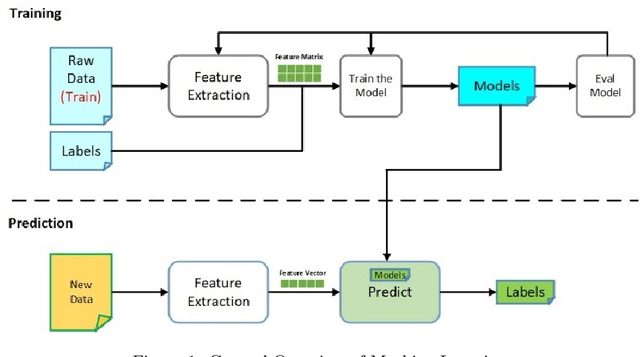
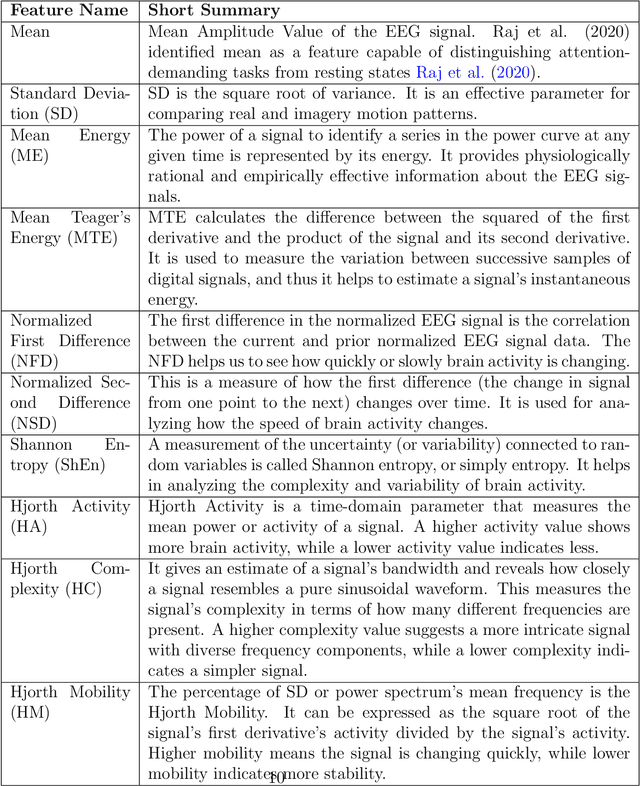
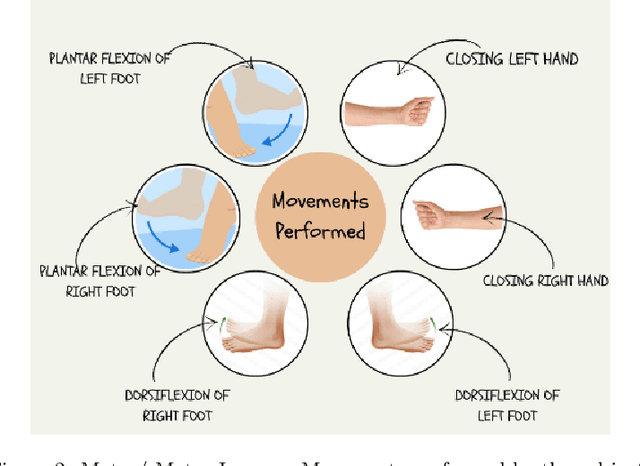
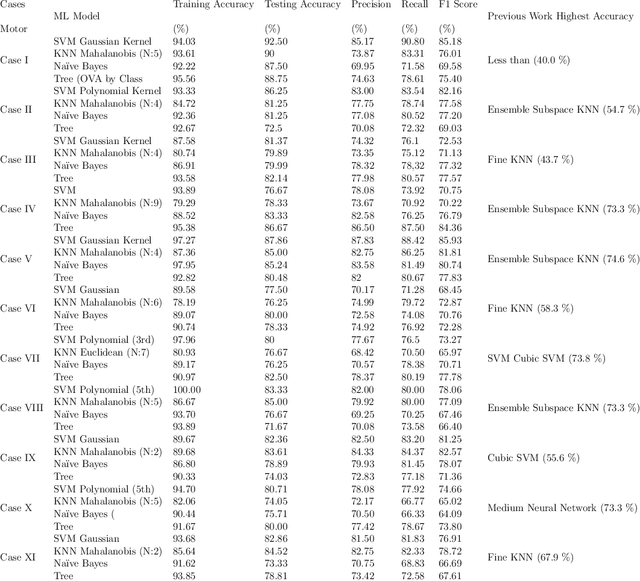
A multitude of individuals across the globe grapple with motor disabilities. Neural prosthetics utilizing Brain-Computer Interface (BCI) technology exhibit promise for improving motor rehabilitation outcomes. The intricate nature of EEG data poses a significant hurdle for current BCI systems. Recently, a qualitative repository of EEG signals tied to both upper and lower limb execution of motor and motor imagery tasks has been unveiled. Despite this, the productivity of the Machine Learning (ML) Models that were trained on this dataset was alarmingly deficient, and the evaluation framework seemed insufficient. To enhance outcomes, robust feature engineering (signal processing) methodologies are implemented. A collection of time domain, frequency domain, and wavelet-derived features was obtained from 16-channel EEG signals, and the Maximum Relevance Minimum Redundancy (MRMR) approach was employed to identify the four most significant features. For classification K Nearest Neighbors (KNN), Support Vector Machine (SVM), Decision Tree (DT), and Na\"ive Bayes (NB) models were implemented with these selected features, evaluating their effectiveness through metrics such as testing accuracy, precision, recall, and F1 Score. By leveraging SVM with a Gaussian Kernel, a remarkable maximum testing accuracy of 92.50% for motor activities and 95.48% for imagery activities is achieved. These results are notably more dependable and gratifying compared to the previous study, where the peak accuracy was recorded at 74.36%. This research work provides an in-depth analysis of the MI Limb EEG dataset and it will help in designing and developing simple, cost-effective and reliable BCI systems for neuro-rehabilitation.