 Add to Chrome
 Add to Firefox
 Add to Edge
DuSCN-FusionNet: An Interpretable Dual-Channel Structural Covariance Fusion Framework for ADHD Classification Using Structural MRI
Mar 27, 2026
Attention Deficit Hyperactivity Disorder (ADHD) is a highly prevalent neurodevelopmental condition; however, its neurobiological diagnosis remains challenging due to the lack of reliable imaging-based biomarkers, particularly anatomical markers. Structural MRI (sMRI) provides a non-invasive modality for investigating brain alterations associated with ADHD; nevertheless, most deep learning approaches function as black-box systems, limiting clinical trust and interpretability. In this work, we propose DuSCN-FusionNet, an interpretable sMRI-based framework for ADHD classification that leverages dual-channel Structural Covariance Networks (SCNs) to capture inter-regional morphological relationships. ROI-wise mean intensity and intra-regional variability descriptors are used to construct intensity-based and heterogeneity-based SCNs, which are processed through an SCN-CNN encoder. In parallel, auxiliary ROI-wise variability features and global statistical descriptors are integrated via late-stage fusion to enhance performance. The model is evaluated using stratified 10-fold cross-validation with a 5-seed ensemble strategy, achieving a mean balanced accuracy of 80.59% and an AUC of 0.778 on the Peking University site of the ADHD-200 dataset. DuSCN-FusionNet further achieves precision, recall, and F1-scores of 81.66%, 80.59%, and 80.27%, respectively. Moreover, Grad-CAM is adapted to the SCN domain to derive ROI-level importance scores, enabling the identification of structurally relevant brain regions as potential biomarkers.

D-GATNet: Interpretable Temporal Graph Attention Learning for ADHD Identification Using Dynamic Functional Connectivity
Mar 27, 2026Attention Deficit Hyperactivity Disorder (ADHD) is a prevalent neurodevelopmental disorder whose neuroimaging-based diagnosis remains challenging due to complex time-varying disruptions in brain connectivity. Functional MRI (fMRI) provides a powerful non-invasive modality for identifying functional alterations. Existing deep learning (DL) studies employ diverse neuroimaging features; however, static functional connectivity remains widely used, whereas dynamic connectivity modeling is comparatively underexplored. Moreover, many DL models lack interpretability. In this work, we propose D-GATNet, an interpretable temporal graph-based framework for automated ADHD classification using dynamic functional connectivity (dFC). Sliding-window Pearson correlation constructs sequences of functional brain graphs with regions of interest as nodes and connectivity strengths as edges. Spatial dependencies are learned via a multi-layer Graph Attention Network, while temporal dynamics are modeled using 1D convolution followed by temporal attention. Interpretability is achieved through graph attention weights revealing dominant ROI interactions, ROI importance scores identifying influential regions, and temporal attention emphasizing informative connectivity segments. Experiments on the Peking University site of the ADHD-200 dataset using stratified 10-fold cross-validation with a 5-seed ensemble achieved 85.18% +_5.64 balanced accuracy and 0.881 AUC, outperforming state-of-the-art methods. Attention analysis reveals cerebellar and default mode network disruptions, indicating potential neuroimaging biomarkers.
Visual or Textual: Effects of Explanation Format and Personal Characteristics on the Perception of Explanations in an Educational Recommender System
Mar 26, 2026Explanations are central to improving transparency, trust, and user satisfaction in recommender systems (RS), yet it remains unclear how different explanation formats (visual vs. textual) are suited to users with different personal characteristics (PCs). To this end, we report a within-subject user study (n=54) comparing visual and textual explanations and examine how explanation format and PCs jointly influence perceived control, transparency, trust, and satisfaction in an educational recommender system (ERS). Using robust mixed-effects models, we analyze the moderating effects of a wide range of PCs, including Big Five traits, need for cognition, decision making style, visualization familiarity, and technical expertise. Our results show that a well-designed visual, simple, interactive, selective, easy to understand visualization that clearly and intuitively communicates how user preferences are linked to recommendations, fosters perceived control, transparency, appropriate trust, and satisfaction in the ERS for most users, independent of their PCs. Moreover, we derive a set of guidelines to support the effective design of explanations in ERSs.
Leveraging Graph Retrieval-Augmented Generation to Support Learners' Understanding of Knowledge Concepts in MOOCs
May 15, 2025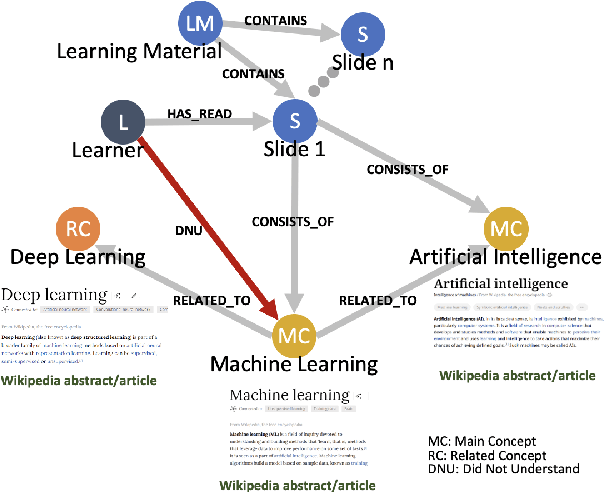
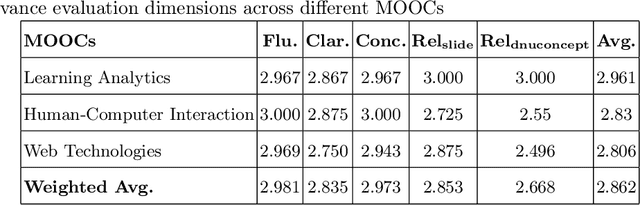
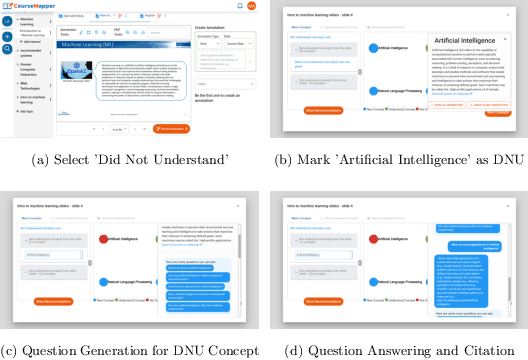
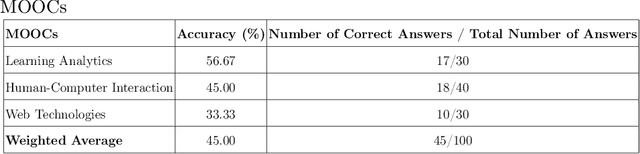
Massive Open Online Courses (MOOCs) lack direct interaction between learners and instructors, making it challenging for learners to understand new knowledge concepts. Recently, learners have increasingly used Large Language Models (LLMs) to support them in acquiring new knowledge. However, LLMs are prone to hallucinations which limits their reliability. Retrieval-Augmented Generation (RAG) addresses this issue by retrieving relevant documents before generating a response. However, the application of RAG across different MOOCs is limited by unstructured learning material. Furthermore, current RAG systems do not actively guide learners toward their learning needs. To address these challenges, we propose a Graph RAG pipeline that leverages Educational Knowledge Graphs (EduKGs) and Personal Knowledge Graphs (PKGs) to guide learners to understand knowledge concepts in the MOOC platform CourseMapper. Specifically, we implement (1) a PKG-based Question Generation method to recommend personalized questions for learners in context, and (2) an EduKG-based Question Answering method that leverages the relationships between knowledge concepts in the EduKG to answer learner selected questions. To evaluate both methods, we conducted a study with 3 expert instructors on 3 different MOOCs in the MOOC platform CourseMapper. The results of the evaluation show the potential of Graph RAG to empower learners to understand new knowledge concepts in a personalized learning experience.
Interactive Explanation with Varying Level of Details in an Explainable Scientific Literature Recommender System
Jun 09, 2023
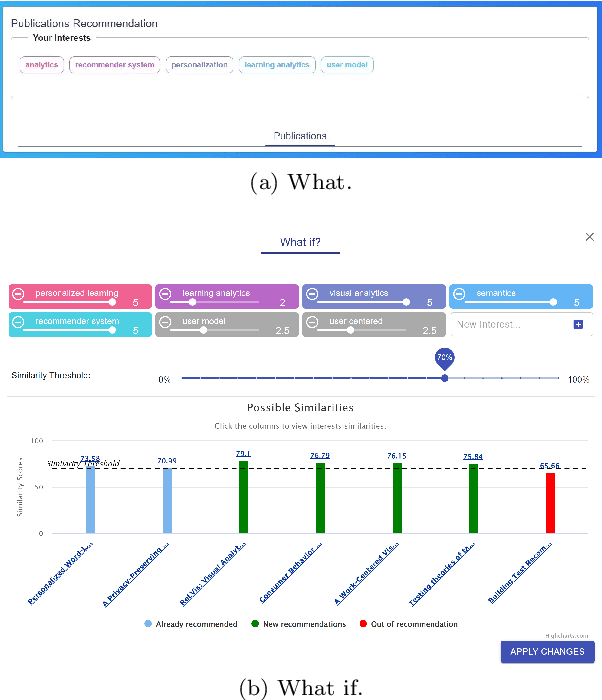
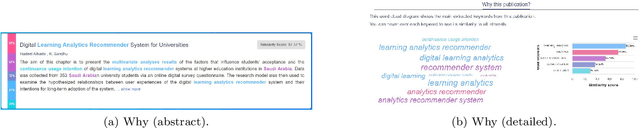

Explainable recommender systems (RS) have traditionally followed a one-size-fits-all approach, delivering the same explanation level of detail to each user, without considering their individual needs and goals. Further, explanations in RS have so far been presented mostly in a static and non-interactive manner. To fill these research gaps, we aim in this paper to adopt a user-centered, interactive explanation model that provides explanations with different levels of detail and empowers users to interact with, control, and personalize the explanations based on their needs and preferences. We followed a user-centered approach to design interactive explanations with three levels of detail (basic, intermediate, and advanced) and implemented them in the transparent Recommendation and Interest Modeling Application (RIMA). We conducted a qualitative user study (N=14) to investigate the impact of providing interactive explanations with varying level of details on the users' perception of the explainable RS. Our study showed qualitative evidence that fostering interaction and giving users control in deciding which explanation they would like to see can meet the demands of users with different needs, preferences, and goals, and consequently can have positive effects on different crucial aspects in explainable recommendation, including transparency, trust, satisfaction, and user experience.
Justification vs. Transparency: Why and How Visual Explanations in a Scientific Literature Recommender System
May 26, 2023
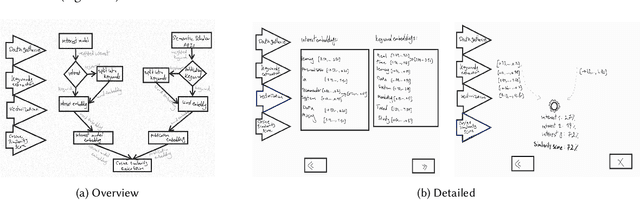
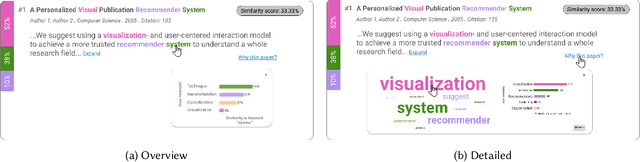
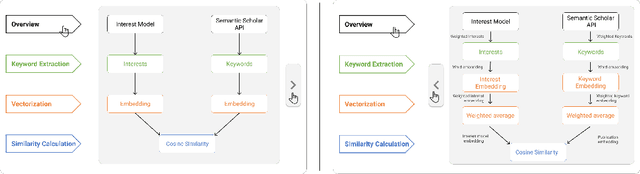
Significant attention has been paid to enhancing recommender systems (RS) with explanation facilities to help users make informed decisions and increase trust in and satisfaction with the RS. Justification and transparency represent two crucial goals in explainable recommendation. Different from transparency, which faithfully exposes the reasoning behind the recommendation mechanism, justification conveys a conceptual model that may differ from that of the underlying algorithm. An explanation is an answer to a question. In explainable recommendation, a user would want to ask questions (referred to as intelligibility types) to understand results given by the RS. In this paper, we identify relationships between Why and How explanation intelligibility types and the explanation goals of justification and transparency. We followed the Human-Centered Design (HCD) approach and leveraged the What-Why-How visualization framework to systematically design and implement Why and How visual explanations in the transparent Recommendation and Interest Modeling Application (RIMA). Furthermore, we conducted a qualitative user study (N=12) to investigate the potential effects of providing Why and How explanations together in an explainable RS on the users' perceptions regarding transparency, trust, and satisfaction. Our study showed qualitative evidence confirming that the choice of the explanation intelligibility types depends on the explanation goal and user type.
Is More Always Better? The Effects of Personal Characteristics and Level of Detail on the Perception of Explanations in a Recommender System
Apr 03, 2023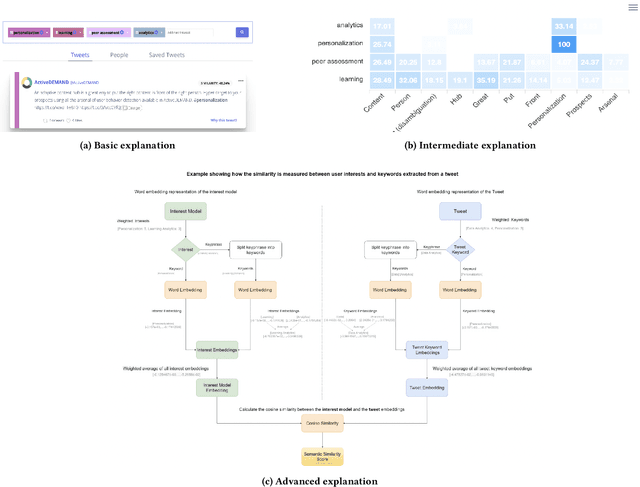
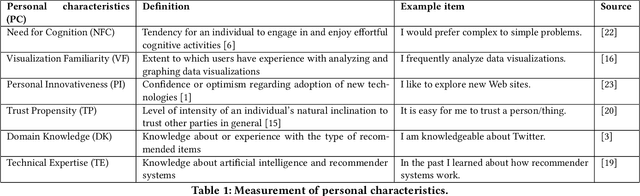
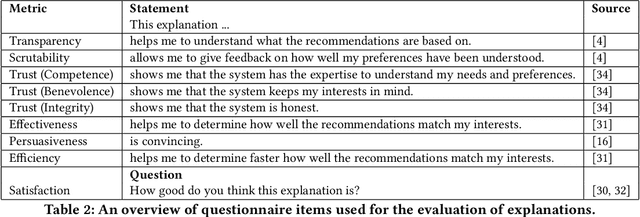
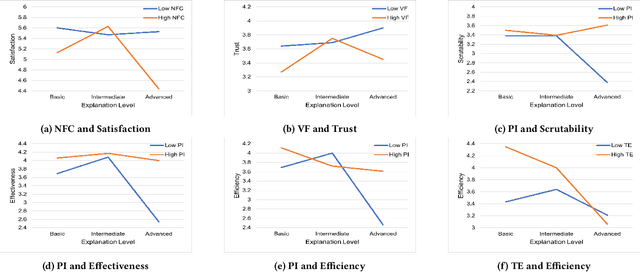
Despite the acknowledgment that the perception of explanations may vary considerably between end-users, explainable recommender systems (RS) have traditionally followed a one-size-fits-all model, whereby the same explanation level of detail is provided to each user, without taking into consideration individual user's context, i.e., goals and personal characteristics. To fill this research gap, we aim in this paper at a shift from a one-size-fits-all to a personalized approach to explainable recommendation by giving users agency in deciding which explanation they would like to see. We developed a transparent Recommendation and Interest Modeling Application (RIMA) that provides on-demand personalized explanations of the recommendations, with three levels of detail (basic, intermediate, advanced) to meet the demands of different types of end-users. We conducted a within-subject study (N=31) to investigate the relationship between user's personal characteristics and the explanation level of detail, and the effects of these two variables on the perception of the explainable RS with regard to different explanation goals. Our results show that the perception of explainable RS with different levels of detail is affected to different degrees by the explanation goal and user type. Consequently, we suggested some theoretical and design guidelines to support the systematic design of explanatory interfaces in RS tailored to the user's context.