 Add to Chrome
 Add to Firefox
 Add to Edge
Clickbait detection: quick inference with maximum impact
Apr 09, 2026
We propose a lightweight hybrid approach to clickbait detection that combines OpenAI semantic embeddings with six compact heuristic features capturing stylistic and informational cues. To improve efficiency, embeddings are reduced using PCA and evaluated with XGBoost, GraphSAGE, and GCN classifiers. While the simplified feature design yields slightly lower F1-scores, graph-based models achieve competitive performance with substantially reduced inference time. High ROC--AUC values further indicate strong discrimination capability, supporting reliable detection of clickbait headlines under varying decision thresholds.

Graph Neural Networks for Misinformation Detection: Performance-Efficiency Trade-offs
Apr 09, 2026The rapid spread of online misinformation has led to increasingly complex detection models, including large language models and hybrid architectures. However, their computational cost and deployment limitations raise concerns about practical applicability. In this work, we benchmark graph neural networks (GNNs) against non-graph-based machine learning methods under controlled and comparable conditions. We evaluate lightweight GNN architectures (GCN, GraphSAGE, GAT, ChebNet) against Logistic Regression, Support Vector Machines, and Multilayer Perceptrons across seven public datasets in English, Indonesian, and Polish. All models use identical TF-IDF features to isolate the impact of relational structure. Performance is measured using F1 score, with inference time reported to assess efficiency. GNNs consistently outperform non-graph baselines across all datasets. For example, GraphSAGE achieves 96.8% F1 on Kaggle and 91.9% on WELFake, compared to 73.2% and 66.8% for MLP, respectively. On COVID-19, GraphSAGE reaches 90.5% F1 vs. 74.9%, while ChebNet attains 79.1% vs. 66.4% on FakeNewsNet. These gains are achieved with comparable or lower inference times. Overall, the results show that classic GNNs remain effective and efficient, challenging the need for increasingly complex architectures in misinformation detection.
Rewrite the News: Tracing Editorial Reuse Across News Agencies
Mar 31, 2026This paper investigates sentence-level text reuse in multilingual journalism, analyzing where reused content occurs within articles. We present a weakly supervised method for detecting sentence-level cross-lingual reuse without requiring full translations, designed to support automated pre-selection to reduce information overload for journalists (Holyst et al., 2024). The study compares English-language articles from the Slovenian Press Agency (STA) with reports from 15 foreign agencies (FA) in seven languages, using publication timestamps to retain the earliest likely foreign source for each reused sentence. We analyze 1,037 STA and 237,551 FA articles from two time windows (October 7-November 2, 2023; February 1-28, 2025) and identify 1,087 aligned sentence pairs after filtering to the earliest sources. Reuse occurs in 52% of STA articles and 1.6% of FA articles and is predominantly non-literal, involving paraphrase and compositional reuse from multiple sources. Reused content tends to appear in the middle and end of English articles, while leads are more often original, indicating that simple lexical matching overlooks substantial editorial reuse. Compared with prior work focused on monolingual overlap, we (i) detect reuse across languages without requiring full translation, (ii) use publication timing to identify likely sources, and (iii) analyze where reused material is situated within articles. Dataset and code: https://github.com/kunturs/lrec2026-rewrite-news.
Fake News Detection: It's All in the Data!
Jul 02, 2024This comprehensive survey serves as an indispensable resource for researchers embarking on the journey of fake news detection. By highlighting the pivotal role of dataset quality and diversity, it underscores the significance of these elements in the effectiveness and robustness of detection models. The survey meticulously outlines the key features of datasets, various labeling systems employed, and prevalent biases that can impact model performance. Additionally, it addresses critical ethical issues and best practices, offering a thorough overview of the current state of available datasets. Our contribution to this field is further enriched by the provision of GitHub repository, which consolidates publicly accessible datasets into a single, user-friendly portal. This repository is designed to facilitate and stimulate further research and development efforts aimed at combating the pervasive issue of fake news.
Deepfake tweets automatic detection
Jun 24, 2024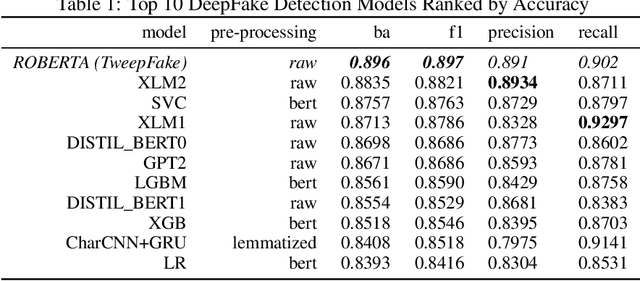
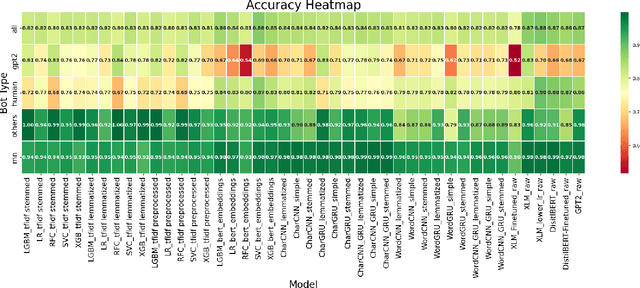
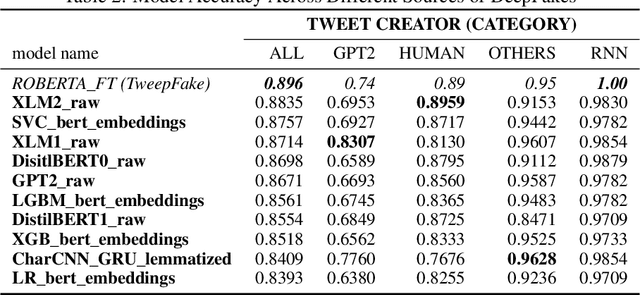
This study addresses the critical challenge of detecting DeepFake tweets by leveraging advanced natural language processing (NLP) techniques to distinguish between genuine and AI-generated texts. Given the increasing prevalence of misinformation, our research utilizes the TweepFake dataset to train and evaluate various machine learning models. The objective is to identify effective strategies for recognizing DeepFake content, thereby enhancing the integrity of digital communications. By developing reliable methods for detecting AI-generated misinformation, this work contributes to a more trustworthy online information environment.