 Add to Chrome
 Add to Firefox
 Add to Edge
Graph Neural Networks for Misinformation Detection: Performance-Efficiency Trade-offs
Apr 09, 2026
The rapid spread of online misinformation has led to increasingly complex detection models, including large language models and hybrid architectures. However, their computational cost and deployment limitations raise concerns about practical applicability. In this work, we benchmark graph neural networks (GNNs) against non-graph-based machine learning methods under controlled and comparable conditions. We evaluate lightweight GNN architectures (GCN, GraphSAGE, GAT, ChebNet) against Logistic Regression, Support Vector Machines, and Multilayer Perceptrons across seven public datasets in English, Indonesian, and Polish. All models use identical TF-IDF features to isolate the impact of relational structure. Performance is measured using F1 score, with inference time reported to assess efficiency. GNNs consistently outperform non-graph baselines across all datasets. For example, GraphSAGE achieves 96.8% F1 on Kaggle and 91.9% on WELFake, compared to 73.2% and 66.8% for MLP, respectively. On COVID-19, GraphSAGE reaches 90.5% F1 vs. 74.9%, while ChebNet attains 79.1% vs. 66.4% on FakeNewsNet. These gains are achieved with comparable or lower inference times. Overall, the results show that classic GNNs remain effective and efficient, challenging the need for increasingly complex architectures in misinformation detection.

Kolmogorov-Arnold networks for metal surface defect classification
Jan 10, 2025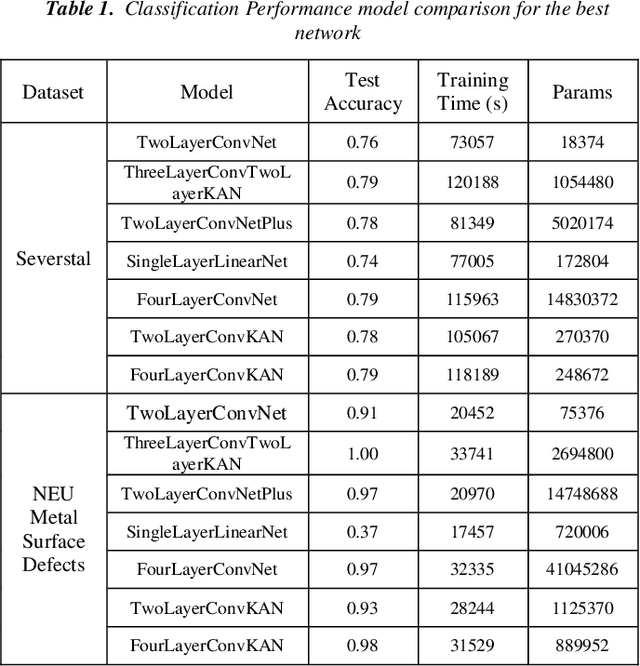
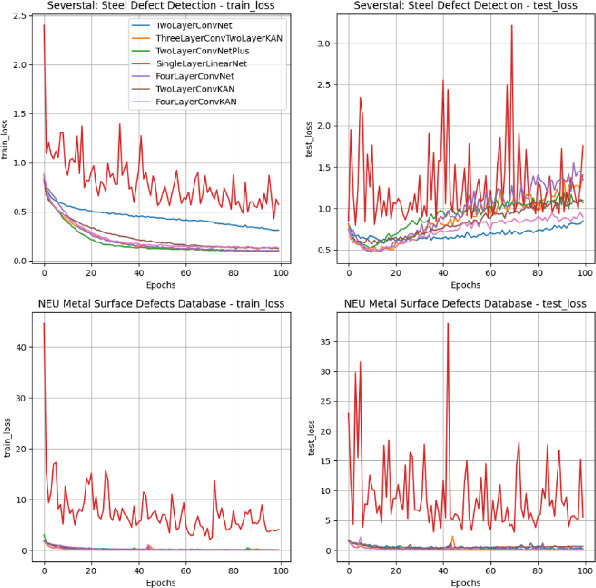
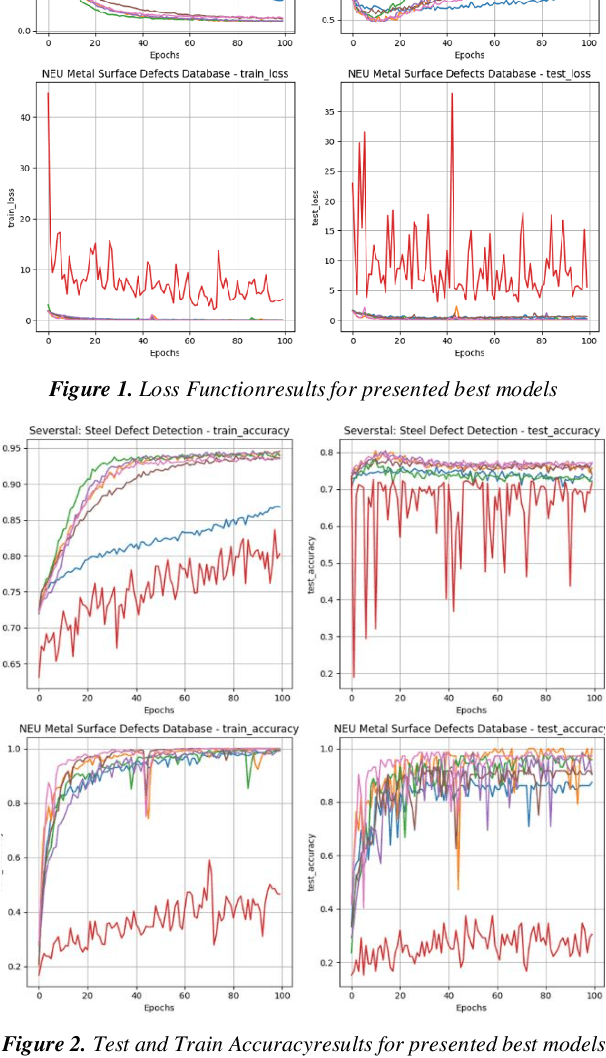
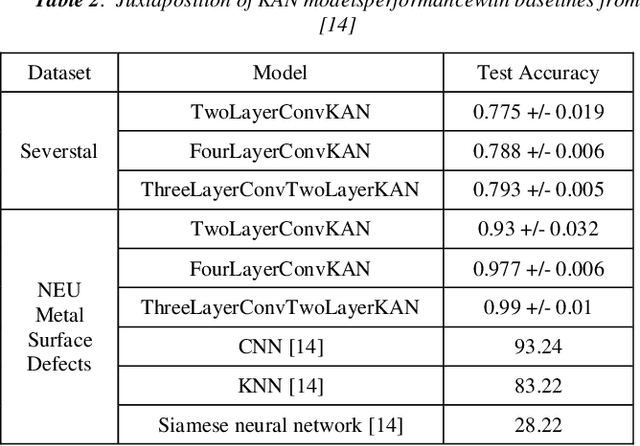
This paper presents the application of Kolmogorov-Arnold Networks (KAN) in classifying metal surface defects. Specifically, steel surfaces are analyzed to detect defects such as cracks, inclusions, patches, pitted surfaces, and scratches. Drawing on the Kolmogorov-Arnold theorem, KAN provides a novel approach compared to conventional multilayer perceptrons (MLPs), facilitating more efficient function approximation by utilizing spline functions. The results show that KAN networks can achieve better accuracy than convolutional neural networks (CNNs) with fewer parameters, resulting in faster convergence and improved performance in image classification.
Graph Neural Networks in Computer Vision -- Architectures, Datasets and Common Approaches
Dec 20, 2022Graph Neural Networks (GNNs) are a family of graph networks inspired by mechanisms existing between nodes on a graph. In recent years there has been an increased interest in GNN and their derivatives, i.e., Graph Attention Networks (GAT), Graph Convolutional Networks (GCN), and Graph Recurrent Networks (GRN). An increase in their usability in computer vision is also observed. The number of GNN applications in this field continues to expand; it includes video analysis and understanding, action and behavior recognition, computational photography, image and video synthesis from zero or few shots, and many more. This contribution aims to collect papers published about GNN-based approaches towards computer vision. They are described and summarized from three perspectives. Firstly, we investigate the architectures of Graph Neural Networks and their derivatives used in this area to provide accurate and explainable recommendations for the ensuing investigations. As for the other aspect, we also present datasets used in these works. Finally, using graph analysis, we also examine relations between GNN-based studies in computer vision and potential sources of inspiration identified outside of this field.