 Add to Chrome
 Add to Firefox
 Add to Edge
Naïve PAINE: Lightweight Text-to-Image Generation Improvement with Prompt Evaluation
Mar 12, 2026
Text-to-Image (T2I) generation is primarily driven by Diffusion Models (DM) which rely on random Gaussian noise. Thus, like playing the slots at a casino, a DM will produce different results given the same user-defined inputs. This imposes a gambler's burden: To perform multiple generation cycles to obtain a satisfactory result. However, even though DMs use stochastic sampling to seed generation, the distribution of generated content quality highly depends on the prompt and the generative ability of a DM with respect to it. To account for this, we propose Naïve PAINE for improving the generative quality of Diffusion Models by leveraging T2I preference benchmarks. We directly predict the numerical quality of an image from the initial noise and given prompt. Naïve PAINE then selects a handful of quality noises and forwards them to the DM for generation. Further, Naïve PAINE provides feedback on the DM generative quality given the prompt and is lightweight enough to seamlessly fit into existing DM pipelines. Experimental results demonstrate that Naïve PAINE outperforms existing approaches on several prompt corpus benchmarks.

OOD-Speech: A Large Bengali Speech Recognition Dataset for Out-of-Distribution Benchmarking
May 15, 2023We present OOD-Speech, the first out-of-distribution (OOD) benchmarking dataset for Bengali automatic speech recognition (ASR). Being one of the most spoken languages globally, Bengali portrays large diversity in dialects and prosodic features, which demands ASR frameworks to be robust towards distribution shifts. For example, islamic religious sermons in Bengali are delivered with a tonality that is significantly different from regular speech. Our training dataset is collected via massively online crowdsourcing campaigns which resulted in 1177.94 hours collected and curated from $22,645$ native Bengali speakers from South Asia. Our test dataset comprises 23.03 hours of speech collected and manually annotated from 17 different sources, e.g., Bengali TV drama, Audiobook, Talk show, Online class, and Islamic sermons to name a few. OOD-Speech is jointly the largest publicly available speech dataset, as well as the first out-of-distribution ASR benchmarking dataset for Bengali.
BaDLAD: A Large Multi-Domain Bengali Document Layout Analysis Dataset
Mar 10, 2023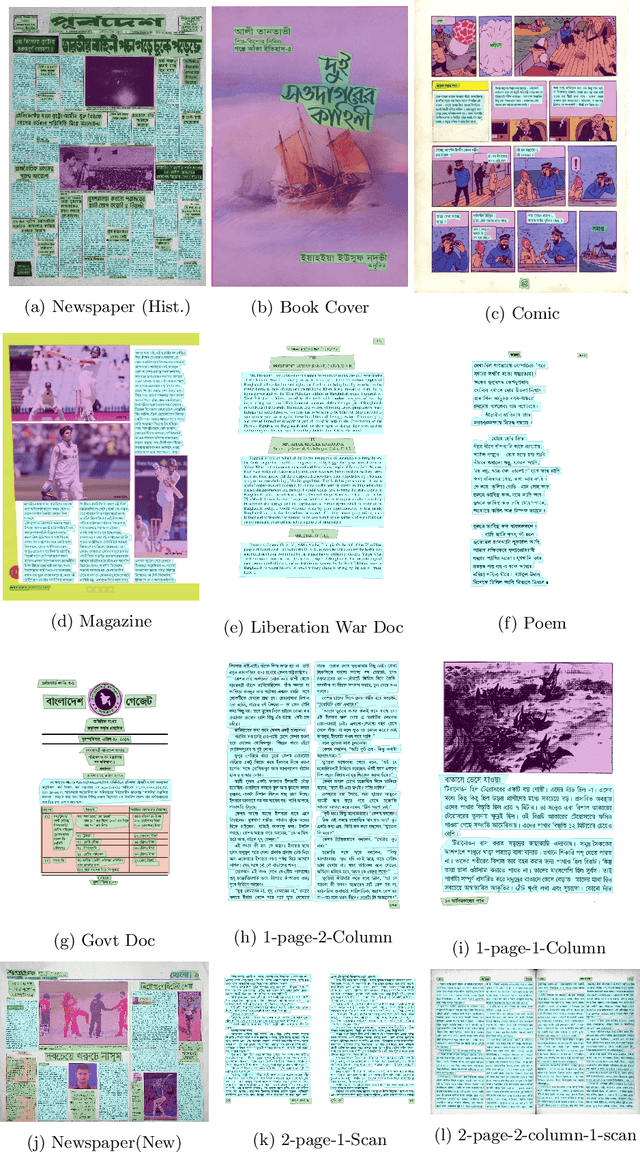
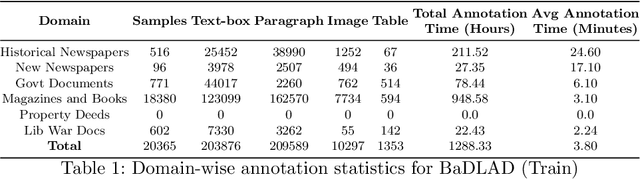
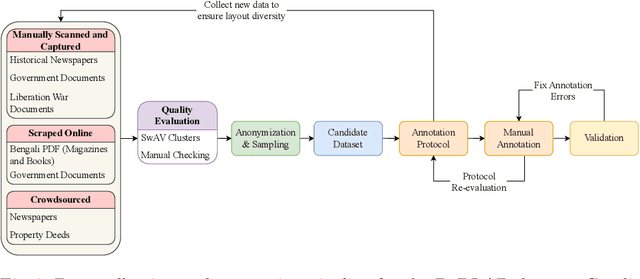
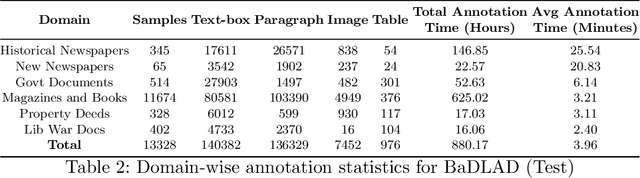
While strides have been made in deep learning based Bengali Optical Character Recognition (OCR) in the past decade, the absence of large Document Layout Analysis (DLA) datasets has hindered the application of OCR in document transcription, e.g., transcribing historical documents and newspapers. Moreover, rule-based DLA systems that are currently being employed in practice are not robust to domain variations and out-of-distribution layouts. To this end, we present the first multidomain large Bengali Document Layout Analysis Dataset: BaDLAD. This dataset contains 33,695 human annotated document samples from six domains - i) books and magazines, ii) public domain govt. documents, iii) liberation war documents, iv) newspapers, v) historical newspapers, and vi) property deeds, with 710K polygon annotations for four unit types: text-box, paragraph, image, and table. Through preliminary experiments benchmarking the performance of existing state-of-the-art deep learning architectures for English DLA, we demonstrate the efficacy of our dataset in training deep learning based Bengali document digitization models.