 Add to Chrome
 Add to Firefox
 Add to Edge
Mining Instance-Centric Vision-Language Contexts for Human-Object Interaction Detection
Apr 02, 2026
Human-Object Interaction (HOI) detection aims to localize human-object pairs and classify their interactions from a single image, a task that demands strong visual understanding and nuanced contextual reasoning. Recent approaches have leveraged Vision-Language Models (VLMs) to introduce semantic priors, significantly improving HOI detection performance. However, existing methods often fail to fully capitalize on the diverse contextual cues distributed across the entire scene. To overcome these limitations, we propose the Instance-centric Context Mining Network (InCoM-Net)-a novel framework that effectively integrates rich semantic knowledge extracted from VLMs with instance-specific features produced by an object detector. This design enables deeper interaction reasoning by modeling relationships not only within each detected instance but also across instances and their surrounding scene context. InCoM-Net comprises two core components: Instancecentric Context Refinement (ICR), which separately extracts intra-instance, inter-instance, and global contextual cues from VLM-derived features, and Progressive Context Aggregation (ProCA), which iteratively fuses these multicontext features with instance-level detector features to support high-level HOI reasoning. Extensive experiments on the HICO-DET and V-COCO benchmarks show that InCoM-Net achieves state-of-the-art performance, surpassing previous HOI detection methods. Code is available at https://github.com/nowuss/InCoM-Net.

JoVALE: Detecting Human Actions in Video Using Audiovisual and Language Contexts
Dec 18, 2024Video Action Detection (VAD) involves localizing and categorizing action instances in videos. Videos inherently contain various information sources, including audio, visual cues, and surrounding scene contexts. Effectively leveraging this multi-modal information for VAD is challenging, as the model must accurately focus on action-relevant cues. In this study, we introduce a novel multi-modal VAD architecture called the Joint Actor-centric Visual, Audio, Language Encoder (JoVALE). JoVALE is the first VAD method to integrate audio and visual features with scene descriptive context derived from large image captioning models. The core principle of JoVALE is the actor-centric aggregation of audio, visual, and scene descriptive contexts, where action-related cues from each modality are identified and adaptively combined. We propose a specialized module called the Actor-centric Multi-modal Fusion Network, designed to capture the joint interactions among actors and multi-modal contexts through Transformer architecture. Our evaluation conducted on three popular VAD benchmarks, AVA, UCF101-24, and JHMDB51-21, demonstrates that incorporating multi-modal information leads to significant performance gains. JoVALE achieves state-of-the-art performances. The code will be available at \texttt{https://github.com/taeiin/AAAI2025-JoVALE}.
JARViS: Detecting Actions in Video Using Unified Actor-Scene Context Relation Modeling
Aug 07, 2024

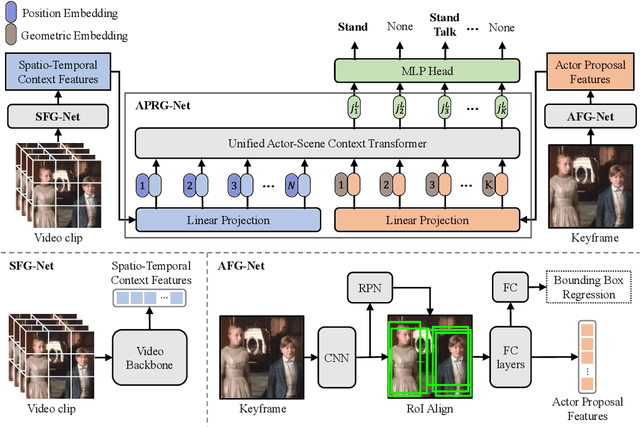

Video action detection (VAD) is a formidable vision task that involves the localization and classification of actions within the spatial and temporal dimensions of a video clip. Among the myriad VAD architectures, two-stage VAD methods utilize a pre-trained person detector to extract the region of interest features, subsequently employing these features for action detection. However, the performance of two-stage VAD methods has been limited as they depend solely on localized actor features to infer action semantics. In this study, we propose a new two-stage VAD framework called Joint Actor-scene context Relation modeling based on Visual Semantics (JARViS), which effectively consolidates cross-modal action semantics distributed globally across spatial and temporal dimensions using Transformer attention. JARViS employs a person detector to produce densely sampled actor features from a keyframe. Concurrently, it uses a video backbone to create spatio-temporal scene features from a video clip. Finally, the fine-grained interactions between actors and scenes are modeled through a Unified Action-Scene Context Transformer to directly output the final set of actions in parallel. Our experimental results demonstrate that JARViS outperforms existing methods by significant margins and achieves state-of-the-art performance on three popular VAD datasets, including AVA, UCF101-24, and JHMDB51-21.