 Add to Chrome
 Add to Firefox
 Add to Edge
Lightweight Safe Reinforcement Learning for End-to-End UAV Navigation
Jul 02, 2026
With the rapid development of autonomous aerial systems, Unmanned Aerial Vehicles (UAVs) are increasingly deployed in applications such as inspection, environmental monitoring, and rescue, creating growing demand for reliable autonomous navigation. However, autonomous UAV navigation in dense environments remains challenging under sparse perception and dynamic constraints. Most reinforcement learning (RL) methods lack explicit safety mechanisms, leading to unsafe exploration, unstable training, and risky behaviors, especially during high-speed flight. Even in safe RL approaches, safety is often enforced by projecting policy outputs onto a safe action set, which may introduce instability. Meanwhile, many learning-based methods rely on dense inputs or large networks, increasing computational burden and limiting lightweight onboard deployment. Facing the above challenges, we propose a safety-constrained perception-control integrated framework for UAV navigation. A lightweight network encodes sparse observations into collision-risk-aware features using asymmetric and depthwise separable convolutions. We formulate the task as a constrained Markov decision process within a hierarchical control architecture and solve it using a Lagrangian-based safe PPO algorithm. Curriculum learning further improves training stability. Experiments with varying obstacle densities and flight speeds demonstrate higher success rates, improved safety, and better efficiency than existing reinforcement learning baselines.

TGSBM: Transformer-Guided Stochastic Block Model for Link Prediction
Jan 28, 2026Link prediction is a cornerstone of the Web ecosystem, powering applications from recommendation and search to knowledge graph completion and collaboration forecasting. However, large-scale networks present unique challenges: they contain hundreds of thousands of nodes and edges with heterogeneous and overlapping community structures that evolve over time. Existing approaches face notable limitations: traditional graph neural networks struggle to capture global structural dependencies, while recent graph transformers achieve strong performance but incur quadratic complexity and lack interpretable latent structure. We propose \textbf{TGSBM} (Transformer-Guided Stochastic Block Model), a framework that integrates the principled generative structure of Overlapping Stochastic Block Models with the representational power of sparse Graph Transformers. TGSBM comprises three main components: (i) \emph{expander-augmented sparse attention} that enables near-linear complexity and efficient global mixing, (ii) a \emph{neural variational encoder} that infers structured posteriors over community memberships and strengths, and (iii) a \emph{neural edge decoder} that reconstructs links via OSBM's generative process, preserving interpretability. Experiments across diverse benchmarks demonstrate competitive performance (mean rank 1.6 under HeaRT protocol), superior scalability (up to $6\times$ faster training), and interpretable community structures. These results position TGSBM as a practical approach that strikes a balance between accuracy, efficiency, and transparency for large-scale link prediction.
GRAIN: Multi-Granular and Implicit Information Aggregation Graph Neural Network for Heterophilous Graphs
Apr 09, 2025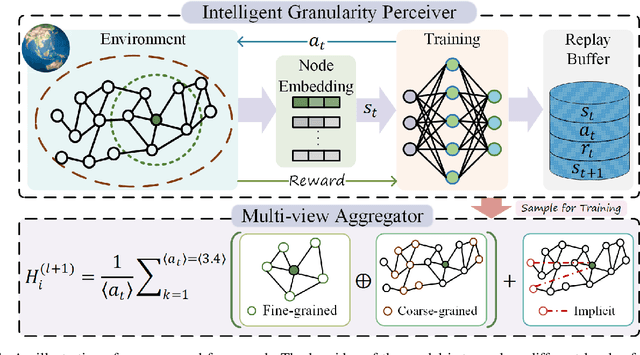
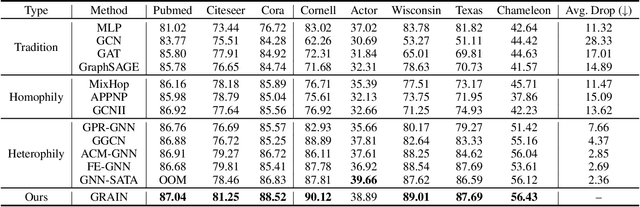
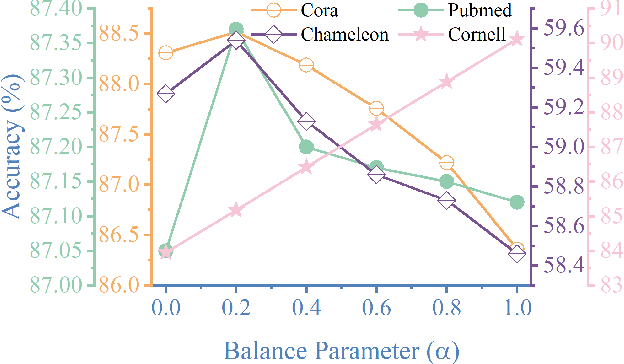
Graph neural networks (GNNs) have shown significant success in learning graph representations. However, recent studies reveal that GNNs often fail to outperform simple MLPs on heterophilous graph tasks, where connected nodes may differ in features or labels, challenging the homophily assumption. Existing methods addressing this issue often overlook the importance of information granularity and rarely consider implicit relationships between distant nodes. To overcome these limitations, we propose the Granular and Implicit Graph Network (GRAIN), a novel GNN model specifically designed for heterophilous graphs. GRAIN enhances node embeddings by aggregating multi-view information at various granularity levels and incorporating implicit data from distant, non-neighboring nodes. This approach effectively integrates local and global information, resulting in smoother, more accurate node representations. We also introduce an adaptive graph information aggregator that efficiently combines multi-granularity and implicit data, significantly improving node representation quality, as shown by experiments on 13 datasets covering varying homophily and heterophily. GRAIN consistently outperforms 12 state-of-the-art models, excelling on both homophilous and heterophilous graphs.