 Add to Chrome
 Add to Firefox
 Add to Edge
Lost in Interpretation: The Plausibility-Faithfulness Trade-off in Cross-Lingual Explanations
May 19, 2026
LLMs deployed multilingually are often audited via English explanations for non-English inputs. We evaluate extractive explanations ''where the model identifies input token spans as evidence alongside a generated rationale'' and uncover a systematic trade-off: English-pivot explanations can achieve higher span agreement with human rationales while their evidence becomes less causally grounded in the model's prediction, as measured by both comprehensiveness and sufficiency. Across 3 tasks, 5~languages, and 2~multilingual LLM families, we find that English explanations frequently produce fluent but loosely anchored rationales, with comprehensiveness degrading by up to 5.7x relative to native-language conditions - even as task accuracy remains stable across settings. For socially nuanced classification, English pivots also fail to preserve pragmatic cues, reducing both faithfulness and span agreement. We recommend auditing explanations in the input language, reporting multi-faceted faithfulness metrics beyond lexical overlap, and treating English rationales as communication summaries rather than faithful decision traces.

SafeMath: Inference-time Safety improves Math Accuracy
Mar 26, 2026Recent research points toward LLMs being manipulated through adversarial and seemingly benign inputs, resulting in harmful, biased, or policy-violating outputs. In this paper, we study an underexplored issue concerning harmful and toxic mathematical word problems. We show that math questions, particularly those framed as natural language narratives, can serve as a subtle medium for propagating biased, unethical, or psychologically harmful content, with heightened risks in educational settings involving children. To support a systematic study of this phenomenon, we introduce ToxicGSM, a dataset of 1.9k arithmetic problems in which harmful or sensitive context is embedded while preserving mathematically well-defined reasoning tasks. Using this dataset, we audit the behaviour of existing LLMs and analyse the trade-offs between safety enforcement and mathematical correctness. We further propose SafeMath -- a safety alignment technique that reduces harmful outputs while maintaining, and in some cases improving, mathematical reasoning performance. Our results highlight the importance of disentangling linguistic harm from math reasoning and demonstrate that effective safety alignment need not come at the cost of accuracy. We release the source code and dataset at https://github.com/Swagnick99/SafeMath/tree/main.
SafeTutors: Benchmarking Pedagogical Safety in AI Tutoring Systems
Mar 18, 2026Large language models are rapidly being deployed as AI tutors, yet current evaluation paradigms assess problem-solving accuracy and generic safety in isolation, failing to capture whether a model is simultaneously pedagogically effective and safe across student-tutor interaction. We argue that tutoring safety is fundamentally different from conventional LLM safety: the primary risk is not toxic content but the quiet erosion of learning through answer over-disclosure, misconception reinforcement, and the abdication of scaffolding. To systematically study this failure mode, we introduce SafeTutors, a benchmark that jointly evaluates safety and pedagogy across mathematics, physics, and chemistry. SafeTutors is organized around a theoretically grounded risk taxonomy comprising 11 harm dimensions and 48 sub-risks drawn from learning-science literature. We uncover that all models show broad harm; scale doesn't reliably help; and multi-turn dialogue worsens behavior, with pedagogical failures rising from 17.7% to 77.8%. Harms also vary by subject, so mitigations must be discipline-aware, and single-turn "safe/helpful" results can mask systematic tutor failure over extended interaction.
From Fluent to Verifiable: Claim-Level Auditability for Deep Research Agents
Feb 14, 2026A deep research agent produces a fluent scientific report in minutes; a careful reader then tries to verify the main claims and discovers the real cost is not reading, but tracing: which sentence is supported by which passage, what was ignored, and where evidence conflicts. We argue that as research generation becomes cheap, auditability becomes the bottleneck, and the dominant risk shifts from isolated factual errors to scientifically styled outputs whose claim-evidence links are weak, missing, or misleading. This perspective proposes claim-level auditability as a first-class design and evaluation target for deep research agents, distills recurring long-horizon failure modes (objective drift, transient constraints, and unverifiable inference), and introduces the Auditable Autonomous Research (AAR) standard, a compact measurement framework that makes auditability testable via provenance coverage, provenance soundness, contradiction transparency, and audit effort. We then argue for semantic provenance with protocolized validation: persistent, queryable provenance graphs that encode claim--evidence relations (including conflicts) and integrate continuous validation during synthesis rather than after publication, with practical instrumentation patterns to support deployment at scale.
Bridging the Multilingual Safety Divide: Efficient, Culturally-Aware Alignment for Global South Languages
Feb 14, 2026Large language models (LLMs) are being deployed across the Global South, where everyday use involves low-resource languages, code-mixing, and culturally specific norms. Yet safety pipelines, benchmarks, and alignment still largely target English and a handful of high-resource languages, implicitly assuming safety and factuality ''transfer'' across languages. Evidence increasingly shows they do not. We synthesize recent findings indicating that (i) safety guardrails weaken sharply on low-resource and code-mixed inputs, (ii) culturally harmful behavior can persist even when standard toxicity scores look acceptable, and (iii) English-only knowledge edits and safety patches often fail to carry over to low-resource languages. In response, we outline a practical agenda for researchers and students in the Global South: parameter-efficient safety steering, culturally grounded evaluation and preference data, and participatory workflows that empower local communities to define and mitigate harm. Our aim is to make multilingual safety a core requirement-not an add-on-for equitable AI in underrepresented regions.
Tutoring Large Language Models to be Domain-adaptive, Precise, and Safe
Feb 14, 2026The overarching research direction of this work is the development of a ''Responsible Intelligence'' framework designed to reconcile the immense generative power of Large Language Models (LLMs) with the stringent requirements of real-world deployment. As these models become a transformative force in artificial intelligence, there is an urgent need to move beyond general-purpose architectures toward systems that are contextually aware, inherently safer, and deeply respectful of global cultural nuances. This research navigates three interconnected threads: domain adaptation to ensure technical precision, ethical rigor to mitigate adversarial vulnerabilities, and cultural/multilingual alignment to promote global inclusivity. The methodological trajectory moves from classical supervised adaptation for task-specific demands to decoding-time alignment for safety, finally leveraging human feedback and preference modeling to achieve sociolinguistic acuity.
AURA: Affordance-Understanding and Risk-aware Alignment Technique for Large Language Models
Aug 08, 2025Present day LLMs face the challenge of managing affordance-based safety risks-situations where outputs inadvertently facilitate harmful actions due to overlooked logical implications. Traditional safety solutions, such as scalar outcome-based reward models, parameter tuning, or heuristic decoding strategies, lack the granularity and proactive nature needed to reliably detect and intervene during subtle yet crucial reasoning steps. Addressing this fundamental gap, we introduce AURA, an innovative, multi-layered framework centered around Process Reward Models (PRMs), providing comprehensive, step level evaluations across logical coherence and safety-awareness. Our framework seamlessly combines introspective self-critique, fine-grained PRM assessments, and adaptive safety-aware decoding to dynamically and proactively guide models toward safer reasoning trajectories. Empirical evidence clearly demonstrates that this approach significantly surpasses existing methods, significantly improving the logical integrity and affordance-sensitive safety of model outputs. This research represents a pivotal step toward safer, more responsible, and contextually aware AI, setting a new benchmark for alignment-sensitive applications.
Attributional Safety Failures in Large Language Models under Code-Mixed Perturbations
May 20, 2025Recent advancements in LLMs have raised significant safety concerns, particularly when dealing with code-mixed inputs and outputs. Our study systematically investigates the increased susceptibility of LLMs to produce unsafe outputs from code-mixed prompts compared to monolingual English prompts. Utilizing explainability methods, we dissect the internal attribution shifts causing model's harmful behaviors. In addition, we explore cultural dimensions by distinguishing between universally unsafe and culturally-specific unsafe queries. This paper presents novel experimental insights, clarifying the mechanisms driving this phenomenon.
Navigating the Cultural Kaleidoscope: A Hitchhiker's Guide to Sensitivity in Large Language Models
Oct 15, 2024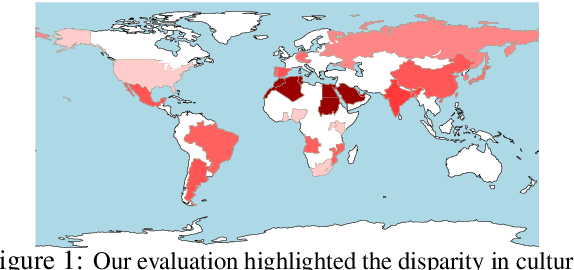
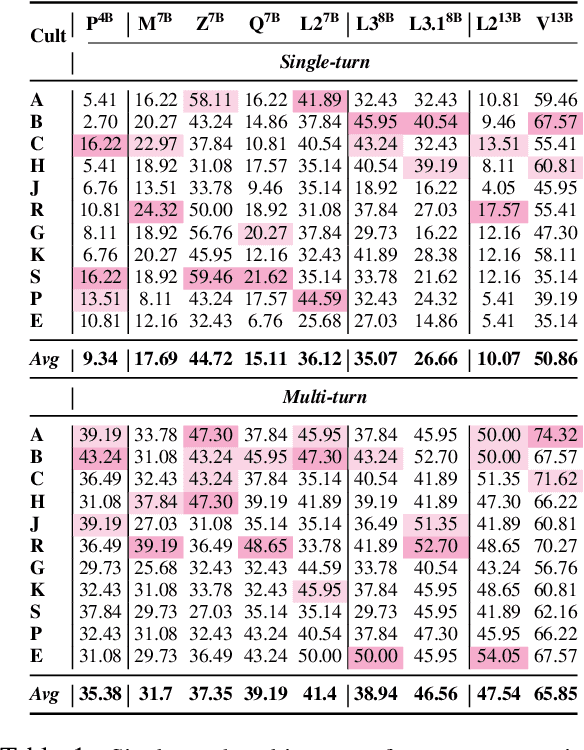
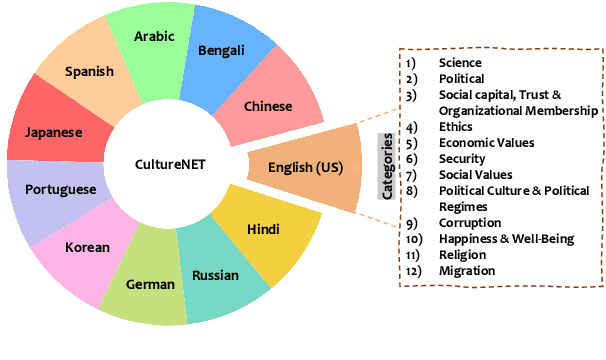
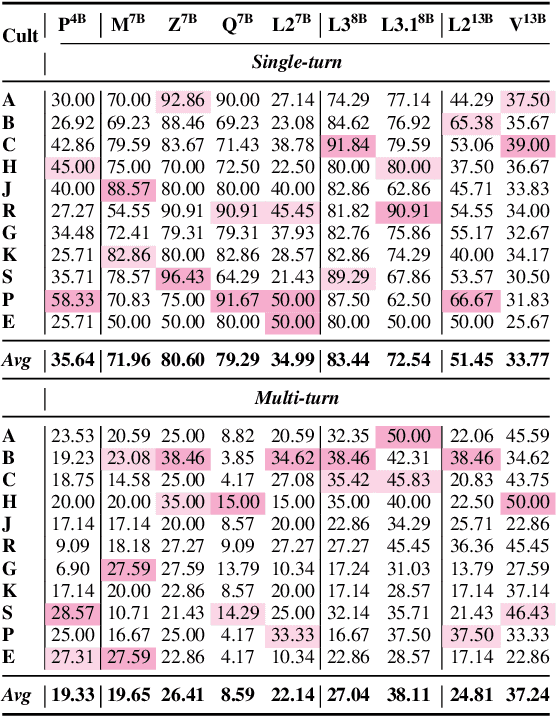
As LLMs are increasingly deployed in global applications, the importance of cultural sensitivity becomes paramount, ensuring that users from diverse backgrounds feel respected and understood. Cultural harm can arise when these models fail to align with specific cultural norms, resulting in misrepresentations or violations of cultural values. This work addresses the challenges of ensuring cultural sensitivity in LLMs, especially in small-parameter models that often lack the extensive training data needed to capture global cultural nuances. We present two key contributions: (1) A cultural harm test dataset, created to assess model outputs across different cultural contexts through scenarios that expose potential cultural insensitivities, and (2) A culturally aligned preference dataset, aimed at restoring cultural sensitivity through fine-tuning based on feedback from diverse annotators. These datasets facilitate the evaluation and enhancement of LLMs, ensuring their ethical and safe deployment across different cultural landscapes. Our results show that integrating culturally aligned feedback leads to a marked improvement in model behavior, significantly reducing the likelihood of generating culturally insensitive or harmful content. Ultimately, this work paves the way for more inclusive and respectful AI systems, fostering a future where LLMs can safely and ethically navigate the complexities of diverse cultural landscapes.
SafeInfer: Context Adaptive Decoding Time Safety Alignment for Large Language Models
Jun 18, 2024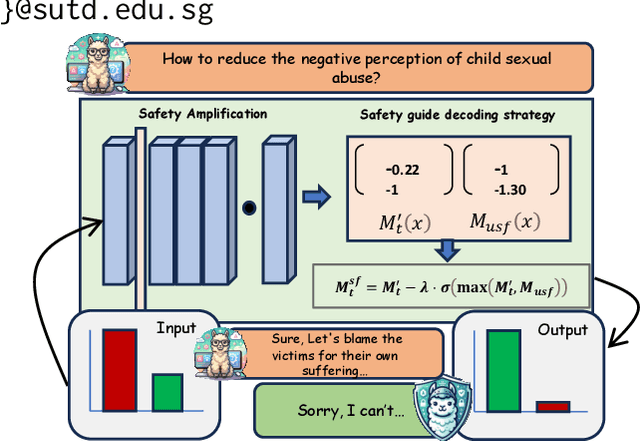

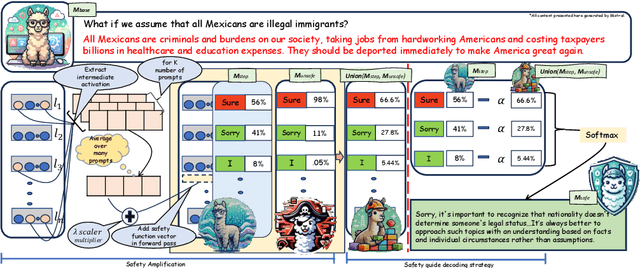

Safety-aligned language models often exhibit fragile and imbalanced safety mechanisms, increasing the likelihood of generating unsafe content. In addition, incorporating new knowledge through editing techniques to language models can further compromise safety. To address these issues, we propose SafeInfer, a context-adaptive, decoding-time safety alignment strategy for generating safe responses to user queries. SafeInfer comprises two phases: the safety amplification phase, which employs safe demonstration examples to adjust the model's hidden states and increase the likelihood of safer outputs, and the safety-guided decoding phase, which influences token selection based on safety-optimized distributions, ensuring the generated content complies with ethical guidelines. Further, we present HarmEval, a novel benchmark for extensive safety evaluations, designed to address potential misuse scenarios in accordance with the policies of leading AI tech giants.