 Add to Chrome
 Add to Firefox
 Add to Edge
How Do Medical MLLMs Fail? A Study on Visual Grounding in Medical Images
Mar 15, 2026
Generalist multimodal large language models (MLLMs) have achieved impressive performance across a wide range of vision-language tasks. However, their performance on medical tasks, particularly in zero-shot settings where generalization is critical, remains suboptimal. A key research gap is the limited understanding of why medical MLLMs underperform in medical image interpretation. In this work, we present a pioneering systematic investigation into the visual grounding capabilities of state-of-the-art medical MLLMs. To disentangle visual grounding from semantic grounding, we design VGMED, a novel evaluation dataset developed with expert clinical guidance, explicitly assessing the visual grounding capability of medical MLLMs. We introduce new quantitative metrics and conduct detailed qualitative analyses. Our study across eight state-of-the-art (SOTA) medical MLLMs validates that they often fail to ground their predictions in clinically relevant image regions. We note that this finding is specific to medical image analysis; in contrast, prior work has shown that MLLMs are capable of grounding their predictions in the correct image regions when applied to natural scene images. Motivated by these findings, we propose VGRefine, a simple yet effective inference-time method that refines attention distribution to improve visual grounding in medical settings. Our approach achieves SOTA performance across 6 diverse Med-VQA benchmarks (over 110K VQA samples from 8 imaging modalities) without requiring additional training or external expert models. Overall, our work, for the first time, systematically validates inadequate visual grounding as one of the key contributing factors for medical MLLMs' under-performance. Additional experiments are included in the Supp.

Vision Transformer Neural Architecture Search for Out-of-Distribution Generalization: Benchmark and Insights
Jan 07, 2025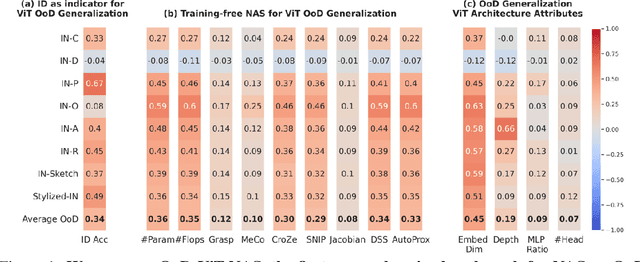
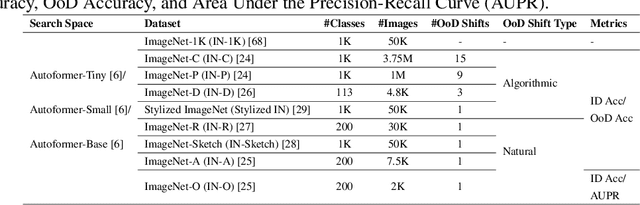
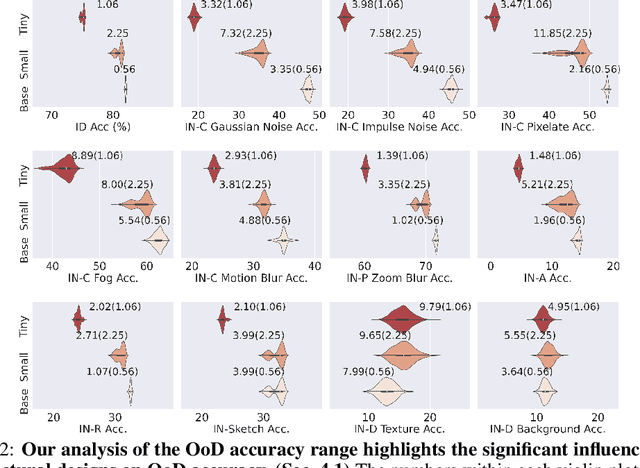
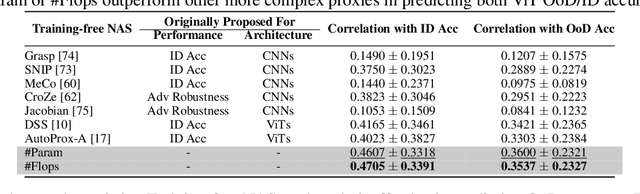
While ViTs have achieved across machine learning tasks, deploying them in real-world scenarios faces a critical challenge: generalizing under OoD shifts. A crucial research gap exists in understanding how to design ViT architectures, both manually and automatically, for better OoD generalization. To this end, we introduce OoD-ViT-NAS, the first systematic benchmark for ViTs NAS focused on OoD generalization. This benchmark includes 3000 ViT architectures of varying computational budgets evaluated on 8 common OoD datasets. Using this benchmark, we analyze factors contributing to OoD generalization. Our findings reveal key insights. First, ViT architecture designs significantly affect OoD generalization. Second, ID accuracy is often a poor indicator of OoD accuracy, highlighting the risk of optimizing ViT architectures solely for ID performance. Third, we perform the first study of NAS for ViTs OoD robustness, analyzing 9 Training-free NAS methods. We find that existing Training-free NAS methods are largely ineffective in predicting OoD accuracy despite excelling at ID accuracy. Simple proxies like Param or Flop surprisingly outperform complex Training-free NAS methods in predicting OoD accuracy. Finally, we study how ViT architectural attributes impact OoD generalization and discover that increasing embedding dimensions generally enhances performance. Our benchmark shows that ViT architectures exhibit a wide range of OoD accuracy, with up to 11.85% improvement for some OoD shifts. This underscores the importance of studying ViT architecture design for OoD. We believe OoD-ViT-NAS can catalyze further research into how ViT designs influence OoD generalization.
* Accepted in NeurIPS 2024