 Add to Chrome
 Add to Firefox
 Add to Edge
How Do Medical MLLMs Fail? A Study on Visual Grounding in Medical Images
Mar 15, 2026
Generalist multimodal large language models (MLLMs) have achieved impressive performance across a wide range of vision-language tasks. However, their performance on medical tasks, particularly in zero-shot settings where generalization is critical, remains suboptimal. A key research gap is the limited understanding of why medical MLLMs underperform in medical image interpretation. In this work, we present a pioneering systematic investigation into the visual grounding capabilities of state-of-the-art medical MLLMs. To disentangle visual grounding from semantic grounding, we design VGMED, a novel evaluation dataset developed with expert clinical guidance, explicitly assessing the visual grounding capability of medical MLLMs. We introduce new quantitative metrics and conduct detailed qualitative analyses. Our study across eight state-of-the-art (SOTA) medical MLLMs validates that they often fail to ground their predictions in clinically relevant image regions. We note that this finding is specific to medical image analysis; in contrast, prior work has shown that MLLMs are capable of grounding their predictions in the correct image regions when applied to natural scene images. Motivated by these findings, we propose VGRefine, a simple yet effective inference-time method that refines attention distribution to improve visual grounding in medical settings. Our approach achieves SOTA performance across 6 diverse Med-VQA benchmarks (over 110K VQA samples from 8 imaging modalities) without requiring additional training or external expert models. Overall, our work, for the first time, systematically validates inadequate visual grounding as one of the key contributing factors for medical MLLMs' under-performance. Additional experiments are included in the Supp.

AIR: Zero-shot Generative Model Adaptation with Iterative Refinement
Jun 12, 2025Zero-shot generative model adaptation (ZSGM) aims to adapt a pre-trained generator to a target domain using only text guidance and without any samples from the target domain. Central to recent ZSGM approaches are directional loss which use the text guidance in the form of aligning the image offset with text offset in the embedding space of a vision-language model like CLIP. This is similar to the analogical reasoning in NLP where the offset between one pair of words is used to identify a missing element in another pair by aligning the offset between these two pairs. However, a major limitation of existing ZSGM methods is that the learning objective assumes the complete alignment between image offset and text offset in the CLIP embedding space, resulting in quality degrade in generated images. Our work makes two main contributions. Inspired by the offset misalignment studies in NLP, as our first contribution, we perform an empirical study to analyze the misalignment between text offset and image offset in CLIP embedding space for various large publicly available datasets. Our important finding is that offset misalignment in CLIP embedding space is correlated with concept distance, i.e., close concepts have a less offset misalignment. To address the limitations of the current approaches, as our second contribution, we propose Adaptation with Iterative Refinement (AIR) which is the first ZSGM approach to focus on improving target domain image quality based on our new insight on offset misalignment.Qualitative, quantitative, and user study in 26 experiment setups consistently demonstrate the proposed AIR approach achieves SOTA performance. Additional experiments are in Supp.
A Survey on Generative Modeling with Limited Data, Few Shots, and Zero Shot
Jul 26, 2023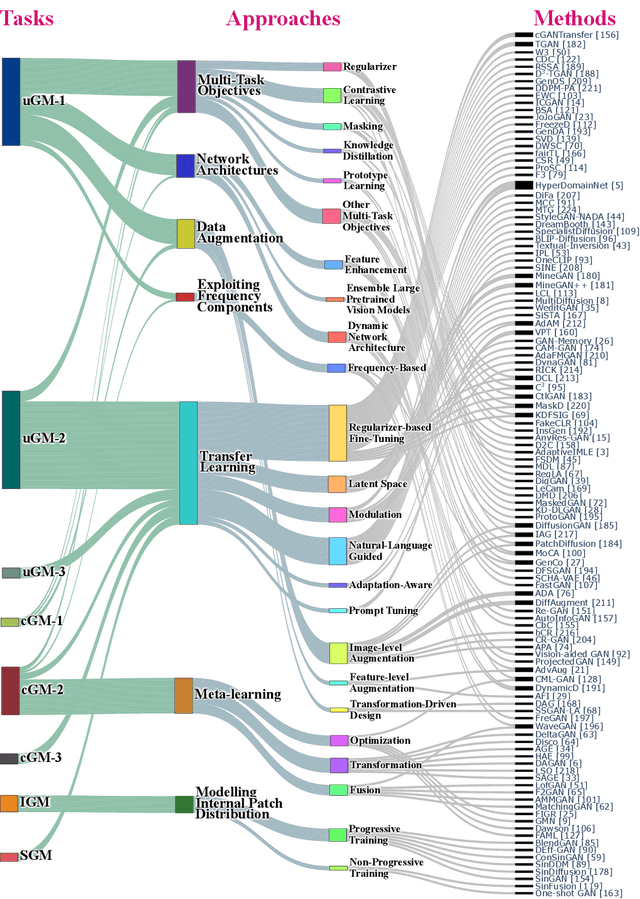


In machine learning, generative modeling aims to learn to generate new data statistically similar to the training data distribution. In this paper, we survey learning generative models under limited data, few shots and zero shot, referred to as Generative Modeling under Data Constraint (GM-DC). This is an important topic when data acquisition is challenging, e.g. healthcare applications. We discuss background, challenges, and propose two taxonomies: one on GM-DC tasks and another on GM-DC approaches. Importantly, we study interactions between different GM-DC tasks and approaches. Furthermore, we highlight research gaps, research trends, and potential avenues for future exploration. Project website: https://gmdc-survey.github.io.