 Add to Chrome
 Add to Firefox
 Add to Edge
Self-Improvement of Large Language Models: A Technical Overview and Future Outlook
Mar 26, 2026
As large language models (LLMs) continue to advance, improving them solely through human supervision is becoming increasingly costly and limited in scalability. As models approach human-level capabilities in certain domains, human feedback may no longer provide sufficiently informative signals for further improvement. At the same time, the growing ability of models to make autonomous decisions and execute complex actions naturally enables abstractions in which components of the model development process can be progressively automated. Together, these challenges and opportunities have driven increasing interest in self-improvement, where models autonomously generate data, evaluate outputs, and iteratively refine their own capabilities. In this paper, we present a system-level perspective on self-improving language models and introduce a unified framework that organizes existing techniques. We conceptualize the self-improvement system as a closed-loop lifecycle, consisting of four tightly coupled processes: data acquisition, data selection, model optimization, and inference refinement, along with an autonomous evaluation layer. Within this framework, the model itself plays a central role in driving each stage: collecting or generating data, selecting informative signals, updating its parameters, and refining outputs, while the autonomous evaluation layer continuously monitors progress and guides the improvement cycle across stages. Following this lifecycle perspective, we systematically review and analyze representative methods for each component from a technical standpoint. We further discuss current limitations and outline our vision for future research toward fully self-improving LLMs.

Catch Me If You Can? Not Yet: LLMs Still Struggle to Imitate the Implicit Writing Styles of Everyday Authors
Sep 18, 2025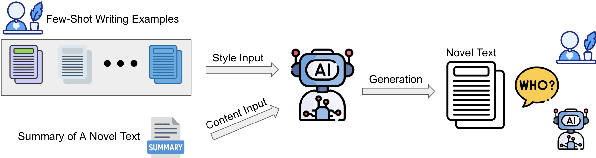

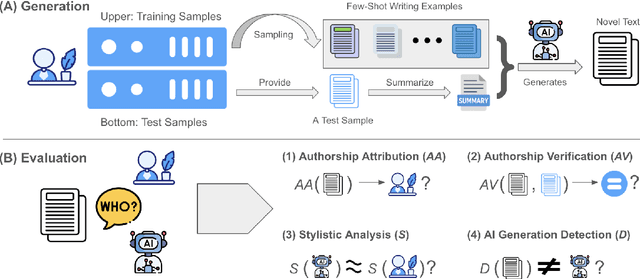
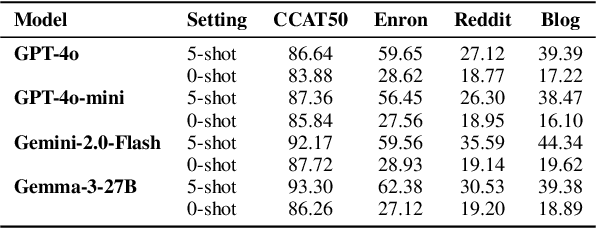
As large language models (LLMs) become increasingly integrated into personal writing tools, a critical question arises: can LLMs faithfully imitate an individual's writing style from just a few examples? Personal style is often subtle and implicit, making it difficult to specify through prompts yet essential for user-aligned generation. This work presents a comprehensive evaluation of state-of-the-art LLMs' ability to mimic personal writing styles via in-context learning from a small number of user-authored samples. We introduce an ensemble of complementary metrics-including authorship attribution, authorship verification, style matching, and AI detection-to robustly assess style imitation. Our evaluation spans over 40000 generations per model across domains such as news, email, forums, and blogs, covering writing samples from more than 400 real-world authors. Results show that while LLMs can approximate user styles in structured formats like news and email, they struggle with nuanced, informal writing in blogs and forums. Further analysis on various prompting strategies such as number of demonstrations reveal key limitations in effective personalization. Our findings highlight a fundamental gap in personalized LLM adaptation and the need for improved techniques to support implicit, style-consistent generation. To aid future research and for reproducibility, we open-source our data and code.