 Add to Chrome
 Add to Firefox
 Add to Edge
Hierarchical Planning with Latent World Models
Apr 03, 2026
Model predictive control (MPC) with learned world models has emerged as a promising paradigm for embodied control, particularly for its ability to generalize zero-shot when deployed in new environments. However, learned world models often struggle with long-horizon control due to the accumulation of prediction errors and the exponentially growing search space. In this work, we address these challenges by learning latent world models at multiple temporal scales and performing hierarchical planning across these scales, enabling long-horizon reasoning while substantially reducing inference-time planning complexity. Our approach serves as a modular planning abstraction that applies across diverse latent world-model architectures and domains. We demonstrate that this hierarchical approach enables zero-shot control on real-world non-greedy robotic tasks, achieving a 70% success rate on pick-&-place using only a final goal specification, compared to 0% for a single-level world model. In addition, across physics-based simulated environments including push manipulation and maze navigation, hierarchical planning achieves higher success while requiring up to 4x less planning-time compute.

SpACNN-LDVAE: Spatial Attention Convolutional Latent Dirichlet Variational Autoencoder for Hyperspectral Pixel Unmixing
Nov 17, 2023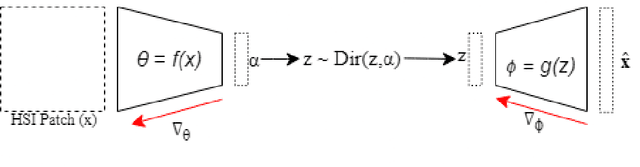
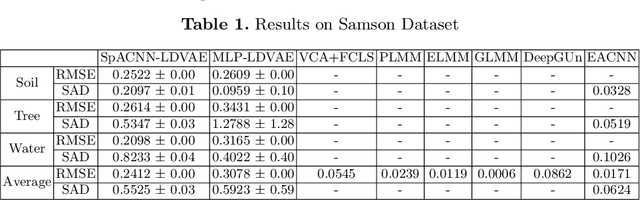
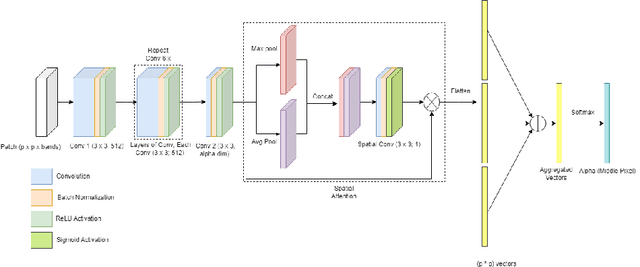
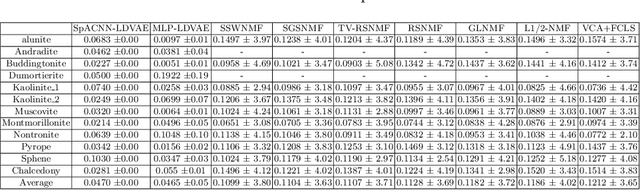
The Hyperspectral Unxming problem is to find the pure spectral signal of the underlying materials (endmembers) and their proportions (abundances). The proposed method builds upon the recently proposed method, Latent Dirichlet Variational Autoencoder (LDVAE). It assumes that abundances can be encoded as Dirichlet Distributions while mixed pixels and endmembers are represented by Multivariate Normal Distributions. However, LDVAE does not leverage spatial information present in an HSI; we propose an Isotropic CNN encoder with spatial attention to solve the hyperspectral unmixing problem. We evaluated our model on Samson, Hydice Urban, Cuprite, and OnTech-HSI-Syn-21 datasets. Our model also leverages the transfer learning paradigm for Cuprite Dataset, where we train the model on synthetic data and evaluate it on real-world data. We are able to observe the improvement in the results for the endmember extraction and abundance estimation by incorporating the spatial information. Code can be found at https://github.com/faisalqureshi/cnn-ldvae