 Add to Chrome
 Add to Firefox
 Add to Edge
Dynamic Rebatching for Efficient Early-Exit Inference with DREX
Dec 17, 2025
Early-Exit (EE) is a Large Language Model (LLM) architecture that accelerates inference by allowing easier tokens to be generated using only a subset of the model's layers. However, traditional batching frameworks are ill-suited for EE LLMs, as not all requests in a batch may be ready to exit at the same time. Existing solutions either force a uniform decision on the batch, which overlooks EE opportunities, or degrade output quality by forcing premature exits. We propose Dynamic Rebatching, a solution where we dynamically reorganize the batch at each early-exit point. Requests that meet the exit criteria are immediately processed, while those that continue are held in a buffer, re-grouped into a new batch, and forwarded to deeper layers. We introduce DREX, an early-exit inference system that implements Dynamic Rebatching with two key optimizations: 1) a copy-free rebatching buffer that avoids physical data movement, and 2) an EE and SLA-aware scheduler that analytically predicts whether a given rebatching operation will be profitable. DREX also efficiently handles the missing KV cache from skipped layers using memory-efficient state-copying. Our evaluation shows that DREX improves throughput by 2-12% compared to baseline approaches while maintaining output quality. Crucially, DREX completely eliminates involuntary exits, providing a key guarantee for preserving the output quality intended by the EE model.

Towards Safer Heuristics With XPlain
Oct 19, 2024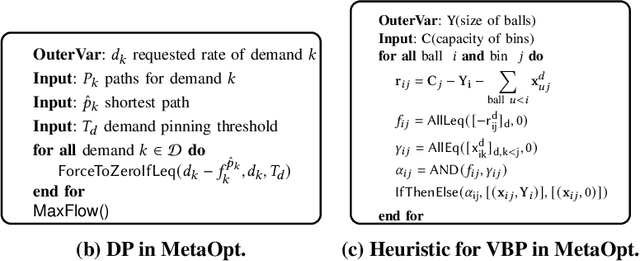



Many problems that cloud operators solve are computationally expensive, and operators often use heuristic algorithms (that are faster and scale better than optimal) to solve them more efficiently. Heuristic analyzers enable operators to find when and by how much their heuristics underperform. However, these tools do not provide enough detail for operators to mitigate the heuristic's impact in practice: they only discover a single input instance that causes the heuristic to underperform (and not the full set), and they do not explain why. We propose XPlain, a tool that extends these analyzers and helps operators understand when and why their heuristics underperform. We present promising initial results that show such an extension is viable.