 Add to Chrome
 Add to Firefox
 Add to Edge
Untethered thin dielectric elastomer actuated soft robot
Dec 12, 2025
Thin dielectric elastomer actuator (DEA) features a unique in-plane configuration, enabling low-profile designs capable of accessing millimetre-scale narrow spaces. However, most existing DEA-powered soft robots require high voltages and wired power connections, limiting their ability to operate in confined environments. This study presents an untethered thin soft robot (UTS-Robot) powered by thin dielectric elastomer actuators (TS-DEA). The robot measures 38 mm in length, 6 mm in height, and weighs just 2.34 grams, integrating flexible onboard electronics to achieve fully untethered actuation. The TS-DEA, operating at resonant frequencies of 86 Hz under a low driving voltage of 220 V, adopts a dual-actuation sandwiched structure, comprising four dielectric elastomer layers bonded to a compressible tensioning mechanism at its core. This design enables high power density actuation and locomotion via three directional friction pads. The low-voltage actuation is achieved by fabricating each elastomer layer via spin coating to an initial thickness of 50 um, followed by biaxial stretching to 8 um. A comprehensive design and modelling framework has been developed to optimise TS-DEA performance. Experimental evaluations demonstrate that the bare TS-DEA achieves a locomotion speed of 12.36 mm/s at resonance, the untethered configuration achieves a locomotion speed of 0.5 mm/s, making it highly suitable for navigating confined and complex environments.

Development and Experimental Evaluation of a Vibration-Based Adhesion System for Miniature Wall-Climbing Robots
Apr 06, 2025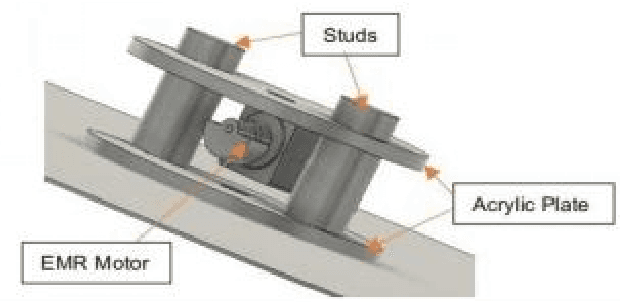
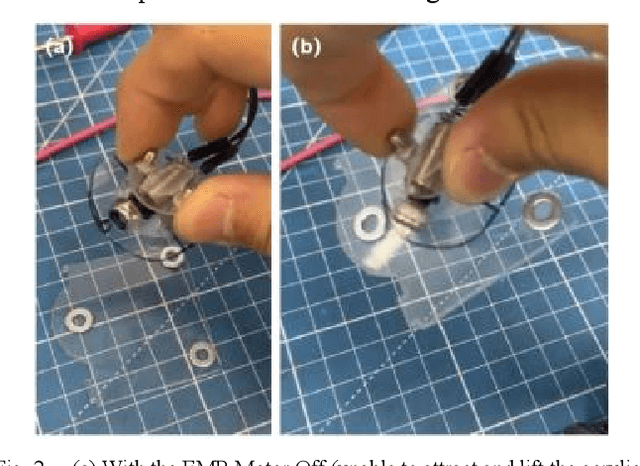
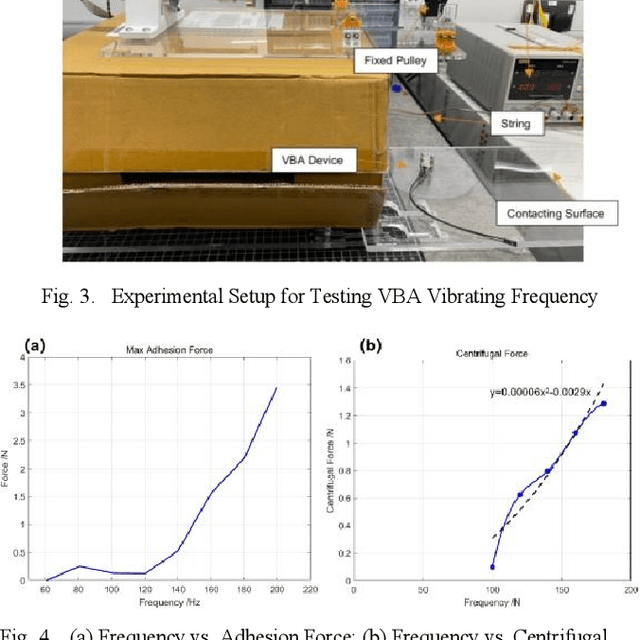
In recent years, miniature wall-climbing robots have attracted widespread attention due to their significant potential in equipment inspection and in-situ repair applications. Traditional wall-climbing systems typically rely on electromagnetic, electrostatic, vacuum suction, or van der Waals forces for controllable adhesion. However, these conventional methods impose limitations when striving for both a compact design and high-speed mobility. This paper proposes a novel Vibration-Based Adhesion (VBA) technique, which utilizes a flexible disk vibrating near a surface to generate a strong and controllable attractive force without direct contact. By employing an electric motor as the vibration source, the constructed VBA system was experimentally evaluated, achieving an adhesion-to-weight ratio exceeding 51 times. The experimental results demonstrate that this adhesion mechanism not only provides a high normal force but also maintains minimal shear force, making it particularly suitable for high-speed movement and heavy load applications in miniature wall-climbing robots.